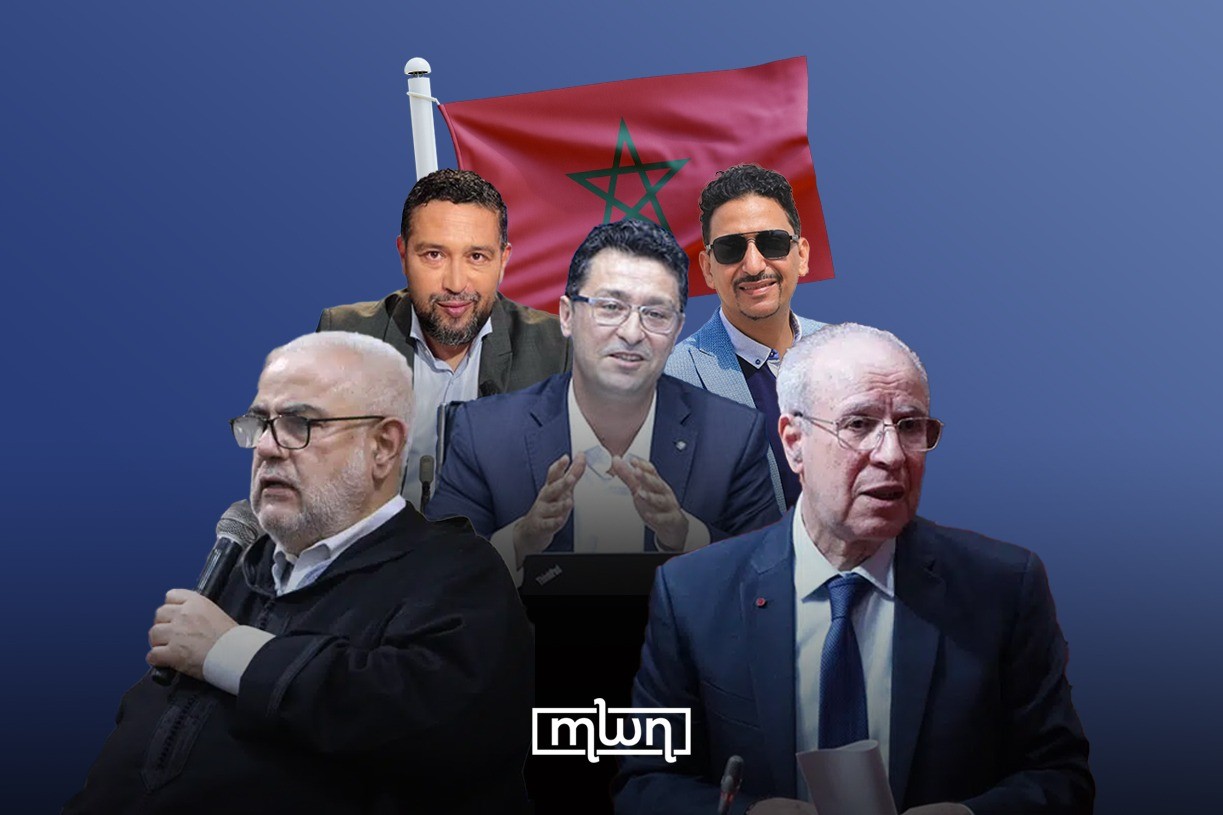
Rabat – The recent secularism debate sparked by two Moroccan prominent figures has become a focal point for discussion — particularly on social media.
The debate was ignited a few weeks ago, when Islamic Minister Ahmed Toufiq said during a parliamentary session that Moroccans are profoundly secular.
In response to his remarks, Abdelilah Benkirane, the leader of the Islamist Justice and Development Party (PJD), strongly opposed Toufiq’s view by suggesting that Morocco is an Islamic state.
Benkirane argued that the country’s identity is rooted in Islam, citing King Mohammed VI’s status as the “Commander of the Faithful.”
The debate quickly expanded to social media, where numerous platforms have increasingly transformed into proverbial town squares where real people and trolls convene to debate, purchase or promote items, and vilify supporters of other factions or causes.
And has become customary in such instances of heated online debates, some joined the discussion without fully understanding the context of the political and cultural nuances at stake.
Some, the seekers of cheap attention and digital likes, appeared to adopt or defend positions simply because they are popular or have been endorsed by influential figures they happen to admire or revere.
It goes without saying that different media outlets have also approached the raging debate in varied ways, in line with where they happen to locate themselves on the Moroccan political or ideological map.
A number of websites have simply constrained themselves to plainly reporting on the events, taking no apparent sides while making an effort to explain each side’s position and the arguments it has invoked in its defense.
By contrast, many others have opted for analysis and in-depth exploration of the question at hand, of course while giving overt or subtle indications of where they stand in this clash of interpretations about the essence of Moroccan identity.
In addition to the two primary protagonists, influential media figures, prominent researchers in Islamic affairs, and liberal intellectuals have joined the conversation, which has oscillated between civilized debate and petty name-calling.
Promising yet timid conversation
Some observers have viewed the ongoing debate on secularism in Morocco as a promoting yet a cautious step forward, noting the importance of the discussions despite its timidness.
Abdellah Tourabi, a journalist specializing in political Islam in Morocco, acknowledged that the debate sparked some public attention. However, he added,it has remained relatively subdued, especially among the Moroccan political class, despite its importance.
“It is interesting because it puts words to realities that have been at work in Morocco for decades – those of the progressive secularization of Moroccan society and political life,” Tourabi told Morocco World News (MWN).
There is a “secularization process underway in Morocco for over a century coinciding with the ‘shock of modernity’ and colonialism,” he argued, noting that Morocco’s sectors — including political, administrative, economic and cultural structures are “no longer under the grip and domination of religion but have become secular.”
Tourabi also discussed what he perceived as the separation between Moroccan law (the constitution and other regulatory texts) and traditional principles, arguing that the country’s regulations are no longer based on Sharia.
The “law emanates directly from parliament, and the ulema are no longer the producers of legal rules through Fiqh,” he said, providing the example of the judiciary system where judges are trained in modern law and that they do not base their judgments on Islamic prescriptions.
Of the debate pitching Toufiq against Benkirane, Tourabi suggested that the very existence of the PJD as a party that participates in parliamentary sessions and alliance games that drive Morocco’s political scene is part and parcel of the country’s growing secularization of its political landscape.
“The PJD is a modern political party that participates in elections and has led a government responsible for implementing modern laws,” he said, noting that Toufik subtly reminded Benkirane of this crucial fact. Even as it describes itself as an Islamist party that wants to salvage or sustain Morocco’s Islamic identity and foundations, Tourabi noted, the PJD’s foundational vocabulary is “modern and secular.”
Secularism through different lenses
This debate comes as there is a growing trend of ijtihad or independent reasoning, meaning people are increasingly interpreting contacts and ideas through the lens of their own cultural, historical, and social contexts.
For instance, secularism is a concept that has been applied in different ways across different political and intellectual contexts.
A country or society can be secular but still predominantly Muslim or Islamic, many observers and intellectuals have argued, noting that the “dominance of religious institutions” does not
This view is more common in Western tradition, particularly with the aim of ending religious support as the church was seen as an impediment to human progress.
In the Anglo-American context, for instance, secularism has been synonymous with allowing space for religious expression while attempting to maintain the separation of religious and political powers.
In the Arab world, this concept is rooted in a complex and divisive history.
No wonder, then, that many Islamic scholars view secularism as an inherently Western construct that is against Islamic principles
But many in the Muslim and Arab world, including Islamic scholars, have notably and unapologetically adopted and embraced it as means to encourage a modern interpretation of Islam.
While some have seen the exchanges between Benkirane and Toufiq as a debate, others believe the Islamic Affairs Minister’s message was carrying a certain “intellectual and philosophical depth.”
Mohamed Abdelouahab Rafiqui, a researcher and expert in Islamic studies, told MWN: “The minister’s message provides a lot to reflect upon, whereas Benkirane’s response seemed more like a typical letter- one that includes an apology and emphasizing sticking to a position without offering any arguments, evidence or engaging with the depth of the minister’s message.”
Rafiqui, whose research focuses on religious reform and legal issues related to religion, argued that Benkirane and Toufiq’s responses to each other show clear difference between the “two men’s backgrounds-one being a highly intellectual, well-read, novelist, and historian with deep engagement in both intellectual and religious matters, while the other is a political with a different training and no strong connection to intellectual and cultural fields.”
For Toufiq, Benkirane’s response “was weak and didn’t match the value of the minister’s statement regardless of whether I agree with him or not.”
After Benkirane’s first response to Toufiq, the minister issued a detailed response defending his recent secularism remarks.
“You are the leader of a modern political party, and the modern political party concept is borrowed from a secular Western system,” Toufiq notably wrote in one of his responses to Benkirane. Directly addressing the PJD leader in the same text, he added: “You were elected based on equal voter rights regardless of voters’ beliefs and backgrounds, and this system is borrowed from a secular Western system.”
The minister also cited some of the reforms and regulations introduced when Benkirane was a head of government, including texts serving “rational interests” — reforms that were similar to approaches adopted by the secular Western system.
In his response, Benkirane appeared to be ailing for the moral high ground. The minister’s comments had a “different impact,” argued the PJD leader. “So I took up my pen, which I rarely do, not to respond to you but only to clarify some facts for you.”
Benkirane went on to claim that his initiation reaction, which he made after Toufik spoke at the parliamentary session and which sparked the debate between the two of them, was not in fact meant as a response to the minister’s speech at the parliament. Instead, he argued, that initial message sought to call out those who wanted to exploit the issue at hand for “bad purposes.”
Benkirane then apologized to the minister in case he had felt offended by some of his remarks, but he added that he still stands by, and is proud of, his opinion about what constitutes the essence of Morocco as a nation.
A misunderstood concept?
Toufiq’s view and explanations are more accurate and more persuasive, Rafiqui told MWN, suggesting that those who responded furiously to the minister’s speech and subsequent comments misunderstood what he meant by Moroccan secularism.
“He clearly explained his position, stating that Moroccans practice a form of secularism in their everyday lives, whether through political parties or individual behaviors,” the researcher said, adding that the minister is one of the strongest defenders of the institution of the “Commander of the Faithful” and heads the High Council of Ulema, Morocco’s highest body of Islamic scholars.
“What he said was that Moroccans, in their reality and daily practices, exhibit characteristics of secularism, and this distinction is important,” Rafiqui argued, adding that the minister also referenced Morocco’s religious pluralism and freedom of practice as undeniable.
Secularism does not necessarily mean “atheism,” Rafiqui went on to add; it means that the state guarantees freedom of religious practice and “does not intervene in people’s religious choices.”
Morocco’s approach to secularism is not the same as the extreme forms seen in other countries like France or Turkey, he stressed. Instead, Moroccan secularism is the expression and culmination of a “distinct model,” where the state upholds religious freedom and pluralism while maintaining its Islamic identity.
Religious or not?
In 2019, a report by Arab Barometer surveyed over 25,000 individuals across 11 Arab countries, including Morocco, Algeria, Sudan, Yemen, and Lebanon.
The report , which the Barometer had conducted for the BBC, showed a notable decrease in religious affiliation particularly in North Africa, with Tunisia, Libya and Morocco experiencing the largest shifts.
The percentage of people that defined themselves as “not religious” rose to nearly 15% in all the surveyed countries, a substantial increase from under 5% in 2013.
This trend stands in contrast to a 2016 study conducted by the Tunisian Sigma Institute in collaboration with the German Konrad Adenauer Foundation and the Arab observatory of Religions and Freedoms.
Focusing on respondents’ relationship with Islam and political Islam, among others, this report found that people defined themselves as highly religious in countries like Morocco, Algeria, Libya, and Egypt.
Over half of respondents identified Islam as their primary defining feature, with 52% Moroccans aligning themselves in this way, the report established.
Tolerance for ambiguity
With most recent reports pointing to a different, opposite trend in North Africa, many argue that the ongoing debate on secularism is vital for fostering the democratic and cultural transition in Morocco.
The country’s tolerance for “ambiguity” is also seen as a key strength that allows for diverse perspectives to coexist.
Rachid Boutayeb, a Moroccan academic, told MWN that what distinguishes Morocco is “its tolerance for ambiguity. Where this tolerance diminishes, the public space shrinks, the mind atrophies, and society becomes desertified, an obstacle to a healthy life for individuals and groups.”
The question of secularism in the Arab context essentially relates to how modernity is interpreted, Boutayeb explained, citing two main approaches — the Salafist and Westernized.
The first approach rejects modern ideas, while the second applies modern ideas without considering the Arab context.
“What characterizes both translations is their alienation from the social-historical reality of the Arab countries on the one hand and their ignorance of the conditions of production associated with modern ideas on the other,” Boutayab said.
Turning to the ongoing debate between Benkirane and Toufiq, Botaueb said if these exchanges are put in this context “we will certainly agree” with Toufiq “unless we are satisfied with the narrow concept of secularism that reduces it to its political aspect.”
But what Benkirane said is also not wrong despite its “populist flavor,” the academic said, invoking the nature of Morocco’s political system where the “King reigns and rules and where the King is also the Commander of the Faithful.”
“Today, universalism is the only viable path to the continuity of tradition. Once we realize this, we will move beyond the dualism that another Moroccan thinker, Abdallah Laroui, criticized,” Boutahar said. At the end of the day, he emphasized, it is particularly important to realize that universalism “can only be integrated into the realities of people’s lives through tradition and a continuous revision of it and not through a complete rupture.”
Indeed, despite some personal attacks here and there and the usual social media acrimony, what transpired from this debate is the existence of a general consensus on the importance of creating spaces to facilitate difficult and complex exchanges about what it means to be Moroccan today.