
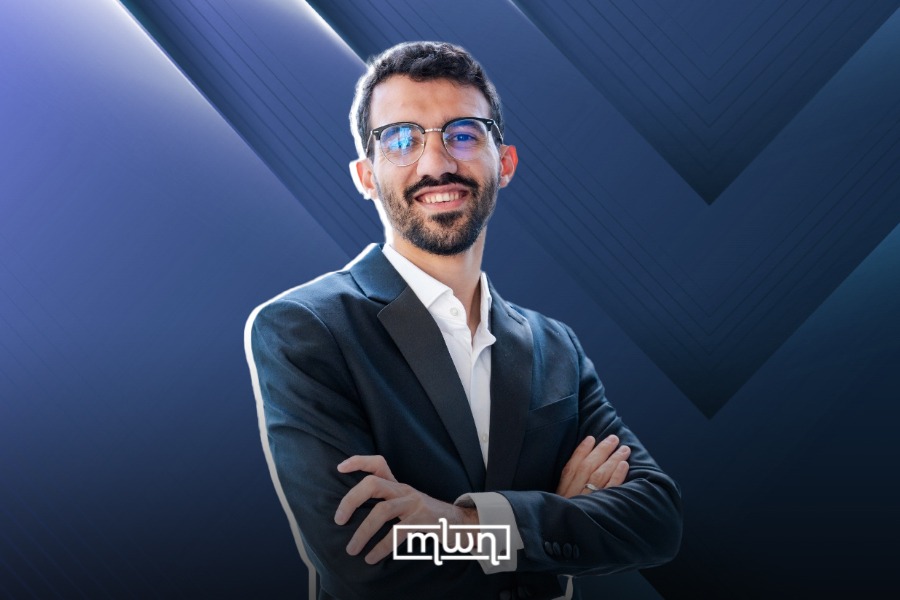
Rabat – Artificial intelligence is often hailed as a revolution in healthcare, promising faster diagnoses and smarter, more personalized care. Yet, as the research of Dr. Ahmed Zahlan, a recent PhD graduate from the Africa Business School at UM6P, reveals, translating that promise into real-world impact is far more complex than the hype suggests.
Dr. Zahlan continues to contribute to the university’s research ecosystem through his work on the dynamics shaping AI-driven healthcare innovation. In a recent study, he conducted interviews with founders from 55 AI healthcare startups to map the practical and ethical hurdles confronting this fast-growing sector.
When the researcher set out to study startups at the intersection of artificial intelligence and healthcare, he expected hard questions. What was not expected was how clearly the interviews would return one recurring answer: data, he revealed in an interview with Morocco World News.
After the 55 in-depth conversations with founders, Zahlan’s grounded-theory study teases apart why AI healthcare ventures face a “double bind,” the twin complexities of regulated healthcare and rapidly evolving AI, and it aimed to offer practical prescriptions for founders, investors, and policy makers who want to turn innovation into better care.
Ahmed’s paper maps a landscape familiar to scholars but newly acute in practice. Healthcare is notoriously slow to adopt innovations. A well-known review of translational research found that the average time lag from discovery to routine clinical practice can be around 17 years, and AI brings extra technical, ethical, and data governance hurdles on top of that.
From that problem statement Zahlan built a careful qualitative project. He interviewed founders (CEOs, CMOs, CTOs and chairpersons) across 55 AI healthcare startups in the US and used grounded theory to surface the mechanisms that let some teams survive and scale while others stall.

The result is a readable, actionable synthesis of strategy, team design, funding practice, and regulatory navigation, and it could have immediate relevance for Morocco, where the AI ecosystem is accelerating but still grapples with digitalization and data infrastructure.
The “double complexity”: why AI + healthcare is harder than the sum of its parts
Dr. Zahlan frames the problem as a dual-complex system. On the healthcare side, startups must integrate fragmented clinical workflows, electronic health records, payer systems and regulatory processes, often working across hospitals, clinics, labs, and national guidance.
On the AI side, they must assemble large, well-labelled datasets, engineer robust models, manage bias, and satisfy explainability and safety demands.
When combined, these demands amplify the classic “liability of newness,” the widely studied idea that new firms struggle to gain legitimacy and resources because they are unknown and untested. “It’s hard for you to gain legitimacy… trust… funding because you are very… small,” Dr. Zahlan told MWN.
Those interviews show how this liability plays out in practice. For instance, banks and traditional lenders shy away from funding risky early devices, while hospitals are risk-averse about adding tools that could affect patient safety. In addition, regulators rightly demand evidence, audits, and clinical validation, all while founders scramble to build product and generate revenue.
Teams, not solo geniuses
One of Zahlan’s clearest findings is about people. He found that diverse founding teams are a competitive advantage in regulated, high-stakes sectors. Founders who combined clinical credibility (doctors, CMOs) with technical fluency (engineers, data scientists) and managerial or commercialization experience were better able to bridge hospital networks, run clinical validation, and explain their technology to investors and regulators.
“Get a doctor with you,” Zahlan said bluntly, a practical line that recurs across the interviews. He argues that medical founders or committed clinician advisors provide legitimacy, patient-centered design insight, and practical access to hospital collaborators. That mix of skills helps startups move beyond prototypes into validated clinical workflows.
Data as the strategic asset, and why “AI washing” is dangerous
Zahlan’s interviews repeatedly returned to a single strategic point, which is data. Having proprietary, high-quality patient data is what investors prize; it becomes a defensible moat once models are trained and validated.
The researcher summarizes the priority plainly, saying that founders who can claim exclusive, well-curated datasets are in a stronger position to raise capital and demonstrate clinical value.

At the same time, he warns against “AI washing” (AIW), a practice in which companies claim to be AI-driven or market themselves as AI startups, even though they rely only on basic algorithms and lack the advanced capabilities or real-world applications that characterize true artificial intelligence solutions.
A report by CFA Institute defined AI washing as “the act of falsely or overly inflating claims about the use of AI in financial products or services.”
Nelson Advisors, a UK-based healthcare and life sciences consulting firm, argues that many products in health tech use minimal automation or simple rule-based systems but are marketed as full AI.
“Companies may overstate their AI capabilities to attract funding, even if their technology relies more on traditional software or basic automation,” the firm says. It explains that startups are aware that attaching the label AI to their product helps them attract funding, partnerships, and media attention. In addition, investors are eager to back “AI-driven” solutions, sometimes without digging deep into whether the tech is truly AI.
Zahlan’s interviews with founders echo that concern, but from a different angle. As he explained, the real danger is not just misleading investors. It’s building solutions that don’t actually meet healthcare’s needs.
“First, find the problem,” he stated. If a problem is solved better with a simpler, non-AI approach, adding machine learning turns into marketing, not impact.
Regulatory strategy, alliances, and sector-focused support
The study surfaces practical pathways for early legitimacy, including alliances with hospitals and universities for clinical trials, joining sector-focused incubators and accelerators that know healthcare’s rhythms, and choosing the right regulatory route.
Zahlan’s interviews suggest that early partnerships with clinical institutions, including spin-offs from hospital-based research, are one of the most reliable routes to validated, usable products.
That pattern is visible in practice. This year, Moroccan health tech startup DeepEcho secured U.S. FDA 510(k) clearance for its AI fetal ultrasound analysis platform, an example of a startup that combined clinical expertise, a large curated dataset, and regulatory planning to reach market clearance.
DeepEcho’s clearance shows how African-rooted healthtech teams can reach global markets when the ingredients come together.
Why this matters for Morocco
Morocco’s national ambitions for digital transformation and AI are accelerating. UM6P itself has positioned AI as a strategic priority and hosts centers and events designed to build regional capacity and ethical AI solutions.
For Morocco to translate that momentum into meaningful health outcomes, Zahlan’s findings point to three near-term priorities. First, hospitals and clinics must accelerate secure, interoperable electronic records and clear rules for research access so startups can build locally-relevant models rather than adapting foreign datasets that may not generalize.
In addition, medical curricula and residency programs should include exposure to applied AI and entrepreneurship, and hospitals must create translational pathways (data access, protected research enclaves, spin-off programs) that let innovators test and validate in-country.
Morocco needs more healthcare-centric incubators, regulatory guidance that clarifies data sharing and device pathways, and public-private programs that enable clinical trials and pilots inside trusted hospital networks. UM6P’s AI initiatives and venture arm may become part of that ecosystem as they scale research-to-market pathways.
Zahlan’s research does important work in translating global debates about AI regulation, translational lags, and startup legitimacy into actionable insights for founders and policymakers.