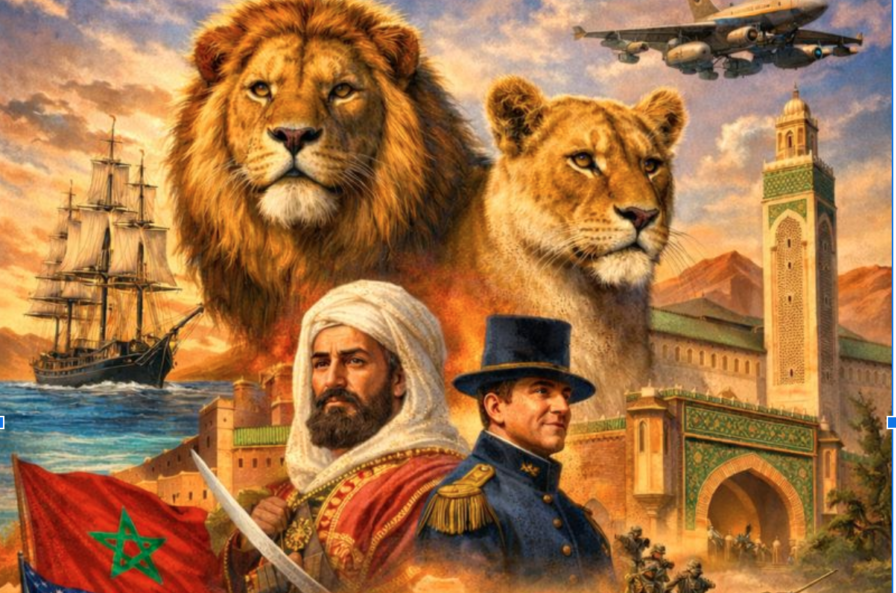
Few bilateral relationships in modern diplomacy combine symbolism, longevity, and strategic depth as compellingly as that between the United States and the Kingdom of Morocco. Often narrated through treaties, military exercises, and economic agreements, the partnership also carries a lesser-known but evocative emblem: the lion. From a literal diplomatic gift in the nineteenth century to today’s flagship military maneuvers known as African Lion, the animal has become an unintentional yet powerful metaphor for the evolution of US—Moroccan relations. The “Lion Gift” thus encapsulates more than anecdote; it signifies a durable alliance shaped by history, pragmatism, and shared geopolitical calculations.
A friendship older than the Republic Morocco occupies a singular place in American diplomatic history. In 1777, it became the first country to formally recognize the independence of the United States, an act of considerable significance at a time when the new republic struggled for international legitimacy. This recognition culminated in the Moroccan–American Treaty of Friendship of 1786, later reaffirmed in 1836, which remains the oldest unbroken treaty in U.S history.
This early alignment was not accidental. For Morocco, engagement with the United States offered commercial opportunities and a counterbalance to European imperial pressures. For Washington, Morocco represented both a gateway to Mediterranean trade and a stable interlocutor in a volatile region marked by piracy, colonial rivalry, and imperial decline. From the outset, relations were framed less by ideology than by mutual interest and strategic foresight.
The Original Lion Gift: Diplomacy by Symbol
The metaphor of the lion entered this relationship quite literally in 1839, when Sultan Abd al-Rahman ibn Hisham sent a lion and a lioness to the United States as a gesture of goodwill. In Moroccan diplomatic culture, such gifts were customary expressions of sovereign generosity and symbolic power. In the American context, however, they posed a problem: US law restricted the acceptance of foreign gifts, and the logistical burden of caring for live lions proved substantial.
Eventually, the animals were auctioned, but the episode endured in diplomatic memory as an illustration of cultural dissonance tempered by political pragmatism. More importantly, it demonstrated how Morocco understood diplomacy not merely as transactional negotiation, but as symbolic exchange. The lion, revered in Moroccan history as a symbol of authority, protection, and continuity, was offered as a token of trust to a distant but promising partner.
The Lion in Moroccan Political Culture
To understand the deeper resonance of the lion in this relationship, one must appreciate its place in Moroccan and Amazigh cultural memory. The Atlas (Barbary) lion, once native to North Africa, symbolized royal power, martial courage, and divine protection. Moroccan sultans were often likened to lions in chronicles and poetry, reinforcing the association between sovereignty and guardianship.
Though extinct in the wild by the mid-twentieth century, the lion remains embedded in Moroccan iconography and state symbolism. Its persistence reflects a broader Moroccan diplomatic tradition: combining historical legitimacy with adaptive statecraft. This tradition would later shape Morocco’s approach to its partnership with the United States, particularly during moments of global transition.
From Symbol to Strategy: Cold War and After
The US–Morocco relationship deepened substantially during the Cold War, when Morocco emerged as a key Western ally in North Africa. Hosting American air bases in the early Cold War period and maintaining a staunchly pro-Western orientation, Rabat positioned itself as a reliable partner amid decolonization and ideological polarization.
This alignment persisted after the Cold War, albeit in new forms. Counterterrorism cooperation intensified after 9/11, with Morocco becoming a critical intelligence and security partner in North Africa and the Sahel. Joint training, intelligence sharing, and defense modernization programs expanded steadily, laying the groundwork for today’s robust military collaboration.
African Lion: An Institutionalized Metaphor
The transformation of the lion from diplomatic gift to strategic brand is most visible in Exercise African Lion, launched in 2004 and co-hosted by the United States Africa Command (AFRICOM) and the Royal Moroccan Armed Forces. Now the largest annual military exercise in Africa, African Lion involves tens of thousands of troops from NATO allies and African partners.
The exercise serves multiple functions:
- Military interoperability: Enhancing joint operational readiness across land, air, maritime, and cyber domains.
- Regional signaling: Demonstrating US commitment to North African and Sahelian stability amid growing Russian and Chinese influence.
- Moroccan leadership: Positioning Morocco as a security hub and mediator between Europe, Africa, and the Atlantic world.
In this sense, African Lion is the modern incarnation of the Lion Gift: a shared platform where symbolism and strategy converge.
Economics, Trade, and Strategic Depth
Military cooperation alone does not define the partnership. The US–Morocco Free Trade Agreement (FTA), in force since 2006, remains the only such agreement between the United States and an African country. It has facilitated trade expansion, foreign direct investment, and industrial integration, particularly in aerospace, automotive, and renewable energy sectors.
American firms have become deeply embedded in Morocco’s economic transformation, while Morocco serves as a gateway for U.S. business into African markets. This economic dimension reinforces the alliance’s durability by anchoring it in mutual prosperity rather than episodic security concerns.
Western Sahara and Strategic Recognition
Perhaps the most consequential recent development in US–Morocco relations came in December 2020, when the United States formally recognized Moroccan sovereignty over its southern provinces in Western Sahara.
For Morocco, the recognition validated decades of diplomatic effort and cemented U.S. alignment with its core territorial priorities. For Washington, it strengthened ties with a key ally while reshaping regional geopolitics.
The Abraham Accords and a New Regional Role
Morocco’s renewed ties with Israel in 2020 further elevated its profile for Washington as a diplomatic bridge-builder. Unlike other normalization cases, Morocco sees its decision within a long history of Jewish–Muslim coexistence and strategic autonomy. The United States, in turn, saw Morocco as a model of pragmatic diplomacy without ideological rupture.
This relationship added a new layer to the Lion Gift: diplomatic leverage. Morocco now occupies a unique position linking Atlantic security, Middle Eastern diplomacy, and African stability.