 Join on WhatsApp
 Join on Telegram
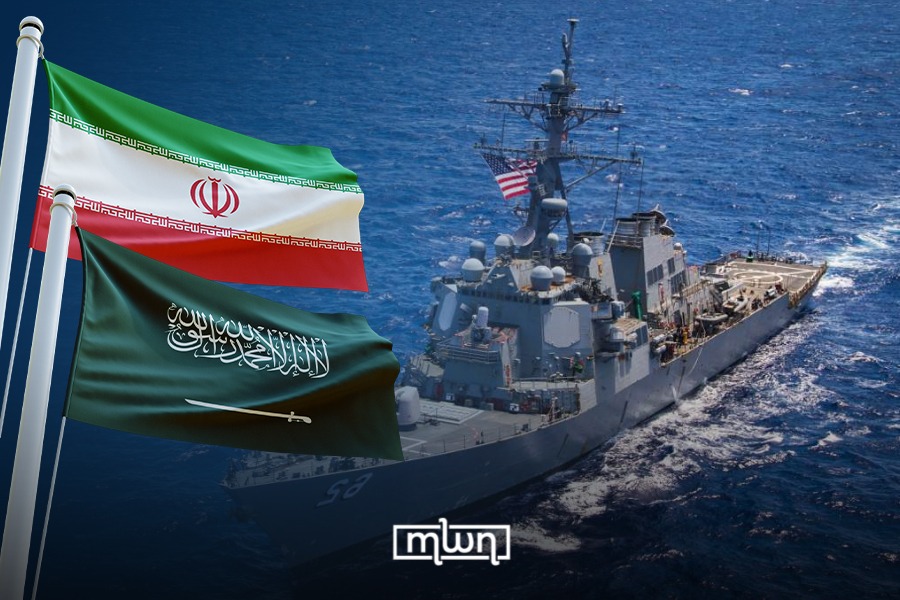
Saudi Arabia appears increasingly reluctant to support military action against Tehran — a shift that could upend decades of US security architecture in the Gulf.
While Western analysts predict Saudi Arabia will abandon Tehran if conflict breaks out, the reality is far more complex. Following the 2025 strike on Doha, Riyadh is no longer just hedging — it’s leading a new, multipolar Muslim bloc that makes a US-led war on Iran prohibitively expensive, says an Moroccan American scholar David Oualaalou.
A significant geopolitical shift is underway in the Middle East. As tensions between the United States, Israel, and Iran reach a potential point of no return, Saudi Arabia appears increasingly reluctant to support military action against Tehran.
“Every major news network is saying the same thing: Saudi Arabia will abandon Iran when war hits. They are all wrong, and not in a subtle way,” he continued, speaking on his YouTube show “Geopolitical but Trends.” Oulaalou is a geopolitical analyst and former international security advisor based in Washington DC.
Oualaalou argues that with this interpretation, Western media “is missing” the trap—the economic cage, the military component, and the religious obligation that makes abandoning Iran literally impossible. His analysis examines the factors driving Riyadh’s strategic recalibration and why the Saudi-Iranian détente may prove far more durable than conventional wisdom suggests.
After decades of close US-Saudi relations, the instinct for self-preservation may finally be overriding long-term security partnerships. Evidence suggests the House of Saud is charting a more independent, pragmatic course.
On February 21, in an unprecedented move, a coalition of eight Muslim nations — Saudi Arabia, Jordan, the UAE, Qatar, Indonesia, Pakistan, Egypt, and Türkiye — coalesced to declare joint support for Palestinian territorial integrity. The countries unilaterally denounced and rejected remarks made by US Ambassador to Israel Mike Huckabee, who said it would be acceptable for Israel to exercise control over Arab territories, including the Palestinian West Bank. They further warned that Israel’s expansionist policies and unlawful measures will only inflame violence and conflict in the region.
All eight are key US allies; several are signatories of the Abraham Accords. More recently, the Islamic Emirate of Afghanistan has signaled a willingness to cooperate with Iran in the event of a US military attack, though they have been careful to frame this support in diplomatic and humanitarian terms.
These commitments emerge just as the Trump administration has ordered a U.S military buildup in the Gulf to prepare for potential strikes against Iran.
Some critics argue that Saudi Arabia has made similar gestures before, only to quietly facilitate US operations when pressure mounted. This time, however, the economic and religious stakes may make quiet capitulation far more costly than before.
The declaration that shifted the balance
On January 28, Saudi Arabia made an unexpected declaration that reverberated across the region. The local Saudi press agency released an official statement from Crown Prince Mohammed bin Salman (MBS) regarding the Kingdom’s position on respecting Iranian sovereignty.
“Saudi Arabia will not allow the use of its airspace or territory in any military actions against the Islamic Republic of Iran or any attacks by any party, regardless of their destination,” the Crown Prince stated.
This represents a rational calculation of national interest in a shifting global environment. The recent rift with the UAE over Yemen, the eight-nation coalition, and the economic imperatives of Vision 2030 all point toward a Kingdom prioritizing regional stability over foreign-led intervention.
Critics have argued that Saudi Arabia is sending mixed signals and that when push comes to shove, the nation will align itself with its longtime ally and military provider, the US. However, Saudi Arabia has refused to allow offensive operation during the Afghanistan War in 2001, expelled all US troops in 2003 after the Iraq invasion and closed Prince Sultan Airbase. This action resulted in the US moving its Central Command headquarters to Al Udeid in Qatar.
Saudi Arabia has adopted a position of “conditional neutrality” and would allow limited Iranian strikes on US bases on Saudi soil under certain conditions, according to recent reporting in The Defense Watch. Privately, the government drew a red line stating that any Iranian large-scale or sustained attacks on Saudi territory or infrastructure would trigger retaliation.
The Saudi-Iran Rapprochement
Relations between Riyadh and Tehran have long been defined by hostility. Following the 1979 Islamic Revolution, Iranian pilgrims were banned from Mecca. More recently, Iranian-backed proxies in Yemen inflicted major damage on Saudi troops and oil infrastructure.
However, the “special relationship” with the U.S. grew tenuous when then-President Joe Biden labeled the Kingdom a “pariah state.” Since then, the return of President Donald Trump signaled an American posture that many in the Gulf perceive as transactional or isolationist.
Professor Oualaalou’s analysis echoes this sentiment. “Saudi Arabia had a stark realization: we can’t count on Washington anymore,” he says. “We need to protect our own interests.”
The 2023 Chinese-mediated restoration of diplomatic ties gave Iran legitimacy, trade, and access to investment. This rapprochement is essential for Vision 2030, which requires hundreds of billions in foreign capital. A regional war would devastate these plans and destroy the very infrastructure the Kingdom is trying to build.
Economic imperatives
“Saudi Arabia and Iran just committed to massive trade deals. They are planning joint currency systems. They are integrated into BRICS with China and Russia,” Oualaalou further explains. “They are building economic relationships that make separation extremely costly.”
He describes this as an “economic cage.” Furthermore, both nations share a vital interest in the security of the Strait of Hormuz. With 30 percent of global oil and gas and 35 percent of maritime trade passing through these waters, any conflict becomes an existential threat to Saudi exports.
“If America punishes Saudi Arabia for standing with Iran by freezing assets or cutting off markets, Saudi Arabia faces a choice: lose everything by abandoning Iran, or lose everything by staying with Iran. At least if they stay with Iran, they have a partner in the pain. That’s not a comfortable alliance—it’s a necessary one,” the academic further argues.
A New Muslim Bloc?
There is a profound religious component to this shift in loyalties. Oualaalou points to a cornerstone of Islamic jurisprudence often overlooked by Western secular analysts called Al-Wala wal-Bara, the principle of “loyalty and disavowal.”
He describes this as the religious obligation of loyalty and alliance among Muslims. “Islamic tradition emphasizes that the Ummah—the global Muslim community—should stand together against external aggression. For decades, this was overshadowed by the Sunni-Shia divide, but external pressure is acting as a catalyst for its revival,” he explains.
This is not merely a theological debate; it is a battle for the heart of Saudi legitimacy. As the Custodian of the Two Holy Mosques in Mecca and Medina, the Saudi King derives his power from his standing as a leader of the Islamic world.
“Saudi Arabia holds the spiritual keys, while Iran positions itself as the defender of the Shia resistance,” says Oualaalou. “When faced with the threat of Western military action, these two poles are finding common ground in the principle of collective defense. It’s not that they have suddenly resolved their sectarian differences—it’s that religion provides the framework for why they must stand together against an outside force.”
The expansion of this sentiment beyond the Arab world is telling. The recent inclusion of Türkiye and Indonesia—the world’s most populous Muslim nation—in the coalition defending Palestinian territorial integrity signals that this shift is cultural and civilizational, not just regional.
In this context, Oualaalou asserts that the stakes for Saudi legitimacy are higher than ever. “If Riyadh abandons Tehran during a US or Israeli attack, they risk being branded as a ‘traitor to the faith’ or a Western puppet. But by standing with Iran, they transform into the defenders of Muslim sovereignty. In the currency of the Middle East, that credibility is worth more than any American weapons deal.”
The military logic of ‘Mutual Assured Disruption’
The catalyst for this shift was the Israeli airstrike on the Leqtaifiya district of Doha, Qatar, on September 9, 2025. Targeting Palestinian negotiators during active ceasefire negotiations, it was the first time Israel had ever struck a member of the Gulf Cooperation Council.
When Western-made anti-missile systems failed to stop the strike, Gulf leaders received a clear message: their sovereignty is vulnerable to the whims of both Israel and the United States, regardless of existing defense agreements. In response, MBS condemned the “brutal aggression” and vowed to stand with Qatar “without limit.”
Ultimately, the strategic accord with Iran is designed to make the cost of U.S. escalation prohibitively high. To explain this, Oualaalou cites the term “Mutual Assured Disruption” – which is defined as instances in which opposing powers will disrupt one another, acknowledging that full-blown escalation would be catastrophic for both sides. It is evolved from the Cold War nuclear power term “Mutually Assured Destruction.”
Oualaalou describes this plainly. “Saudi Arabia standing with Iran doesn’t mean they are going to fight America side-by-side. It means they are making it so expensive and risky for America to fight Iran that war becomes irrational.”
For the academic, this signals the end of an era. “What’s really happening here is the emergence of a multipolar world. The 80-year era of the US as the sole dominant superpower is ending. Saudi Arabia and Iran are just the canary in the coal mine.”
The real question is no longer whether the multipolar world is coming. It is whether Washington will recognize it before the cost of denial becomes irreversible.