 Join on WhatsApp
 Join on Telegram
Some may be surprised to learn that British voters cast their ballots using a pencil. Yes, a simple pencil, the kind any eraser could wipe away. And yet, last Thursday, that very pencil set off a political earthquake that shook the world’s most established democracy. The paradox worth pausing over is not the instrument itself, but what that instrument represents in the construction of trust.
What happened in Britain?
In the local elections of 7 May, which covered municipal councils across England and the devolved parliaments in Wales and Scotland, Reform UK, led by Nigel Farage, achieved a surge unprecedented in modern British political history, sweeping up 1,453 seats and taking outright control of fourteen local councils, including historic county authorities such as Essex, Norfolk, and Suffolk.
Meanwhile, the ruling Labour Party was dealt a stinging blow, losing 1,496 seats and ceding control of thirty-eight councils. The Conservatives, for their part, lost 563 seats and six councils.
How is it that a party which held only two seats four years ago has today become the leading local force in England, drawing 29% of the national vote and outpacing the two parties that have alternated in power for the better part of a century? Not to mention that it also came second in both Scotland and Wales.
Why did reform rise?
The rise of Reform UK is no surprise to anyone who carefully observed the British mood. Three main factors paved the way for this sweep.
First, immigration. Britain received around 3.8 million long-term migrants between 2021 and 2024, according to official statistics, a figure that fueled a feeling that the state had lost control of its borders.
The second is a struggling economy, with average per-capita growth no greater than 0.5% since 2007, effectively two lost decades of prosperity.
Third, exhausted public services, especially the National Health Service (NHS), which has become a symbol of the collapse of Britain’s social contract.
Yet beneath these figures lies something far deeper: a growing sense that the political class, right and left alike, trades chairs while ignoring the people. Farage did not invent this anger; he merely rode its wave. His simple populist message, centered on border control, tax cuts, and “taking Britain back,” found a willing ear in a voter tired of broken promises.
The proof lies in the fact that the wave did not flow only toward the populist right, the Greens, too, claimed a share of it, winning 587 seats and taking control of five councils. The message was unmistakable: collective punishment of the two major parties.
A lesson that reaches beyond Britain
What is unfolding in England is not uniquely a British exception. It is part of a sweeping wave across Western democracies: Giorgia Meloni in Italy, the National Rally advancing in France, the AfD achieving unprecedented results in Germany, and Trump’s return to the White House.
The common denominator is the collapse of trust in traditional ruling systems and the rise of forces that promise to break their rules.
Herein lies the deeper lesson. When voters feel that their vote genuinely makes a difference, they will use it, even if what they hold in their hand is only a pencil that can be rubbed out. And when ruling elites fail to honor their promises, they pay a heavy price at the ballot box.
The British system does not protect itself through sophisticated electronic devices or rigorous electoral codes, but by something deeper still: a profound conviction that the verdict of the ballot box is binding, that the loser concedes defeat, and that the winner, even if controversial, governs legitimately.
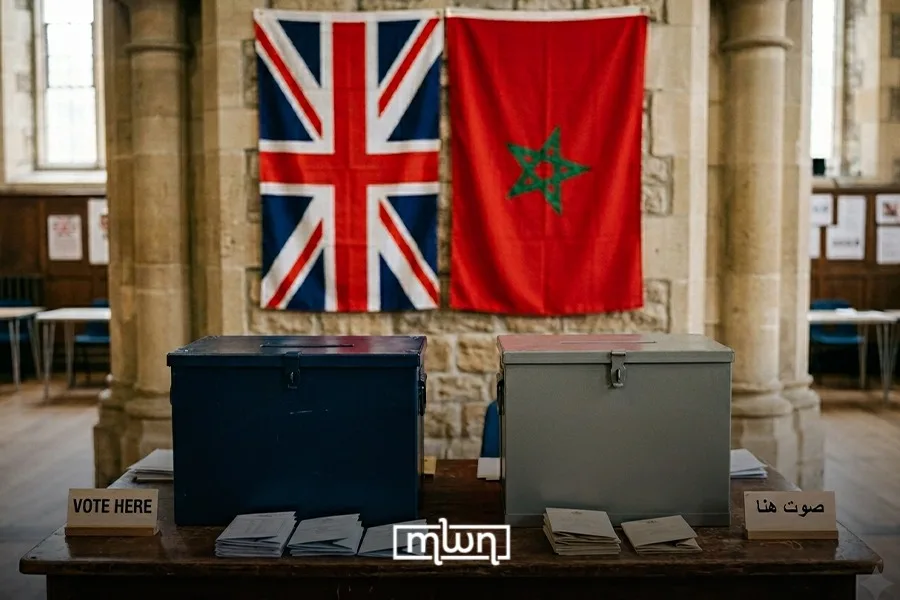
And what about Morocco?
On 23 September, Moroccans will head to the polls to elect their House of Representatives. The context is, of course, different: a constitutional monarchy, a plural party landscape, and political traditions with their own particularities.
But the central question remains one and the same in every democracy, nascent or long-established: do voters truly believe their vote brings about real change?
Morocco’s challenge does not lie in the tools. Our ballot boxes are paper-based and well organized, our electoral rolls are up to date, and the recently adopted electoral laws seek to reinforce integrity. The challenge lies somewhere deeper in questioning the very meaning of the electoral act itself.
When turnout falls, when the young say “they are all the same,” and when elections are reduced to a game of balances among notables, families, and interest groups, the voter’s pen, whatever its kind, loses its meaning.
The British lesson
What Britain’s pencil produced last week is not merely the victory of a populist right-wing party with which one might agree or disagree. It is a reminder that a living democracy is one that allows public anger to find its way into the institutions rather than onto the streets, and that elites who imagine the game is “settled in advance” may wake one morning to find a voter who has resolved to play by his own rules.
The question posed by Morocco’s upcoming September elections is not merely a technical one. It is not about the voter card, the ballot box, or the pen used.
The real question is this: will the 2026 elections be a moment of genuine renewal of the trust between citizens and institutions, or merely a reshuffling of the same faces into different chairs?
In Britain, the voters gave their answer with a pencil. Moroccans, when their moment comes, will answer too. But the question is, will their voices be heard?