 Join on WhatsApp
 Join on Telegram
Marrakech – Spain’s government has once again categorically sidelined allegations linking Morocco to the Pegasus spyware affair, declaring in a formal parliamentary response that the matter “does not form part of bilateral relations” with Rabat – a diplomatic formulation that effectively neuters the Popular Party’s (PP) relentless attempts to weaponize the issue against the North African country.
The response, disclosed by Spanish outlet The Objective on Sunday, came after PP lawmakers pressed the government in February on whether the Pegasus case had been raised in any bilateral meeting with Morocco.
Madrid’s reply was unequivocal: the espionage controversy occupies no space in the architecture of Spain-Morocco relations, which the government characterized as grounded in “a relationship of neighborliness within a framework of cooperation.”
The rebuke constitutes the latest iteration of a pattern now years in the making – one in which Spain’s own executive apparatus systematically dismantles the very accusations that opposition figures and hostile actors continue to peddle against Rabat.
PP’s fixation: A calculated provocation
The Popular Party’s parliamentary maneuver was neither spontaneous nor benign. It represented a calculated provocation from a political formation that has, with metronomic predictability, sought to exploit the Pegasus affair as a cudgel against Morocco.
The PP – a center-right, conservative bloc that has never reconciled itself with Pedro Sánchez’s landmark March 2022 pivot on Western Sahara – has consistently instrumentalized every available grievance to corrode the Madrid-Rabat axis.
Unable to contest the substance of the Sahara repositioning, which aligned Spain with the United States, France, and over 120 nations endorsing Morocco’s Autonomy Plan, PP’s leadership reached for the only explanatory crutch available: the insinuation that Pegasus coerced the shift.
It is a narrative born not of evidence but of political impotence – a party whose leader, Alberto Núñez Feijóo, privately assured Moroccan interlocutors ahead of the July 2023 elections that no reversal on the Sahara would follow a PP victory, yet now publicly demands congressional inquiries into the very position it tacitly endorsed.
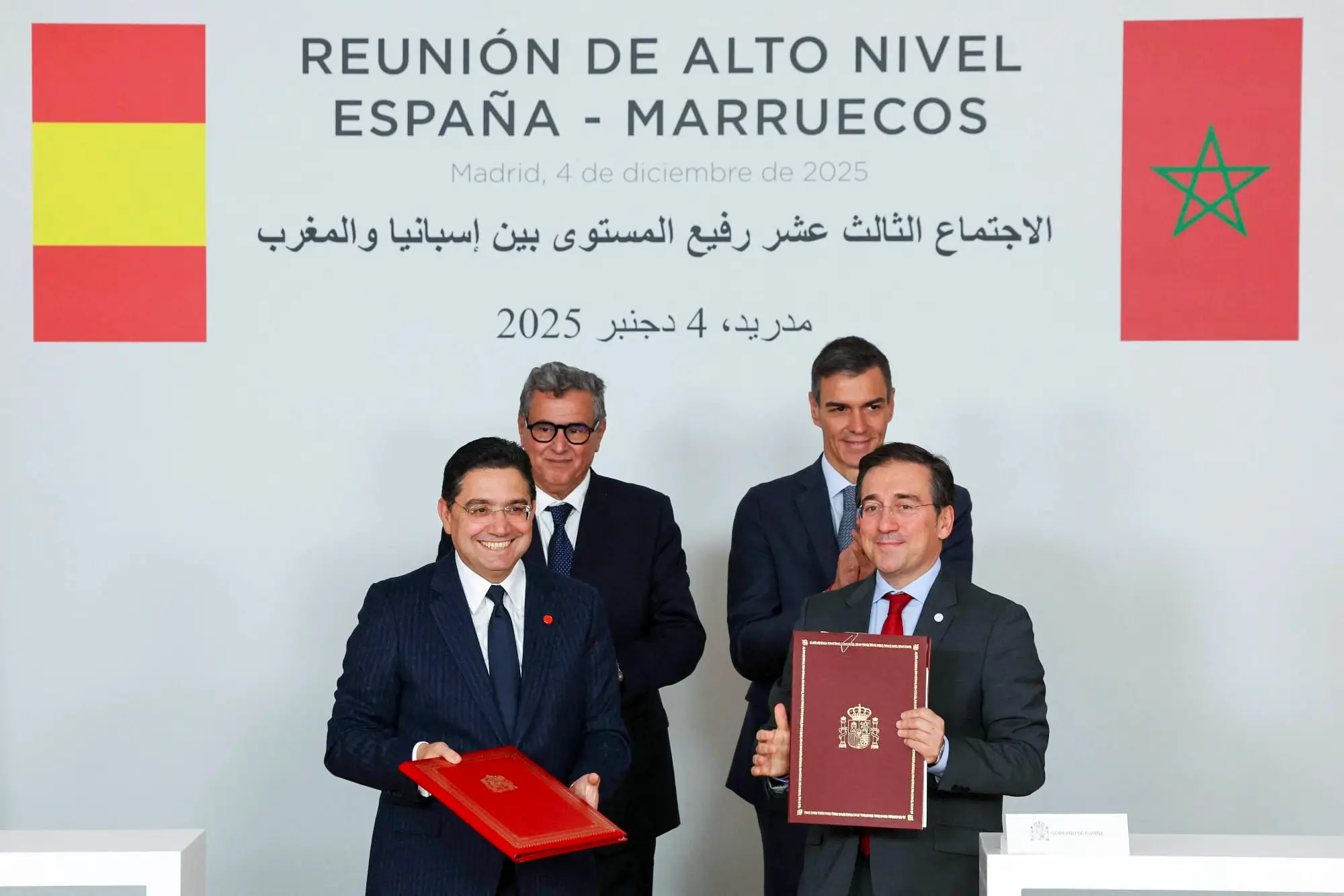
Each time Madrid and Rabat deepen their partnership – whether through the 13th High-Level Meeting held on December 4, 2025, in Madrid, which produced 14 bilateral agreements spanning migration, security, anti-corruption, and 2030 FIFA World Cup coordination – PP operatives resurface the espionage narrative with surgical timing.
In July 2025, the party invited Polisario representative Abdulah Arabi to its national congress. By November, the PP had taken the fight back to Congress, pushing a non-binding parliamentary motion that demanded the government reverse Spain’s Sahara position and reinforce ties with Algeria.
And in February 2026, Foreign Minister José Manuel Albares publicly lacerated the PP for its duplicity, accusing the party of dispatching envoys to Rabat to express private support for Morocco’s Autonomy Plan while simultaneously attempting to sabotage it from the floor of parliament.
The pattern is inexorable: the PP does not engage the Pegasus question as a matter of national security but deploys it as a rotating ammunition clip in a broader campaign to destabilize a bilateral relationship it cannot politically afford to embrace yet dares not genuinely dismantle.
What renders this posture particularly disingenuous is the evidentiary void underpinning it. Spain’s National Court, led by magistrate José Luis Calama, shelved its Pegasus investigation in January after Israel refused to cooperate with judicial inquiries, leaving the case without an attributable perpetrator.
No forensic trail, no judicial finding, no intelligence assessment has ever implicated Morocco. The accusation persists solely in the rhetorical arsenal of political actors with an unmistakable agenda.
A familiar playbook, repeatedly discredited
This is far from the first time Spanish institutions have repudiated the Pegasus smear against Morocco.
In April 2024, Óscar López, then director of the Presidency Office, appeared before the Joint Committee on National Security and branded the Morocco-Pegasus insinuation a “hoax, slander, and conspiracy theory.”
López expressed open bewilderment that elected representatives would traffic in narratives he associated with “the extreme right,” rebuking both Bildu’s Jon Iñarritu and PP’s Rafael Hernando for peddling unsubstantiated suspicions in a parliamentary forum.
Just before, Spain’s 2023 Annual National Security Report delivered perhaps the most authoritative repudiation of all.
The document’s “Espionage” chapter made zero reference to Morocco – a conspicuous and deliberate omission in a section that explicitly identified intelligence activities by China and Russia. The report’s silence on Rabat spoke louder than any diplomatic communiqué, demolishing the foundational premise of every Pegasus allegation leveled against the country.
In December 2024, Defense Minister Margarita Robles – herself among the officials whose devices were reportedly compromised – publicly excoriated PP lawmaker José Enrique Núñez Guijarro for directing “imputations to Morocco without evidence” from the floor of parliament.
Robles confirmed that Spain’s National Intelligence Center had furnished ten comprehensive reports to the investigating judge and stressed that the government “was the victim” – not the architect of geopolitical mischief.
Morocco’s line throughout this protracted saga has been one of principled defiance. Rabat has consistently demanded that its accusers – from Amnesty International and Forbidden Stories to hostile factions within the European Parliament – produce concrete evidence substantiating their claims. None has materialized.
Olivier Baratelli, the French lawyer representing Morocco in the case, reiterated in February 2023 the total absence of any evidentiary nexus linking the North African country to Pegasus deployment.
The PP’s insistence on resurrecting a debunked narrative serves no judicial or security purpose. It functions exclusively as a political instrument – one designed to corrode the Spanish-Moroccan partnership at moments of deepening bilateral convergence.
Read also: The Tired Playbook of Spain’s Far Right: Vox Wants ‘High Fences’ Against Morocco