 Join on WhatsApp
 Join on Telegram
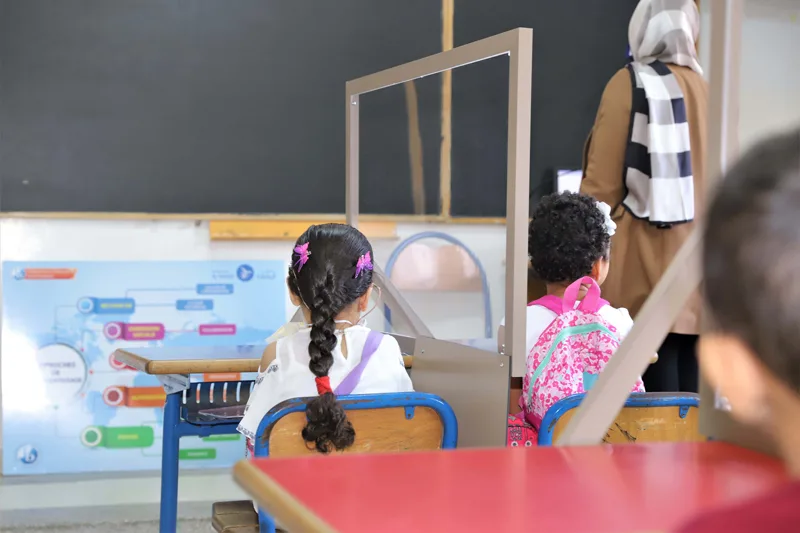
Marrakech – Morocco’s Pioneer Schools program has expanded from 626 public primary schools, 320,000 students, and 82 provinces during its 2023-2024 pilot phase to 4,626 schools nationwide, now covering roughly 54% of the public primary school system. The initiative reaches more than 2 million students, supported by approximately 75,000 teachers and 960 inspectors.
The World Bank Group published on Thursday a feature story detailing the scope and early results of the program, which the kingdom launched as a central component of its 2022-2026 Education Strategic Roadmap.
Guided by the Strategic Vision for Reform 2015-2030, the country is undertaking a far-reaching transformation of its education system that, according to the World Bank, “prioritizes learning outcomes, invests in teachers and school leadership, and seeks to ensure that opportunity and accountability reach every classroom.”
Yet, as of 2023, nearly 60% of Moroccan 10-year-olds were unable to read and understand a simple text by the end of primary school.
The program’s objective is to significantly increase the share of primary school students mastering foundational skills while reducing school dropout rates by at least one-third. It represents a shift from a curriculum coverage approach to a mastery approach, equipping teachers with tools for instruction, formative assessment, and enriched curricula.
The World Bank is backing the reform through a $750 million Education Support Program (PASE), launched in 2019 with additional financing in 2023. The PASE program supports early childhood education, foundational learning, teacher workforce improvements, and the scaling of evidence-based teaching methods. It also strengthens local education governance structures, with a focus on the management tools of Regional Academies (AREFs).
Read also: UM6P Education Chief Explains Why Morocco’s School Reform Is Finally Working
A preliminary impact evaluation conducted by J-PAL found that Pioneer Schools students outperform 82% of their peers in comparable schools after just one year. The gains were particularly notable in reading, writing, and math.
Learning improvements are supported by evidence-based teaching practices, including Teaching at the Right Level (TaRL) instruction.
A dedicated remedial month held each September provides intensive instruction in Arabic, French, and mathematics. Students are grouped by learning level and supported through continuous formative assessments and structured teaching materials. Those who continue to need support receive additional tutoring throughout the academic year.
Teacher Zoubir Reguani said the approach “aims to create a comfortable learning environment where struggling students are given the time and support to catch up with their peers.” He noted that “over the course of four weeks, this approach helps ensure that all students can progress together at the same pace.”
Teacher Ilham Ait Azzi offered a similar account, noting that “the Pioneer Schools program places equal emphasis on the student, the teacher, and the institution itself – calling on schools to rise to the level of both learning and the learner.”
For students like Hiba Hamoudi, the changes are tangible. “When we make mistakes, they encourage us and tell us to keep going,” she recounted.
‘Morocco’s commitment to foundational learning for all’
Beyond pedagogy, schools receive upgraded infrastructure, digital equipment, and increased operational resources. School budgets have tripled under the program.
The reform has also extended to lower-secondary education. A pilot phase of Pioneer Middle Schools began in 2024-2025 and now involves 786 schools and approximately 678,000 students, particularly in areas with high dropout rates.
The initiative also incorporates an extracurricular component with socio-emotional support mechanisms designed to reinforce student learning and well-being.
The World Bank report affirmed that “the Pioneer Schools initiative reflects Morocco’s commitment to foundational learning for all,” adding that its aim is “to reduce disparities in educational outcomes linked to geography, socioeconomic background, or school location, and to ensure that all students are supported.”
Looking ahead, the report projected that as preschool education becomes more widespread, “children will be better prepared when they start primary school,” and that this, “along with the Pioneer Schools reform, will likely lead to even stronger learning results and long-lasting improvements in foundational skills.”
The report concluded that “by aligning a clear national vision with evidence-based classroom practices, sustained teacher support, and adequate resources, Morocco is demonstrating that meaningful improvements in learning are possible at scale.”