 Join on WhatsApp
 Join on Telegram
Marrakech – In his first official visit outside the capital, France’s new ambassador to Morocco, Philippe Lalliot, traveled to Laayoune on Wednesday, choosing the largest city in the kingdom’s southern provinces in the Western Sahara to begin his diplomatic mission on the ground.
The trip came only weeks after Lalliot presented copies of his credentials to Foreign Affairs Minister Nasser Bourita on June 2, and days after King Mohammed VI received his letters of credence at the Royal Palace on June 4, alongside eleven other envoys.
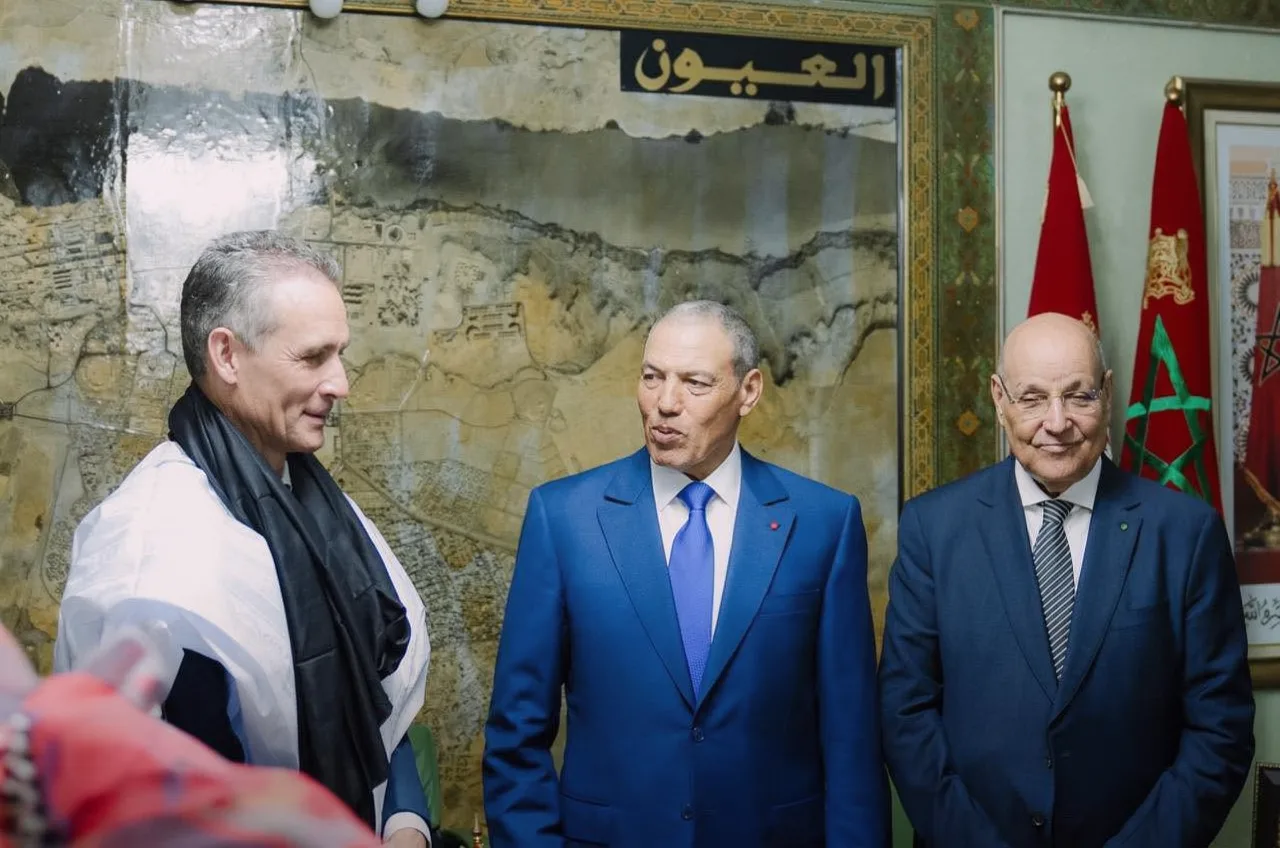
The president of the Laayoune communal council, Moulay Hamdi Ould Errachid, received the ambassador and his delegation at the communal palace, in a meeting attended by the council’s vice-presidents and several municipal officials.
According to the commune, the encounter served as an occasion to present the city’s major development projects and to spotlight the structuring works that have turned it into a leading urban and development hub in the southern provinces, built on a strategic vision spanning infrastructure, the environment, culture, and social services.
The two sides examined ways to reinforce decentralized cooperation, open the region to international expertise, and develop joint initiatives in culture and education.
The commune framed these efforts as serving shared interests and consolidating the historical friendship between Morocco and France. It placed the visit within the new dynamic in bilateral relations, marked by a stronger French institutional and cultural presence in the Western Sahara.
Lalliot held separate talks with Abdeslam Bekrate, wali of the Laayoune-Sakia El Hamra region, and with Ould Errachid, president of the Laayoune commune. He conveyed his gratitude for the welcome extended to him and his delegation, remarking that the meetings reflected the strength of Moroccan-French ties and opened fresh prospects for institutional, economic, and cultural cooperation at the territorial level.
Autonomy Plan anchors the ambassador’s message
The ambassador connected his choice of Laayoune to the trajectory Paris has followed since President Emmanuel Macron’s letter to King Mohammed VI, which recognized the autonomy initiative as the serious, realistic, and most credible basis for resolving the dispute over the Moroccan Sahara. He recalled that French policy has defended this direction inside the UN Security Council since Morocco tabled the initiative in 2007.
Lalliot cast the trip as part of implementing the commitments born from the exceptional partnership between Rabat and Paris, and as preparation for upcoming bilateral milestones. Foremost among them, he noted, is the framework agreement establishing a new phase of cooperation, along with high-level events and an anticipated royal visit meant to lift the relationship to a more ambitious level in the coming years.
On the economic front, the diplomat presented the southern provinces as a strategic space for investment and production. He said Paris intends to accompany the region’s major projects, encourage the presence of French firms and capital, and take part in structuring works.
“The next ten years will be decisive,” remarked the diplomat, depicting the region as an economic pole linking Europe to its African depth. He identified infrastructure, renewable energy, the blue economy, vocational training, and higher education as promising fields for the partnership.
Turning to the political track, Lalliot argued that the international momentum behind the Moroccan plan opens new horizons for the UN-sponsored process, and voiced his country’s hope that negotiations would yield a lasting, realistic settlement based on autonomy under Moroccan sovereignty.
The talks also touched on the future of the MINURSO mission, ceasefire prospects, and the humanitarian situation of the population in the Tindouf camps, including mechanisms for their eventual return.
Bekrate welcomed the ambassador to one of the major cities of the Sahara, describing the visit as “a real embodiment of the historical and renewed relations between Morocco and France.”
He tied its economic dimension to King Mohammed VI’s vision of developing the region into a distinguished economic hub in Africa, and recalled that the two countries had entered a new chapter since Macron’s state visit in October 2024. The declaration issued during that visit, he observed, stands as a reference document crowning a new stage in bilateral diplomacy.
Ould Errachid, for his part, valued on behalf of Laayoune’s residents the French position supporting Morocco’s territorial integrity and the autonomy initiative as the only viable path to close what he called a fabricated dispute.
He offered the delegation an overview of the region’s history, its ties to the kingdom, and the population’s attachment to the bay’a inherited from their ancestors to the Alaouite throne. He also reviewed the investment prospects opened by the region’s infrastructure and its position as Morocco’s gateway to Africa.
Responding to the ambassador’s questions about the Tindouf population, Ould Errachid maintained that the Polisario Front represents only a limited fraction of Sahrawis, not the majority living across the southern provinces. He pointed to Morocco’s institutional and humanitarian experience in reintegration as a guarantee of stability and rights.
On MINURSO, he noted that the mission’s mandate is confined to monitoring the ceasefire, recalling that the Polisario was the first to renege on the accord in 2020 during the Guerguerat events, before Morocco restored normal traffic at the crossing.
A widening French footprint in the south
The visit extends work begun under Lalliot’s predecessor, Christophe Lecourtier, who now heads the French Development Agency (AFD). In April, Lecourtier presided over the inauguration of the new site of the Paul Pascon French international school in Laayoune, a project completed in just over a year on a two-hectare site able to host up to 600 students from kindergarten through the baccalaureate.
Founded in 2012, the school is the first and only French education network institution in the Laayoune-Sakia El Hamra region. During that ceremony, Lecourtier announced the coming opening of an Alliance Française in the city, whose launch Lalliot attended on Wednesday. For the ambassador, the presence of both the center and the school stands as proof of a shared will to invest in knowledge and youth.
That institutional buildup has accelerated since France recognized Moroccan sovereignty over Western Sahara in July 2024. The AFD, authorized to operate in the territory since late 2024, announced plans to invest €150 million in the southern provinces.
Paris has also extended consular services to Laayoune, Dakhla, and Es-Semara, opening a TLS Contact visa center in Laayoune in May 2025, and a Morocco-France Economic Forum gathered more than 300 business leaders in Dakhla that October.
Read also: For First Time, US Delegation Visits Morocco’s El Guerguerat Border Crossing