Airport terminals occupy a unique position in contemporary architecture. Few building types are required to perform so many functions simultaneously. They must process thousands of passengers with speed and precision, coordinate complex security and logistical systems, accommodate future growth, and remain operational around the clock. Every spatial decision carries consequences for efficiency, safety, and comfort.
At the same time, for many travelers, terminals constitute the first and last encounter with a country. Before a visitor experiences a country’s streets, monuments, or landscapes, they experience its airport. As a result, terminals increasingly serve as architectural ambassadors; they are expected to communicate something about the identity, culture, and aspirations of the nation they represent.
Yet reconciling these ambitions is no simple task.
The challenge for architects is therefore to design an efficient machine for movement, and also to create a gateway that feels rooted in its place.
Currently under construction, the new terminal at Mohammed V International Airport, designed by RSHP in collaboration with Ala Concept, offers an opportunity to examine how architecture negotiates this tension. Beyond questions of capacity and circulation, the project raises a broader question: can a terminal express a meaningful sense of Moroccan identity while remaining one of the world’s most complex pieces of infrastructure?
Designing a machine for movement
The architecture of airport terminals is fundamentally shaped by movement.
Passengers arrive from multiple directions, pass through check-in, security screening, passport control, retail areas, waiting lounges, boarding gates, baggage claim, and ground transportation networks. Each stage introduces potential bottlenecks capable of compromising the passenger experience. To manage these flows, airport planners frequently rely on Level of Service (LOS) principles, which evaluate how comfortably and efficiently travelers move through a terminal.
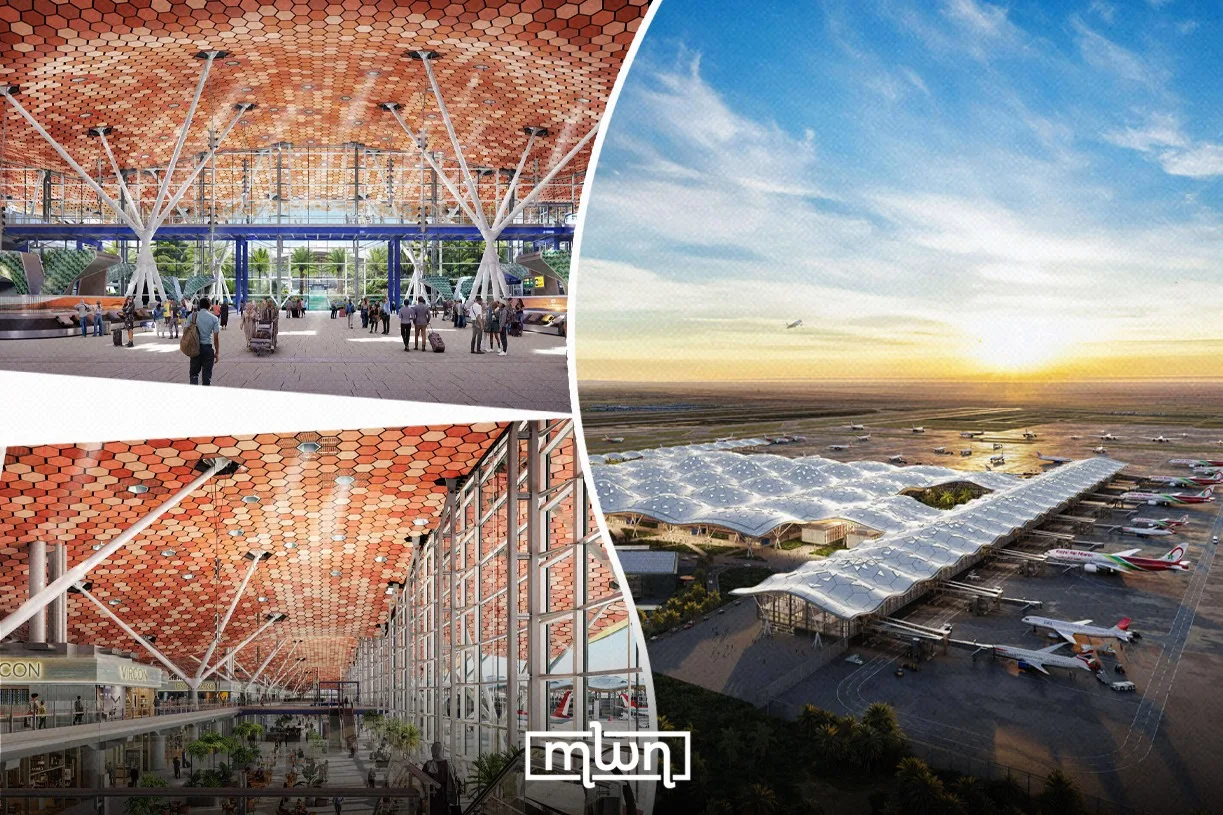
The architects’ response to these operational demands can be read in the building’s H-shaped configuration.
Rather than organizing the building as a single elongated concourse, the design distributes capacity through multiple branching arms connected by a central processing zone. This configuration appears intended to reduce walking distances while maintaining direct routes between major passenger functions.
The plan also appears designed with future growth in mind, with its geometry allowing capacity to expand without requiring a complete reorganization of the terminal.
Even the project’s emphasis on daylight, open spans, and landscaped areas can be understood through the lens of performance. While efficiency is often measured quantitatively, architecture also shapes the psychological experience of movement.
Spacious interiors and visual openness can make large crowds feel less oppressive, transforming efficiency into comfort.
Judged as infrastructure, the proposal appears to respond thoughtfully to many of the challenges that define contemporary terminal design. Once questions of circulation, capacity, and performance have been addressed, another challenge emerges: how can a terminal create a meaningful sense of place?
Can a terminal express Casablanca?
The architects of the Mohammed V terminal frame the project within a Moroccan context. According to the design narrative, the roof’s sweeping undulations evoke the waves of the Atlantic Ocean. Large landscaped oases punctuate the interior, while an ochre-toned soffit articulated through hexagonal geometries references bejmat, terracotta zellige, and the craftsmanship traditions of Morocco’s southern provinces.
Do these references genuinely create a sense of place, or do they merely symbolize one?
Architecture has long relied on references, metaphors, and cultural motifs. But a meaningful sense of place rarely emerges through visual association alone. A roof inspired by Atlantic waves does not necessarily produce an experience connected to the ocean. Likewise, references to traditional craftsmanship do not automatically generate a meaningful relationship with local culture.
The challenge is to translate symbols into spatial experience.
A reference becomes architectural when it shapes the way a building is inhabited. If the roof’s geometry influences the quality of daylight entering the terminal, if landscaped areas provide moments of relief within the intensity of air travel, if material choices affect atmosphere and perception, then these references operate as more than images. They become active participants in the experience of the building.
Travelers experience terminals through movement. They walk through them, wait within them, orient themselves inside them, and form impressions through a sequence of spaces rather than through a single view.
Renderings can communicate intentions, but they cannot fully communicate the atmosphere. They reveal how architects wish a building to be perceived, yet they offer only limited insight into how it will ultimately feel to use.
The project’s success will not depend on whether travelers identify allusions to Atlantic waves, bejmat, or zellige. It will depend on whether these ideas influence light, movement, materiality, scale, and atmosphere in ways that create a memorable experience of arrival and departure. In other words, the challenge is not representing but translating cultural references into spatial experiences that can be felt rather than merely recognized.
If the terminal succeeds in doing so, it will achieve something increasingly rare. It will demonstrate that even one of architecture’s most demanding and operationally constrained building types can still create a meaningful sense of place.