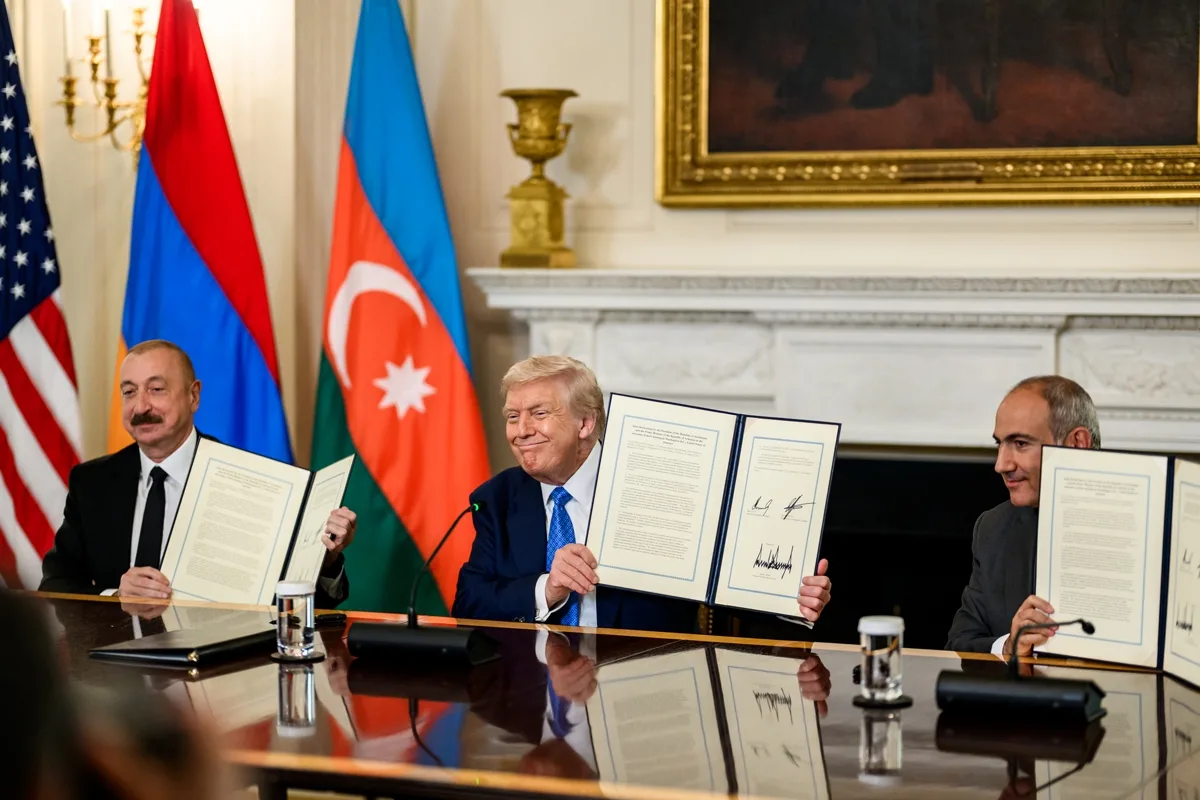
For the first time in more than three decades, peace between Azerbaijan and Armenia no longer feels like a distant aspiration. It has become a realistic political objective.
The text of a peace agreement has been finalized. Washington has intensified diplomatic engagement. European and regional actors increasingly speak not about whether peace is possible, but about how to make it sustainable.
Yet history teaches an important lesson: wars do not necessarily end when documents are signed. Lasting peace begins only when societies, institutions and political systems become capable of protecting it.
Today, the South Caucasus stands precisely at that crossroads.
One of the most misunderstood aspects of the current negotiations concerns Azerbaijan’s insistence that Armenia amend its Constitution before a final peace agreement can be signed.
Outside the region, this demand is sometimes portrayed as an additional political condition. In reality, Baku presents it as a legal necessity.
President Ilham Aliyev has repeatedly argued that Armenia’s Constitution still contains references that can be interpreted as territorial claims against Azerbaijan through the country’s Declaration of Independence. From Azerbaijan’s perspective, signing a peace treaty while such constitutional provisions remain unchanged would leave an obvious legal contradiction unresolved.
As President Aliyev recently stated, Azerbaijan’s conditions are “logical, reasonable and legitimate.” They are not presented as new demands but as prerequisites for ensuring that peace rests on a durable legal foundation rather than political goodwill alone.
Whether one agrees with this assessment or not, the argument deserves to be understood in its proper legal context rather than reduced to political rhetoric.
Assistant to the President of Azerbaijan and Head of the Foreign Policy Affairs Department of the Presidential Administration Hikmat Hajiyev recently remarked that “we are already at real peace.” His words may sound surprising after decades of confrontation, yet they reflect an important reality.
Military escalation has ceased. Direct contacts between officials have become routine. Discussions increasingly focus on transport corridors, regional connectivity and economic cooperation instead of ceasefire violations.
The language of diplomacy itself has changed.
But Hajiyev also emphasized that sustainable peace still requires constitutional changes inside Armenia. This distinction matters.
A ceasefire can stop violence. Only institutions can prevent its return.
Foreign Minister Jeyhun Bayramov has similarly stressed that while negotiations over the agreement itself have concluded, implementation still depends on addressing the remaining legal issues.
This demonstrates that today’s diplomatic process is no longer primarily about negotiating the wording of a treaty. It is about creating conditions under which that treaty cannot easily be challenged tomorrow.
The implications extend well beyond Azerbaijan and Armenia.
A durable peace would strengthen the Middle Corridor connecting Europe and Asia, reinforce Europe’s energy security, improve regional connectivity and create new opportunities for economic integration across the South Caucasus.
It could also facilitate further normalization between Armenia and Türkiye while reducing one of the most persistent sources of geopolitical instability in Eurasia.
This is why developments in the South Caucasus increasingly attract attention not only in Brussels or Moscow, but also in Washington, Ankara, Jerusalem and Beijing.
Regional peace has become part of a much larger international equation.
Yet diplomacy alone cannot complete this transformation.
Political agreements require public trust. Trust requires responsible public discourse.
And that is where journalism becomes more than simply reporting events.
This year’s Shusha Global Media Forum addressed precisely this challenge under the theme of media’s role in promoting peace, restoring truth and rebuilding trust. The discussion reflected a growing understanding that modern conflicts are fought not only on battlefields but also through narratives, misinformation and competing historical memories.
Media therefore carries a responsibility that extends beyond headlines. It can either deepen divisions or help societies understand why peace serves their long-term interests. This is particularly relevant in the South Caucasus, where decades of mutual distrust cannot disappear overnight.
Reconciliation cannot be legislated. It must gradually become socially acceptable.
History shows that political courage is often required not only to wage wars but also to end them.
Today, leaders on both sides face difficult domestic realities, competing political pressures and unresolved historical grievances.
The easier political choice is often to postpone compromise. The harder choice is to invest in peace despite criticism.
The South Caucasus has arrived at one of those rare historical moments when the future remains genuinely open.
The opportunity exists.
The diplomatic framework exists.
International support exists.
What remains uncertain is whether political will, legal reforms and public trust can advance together.
Peace agreements end wars.
Constitutions secure them.
But only trust allows them to survive.