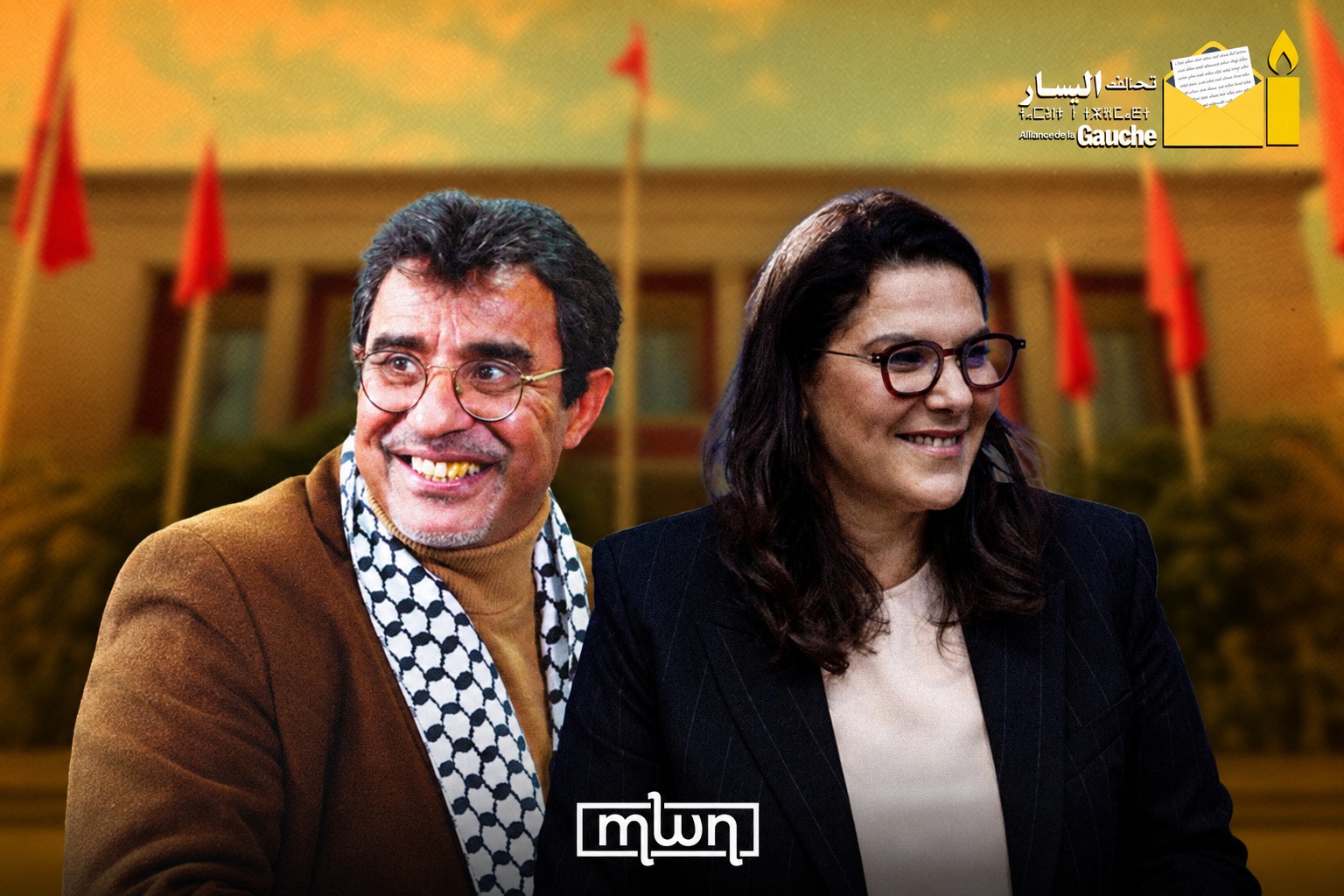
Marrakech – The Left Alliance announced on Thursday that its planned meeting with Head of Government-designate Fatima Ezzahra El Mansouri, scheduled for Friday, would not take place. A dispute over the venue blocked it, one day after the Justice and Development Party (PJD) declined to meet her on the same grounds.
In a communiqué issued from Casablanca on Thursday, the alliance explained that El Mansouri had contacted the secretaries-general of its two component parties, Abdelssalam Laâziz and Jamal El Asri, to arrange a meeting as part of her consultations to form the next government. The two leaders gave their initial agreement to take part.
At the same time, the alliance reaffirmed its choice of “citizen opposition” from within Parliament, with the political, oversight, and advocacy responsibilities that this entails toward national issues.
The group requested that the meeting be held in a neutral space, independent of any party headquarters. According to the statement, such a venue would preserve the institutional character of a meeting between a prime minister-designate and the secretaries-general of political parties.
No agreement was reached on the location. The alliance noted that El Mansouri was conducting the consultations in her party capacity, as coordinator of the collective leadership of the Authenticity and Modernity Party (PAM). On that basis, the meeting could not be organized.
The alliance, which groups the Unified Socialist Party (PSU) and the Federation of the Democratic Left (FGD), drew a clear line between two separate questions.
According to sources within the alliance, reports of a refusal of consultations were inaccurate. The alliance did not reject the consultative meeting or the government talks in principle, but objected to the location. The group refused to attend at PAM’s central headquarters, and argued that consultations on forming a government should take place in a neutral setting.
For the alliance, opposition is “not merely a political positioning.” It described the choice as rooted in its commitment to citizens’ concerns and to the country’s higher interest. The group renewed its resolve to keep working for “another possible Morocco,” one built on freedom, dignity, social justice, democracy, and effective equality.
The alliance raised its representation in the House of Representatives for the first time, winning eight seats in the September 23 elections.
Opposition parties hold firm as El Mansouri defends her approach
The PJD had taken a comparable stance a day earlier. Its secretary-general, Abdelilah Benkirane, announced on Wednesday evening that none of his party’s leaders would attend the meeting scheduled with El Mansouri on Thursday.
In a video, he recounted receiving a phone call from her and welcoming the request, noting that he was ready to receive her because she had initiated it.
Benkirane recalled that during his own tenure as head of government, he had visited former heads of government and political leaders as part of his consultations. He objected after learning that El Mansouri was receiving party leaders at PAM headquarters.
According to his account, she had reached him through Mehdi Bensaid before direct contact produced an initial agreement on timing. He then conditioned any meeting on it being held at PJD headquarters, since she was the one who had sought it.
Benkirane stated that his party had already resolved to sit in the opposition, a position approved by its general secretariat and national council. He added that he would remain available to meet El Mansouri later, after the government is formed and installed, if the need arose.
El Mansouri responded on Thursday. Her party’s approach since the election results, she noted, had rested on contacting every political party represented in Parliament, because of “the common thing between us, which is the homeland.” Consultation, she argued, “is imposed on us,” while each party kept the freedom to accept dialogue or decline it.
“Dialogue is a fundamental principle in every democratic state,” she stated, adding that “each of us retains our choices and freedom.” A PAM source was more blunt, describing Benkirane’s demand as “a custom he created himself” and stating that the party would not respond to it.
Nabila Mounib, former secretary-general of PSU, framed the appointment in conditional terms. She argued that naming a woman to head the government would have been a positive development for women, at least symbolically, had Morocco been a democracy, a state governed by rights and law, with social and regional justice, and a society of science and knowledge.
Mounib placed the appointment against the backdrop of a patriarchal society, which she described as a system of male domination at the political, social, and economic levels. She maintained that there is no modernity without democracy and no modernity without a state of rights and law.
PAM is a party that was “created” and is not independent, she further contended, describing the party as marked by corruption, implicated in previously compromised governments, and historically failing to clearly link responsibility and accountability.
Though the appointment followed Article 47 of the Constitution, the more important question, she said, was what project El Mansouri carried, given her role in past governments led by her party.
The standoff unfolds as El Mansouri works to assemble a coalition. King Mohammed VI appointed her on Tuesday. The mayor of Marrakech and a co-leader of PAM became Morocco’s first woman head of government. Her party won the September 23 vote with 97 of the 395 seats, short of an absolute majority.
PAM finished ahead of the National Rally of Independents (RNI), with the Istiqlal Party third and the PJD fourth.
One million of the 15.8 million registered voters backed PAM, and turnout fell to 38% from 50% five years earlier. The vote was the first since last year’s Gen Z youth-led protests and the July border crisis at occupied Ceuta. Parliament is scheduled to reconvene on October 9.