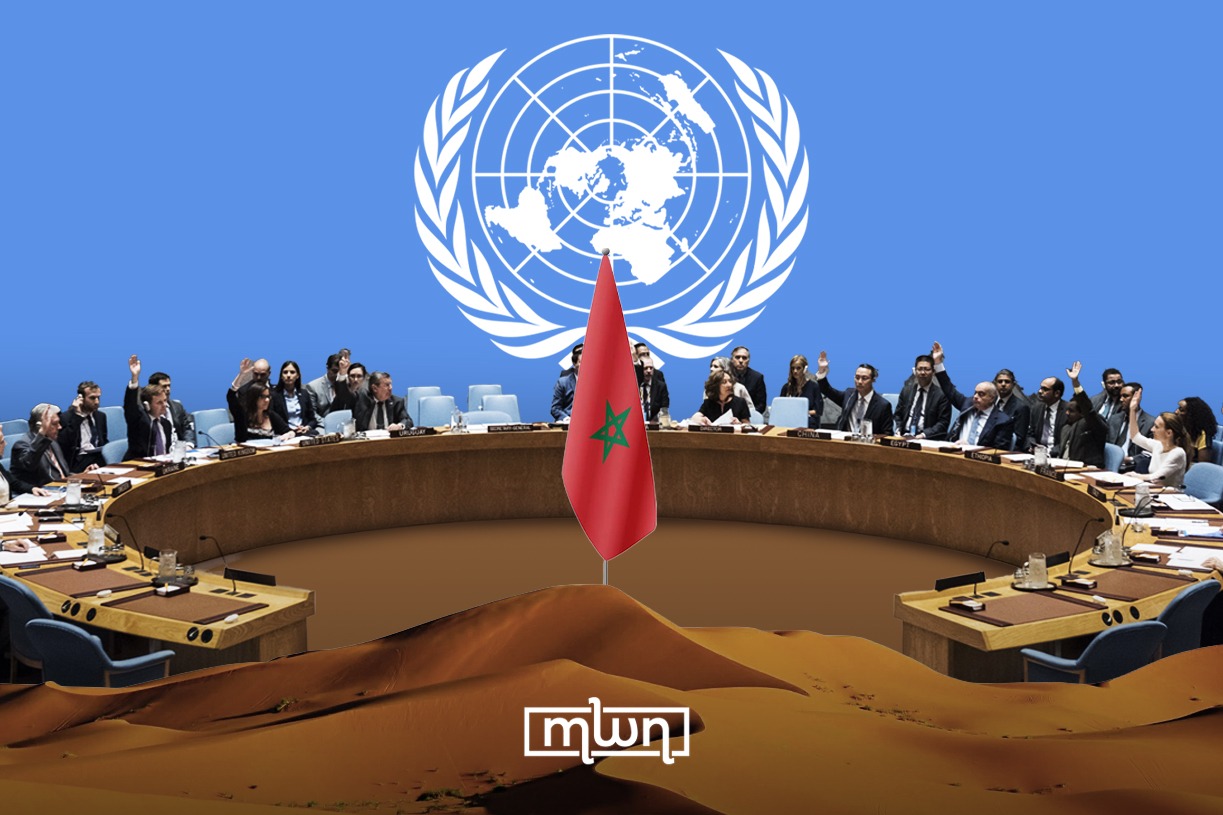
Marrakech – The United Nations Security Council (UNSC) will hold two closed meetings on Morocco’s Western Sahara on October 7 and 8, ahead of the October 31 expiry of the mandate of the UN Mission in Western Sahara (MINURSO). Greece, which holds the Council presidency for October, adopted the provisional program of work on October 1.
The October 7 session is a closed meeting with troop-contributing countries, while October 8 brings closed consultations of the whole Council.
Before the mandate renewal, the Council will hold a private meeting with MINURSO’s troop-contributing countries, with Special Representative and Head of MINURSO Alexander Ivanko taking part.
Council members will then receive a briefing in consultations from Ivanko and the Personal Envoy of the Secretary-General, Staffan de Mistura, on the Secretary-General’s annual report. A vote on a resolution to renew the mission’s mandate is expected later in the month.
The meetings unfold against a diplomatic landscape whose center of gravity has been shifting, with gathering force, toward Morocco. Resolution 2797, adopted on October 31, 2025, extended MINURSO’s mandate for a year and expressed the Council’s full support for the Secretary-General and his Personal Envoy in facilitating negotiations that take Morocco’s Autonomy Plan as a basis.
The plan, submitted to the UN in 2007, calls for integrating the territory into Morocco, with the local population managing its internal affairs while Morocco handles external representation. The resolution also urged the parties to engage without preconditions, using the proposal as a basis, and recognized that genuine autonomy could represent a feasible outcome.
Washington, the penholder on the file, remains central to that momentum. The United States recognized Moroccan sovereignty over the Sahara in December 2020 and has kept that position in place. The current Donald Trump administration has reiterated that Morocco’s Autonomy Plan is the only basis for a just and lasting solution.
Diplomatic activity picked up earlier this year. In February, the United States convened ministerial-level delegations from Morocco, Algeria, Mauritania, and the separatist Polisario Front for talks in Madrid, with US Permanent Representative Mike Waltz and Senior Advisor for Arab and African Affairs Massad Boulos joining de Mistura.
The gathering marked the first time since 2019 that all four stakeholders had met in person in that format, and a second round followed in Washington on February 23 and 24.
‘No imminent solution’ for the moment
The meetings produced no narrowing of positions, and the obstruction has a clear source. Morocco anchors any settlement in autonomy under its sovereignty, a workable formula that itself delivers self-determination by letting the local population run its own affairs. The Polisario, by contrast, clings to a rigid and hollow reading of self-determination, a maximalist slogan detached from any realistic outcome and sustained mainly to prolong a stalemate that serves Algiers.
In a September 25 interview with France 24, Boulos said there was “no imminent solution” for the moment, noting that three rounds of talks had gathered the foreign ministers of Morocco, Mauritania, and Algeria along with Polisario leaders.
He called the discussions “constructive and productive” yet acknowledged they had yielded no agreement, and he placed the blame squarely on one side. “We are still waiting for formal feedback from the Polisario on the Autonomy Plan, otherwise we will not be able to see the UN process through,” he said, pointing to the group’s refusal to submit any formal response since the negotiations resumed.
That stalling has shifted Washington from mediator to enforcer, and the two letters Ambassador Waltz delivered during his meetings with the Polisario and the Sahrawi Movement for Peace (MSP) this week make that turn explicit.
In the first, Waltz told the Polisario that the populations held hostage in Tindouf had “waited fifty years” and “deserve real choices, not another decade of waiting,” before insisting that “the basis for a solution is on the table” and warning that “any other path will only prolong the status quo, which is unacceptable.”
The tone flipped in the second letter, where he praised the breakaway movement as “Sahrawi voices committed to peace” whom “the world should listen to.” By publicly recognizing a faction that split from the Polisario and accepts the autonomy framework, Washington opens space for an alternative Sahrawi interlocutor and undercuts the Front’s claim to be the sole legitimate representative of the population.
Resolution 2797 also requested a strategic review of MINURSO’s future mandate within six months. During closed consultations on April 23, Asif Khan, Director of the Policy and Mediation Division in the UN Department of Political and Peacebuilding Affairs, briefed members, though the review had not yet been finalized.
The options under consideration included realigning MINURSO’s tasks in the event of a political agreement, from ceasefire monitoring to facilitating refugee returns and supporting disarmament.
The situation on the ground has stayed stable in the territory, marred only by the Polisario’s reckless provocations. On May 5, three rockets struck near the city of Es-Smara, landing close to the local prison and cemetery and injuring one civilian, with the separatist group claiming responsibility for the indiscriminate assault on a civilian area. The attack drew condemnation from the Council’s three Western permanent members, the European Union, and the Gulf Cooperation Council.
On June 7, a reported Moroccan drone strike in the Mijek area, east of the berm, killed prominent Polisario figure Lahbib Mohamed Abdelaziz and two other members of the group.
De Mistura kept up his regional consultations through June, traveling to the Tindouf camps in Algeria, where he met Polisario leader Brahim Ghali, before meeting with Boulos at the Oslo Forum, Algerian Foreign Minister Ahmed Attaf in Algiers, and Mauritanian President Mohamed Ould Cheikh El Ghazouani in Nouakchott.
A pro-Moroccan Council
For the renewal itself, members weigh a straightforward one-year rollover or a shorter six-month extension that would create an earlier checkpoint to assess the talks. A press statement supporting the diplomatic efforts led by de Mistura and the United States is also among the options.
Broader Council dynamics reflect Morocco’s widening support. France backs the Autonomy Plan as the “only basis” for a solution, while the United Kingdom describes it as the “most credible, viable and pragmatic basis.” Denmark calls it “a good basis for an agreed solution between all parties,” and Greece considers it “serious and credible.”
Bahrain, the Democratic Republic of the Congo, and Liberia support Moroccan sovereignty and have opened consulates in the territory. Somalia, in a December 2025 statement, reaffirmed its commitment to cooperation with Morocco and respect for its national unity.
Colombia recognized Moroccan sovereignty in August following the election of President Abelardo de la Espriella, and Panama, which suspended relations with the self-declared Sahrawi republic in November 2024, has described the Autonomy Plan as the “most serious, credible, and realistic basis” for a lasting solution.
Latvia maintains cordial relations with both Rabat and Algiers. It recognizes neither the Polisario-proclaimed SADR nor Moroccan sovereignty over Sahara, but as an EU member it is bound by the bloc’s common position adopted in January, which welcomed Resolution 2797 and backed negotiations taking Morocco’s Autonomy Plan as their basis.
Pakistan, which abstained on Resolution 2797 to keep its position consistent with its stance on Kashmir, nonetheless frames the move as support for Morocco. Ambassador Syed Adil Gilani told Morocco World News (MWN) at the time that Islamabad holds the Sahara to be Moroccan and that by not voting against the plan, Pakistan backs it.
The Council is composed of its five permanent members – China, France, Russia, the United Kingdom, and the United States – alongside ten elected members currently serving two-year terms.
Read also: Ex-UN Official to MWN: Morocco Can Help Keep the Security Council Talking