

































































Marrakech – Morocco is moving to turn decades of military procurement and civilian industrial experience into a defense-industrial base of its own. On November 18, King Mohammed VI, accompanied by Crown Prince Moulay El Hassan, chaired a working session at the Royal Palace in Rabat devoted to the “Offre Maroc” (Morocco Offer) initiative, an overarching roadmap for developing the national defense and security industry.
The plan sets out to shift the kingdom from importing finished military equipment toward manufacturing, maintaining, developing, and eventually exporting defense systems. The Royal Office tied the initiative directly to defense sovereignty and to building an industrial and technological base capable of supplying both the Royal Armed Forces (FAR) and export markets.
The session brought together the officials who will carry the plan forward. Present were the Head of Government, Fatima Ezzahra El Mansouri; the Adviser to the King, Fouad Ali El Himma; the Minister of Industry, Commerce, Investment and Economic Inclusion, Ryad Mezzour; the Minister Delegate to the Head of Government in charge of the National Defense Administration, Abdeltif Loudyi; the General of the Army Corps, Inspector General of the FAR and Commander of the Southern Zone, Mohammed Berrid; and the Director General of the Moroccan Agency for Investment and Export Development (AMDIE), Ali Seddiki. General Berrid and Seddiki presented the main lines of the “Morocco Offer” and its deployment roadmap to the King.
View this post on Instagram
From there, the document sets a clear direction. The vision calls for an integrated industrial ecosystem covering the full value chain of defense and security industries, with particular focus on design and production, maintenance, testing, and storage. According to the Royal Office, the goal is to position Morocco within the restricted club of countries that produce defense and security equipment and solutions.
The plan is built around measurable 2035 targets, which the Royal Office presented as expected outcomes rather than achievements already reached. The base is projected to create close to 50,000 direct and indirect jobs. It is meant to cover roughly 40% of the needs of the FAR and the security services. It is also expected to generate more than 65% of its revenue through exports, while positioning Morocco in high-value-added activities and reinforcing its place in international value chains.
Mezzour tied those figures to the state of Moroccan industry. According to the minister, the “Morocco Offer” and its roadmap confirm “the maturity of the Moroccan industrial ecosystem” and will let it answer, by 2035, “40% of the needs of the Royal Armed Forces” while generating “65% of the revenues of this defense technology base through exports.” He described the undertaking as “a new global vocation for Morocco” that leans on advanced training and draws in the talent of Moroccans living abroad.
Six priority segments and a full value chain
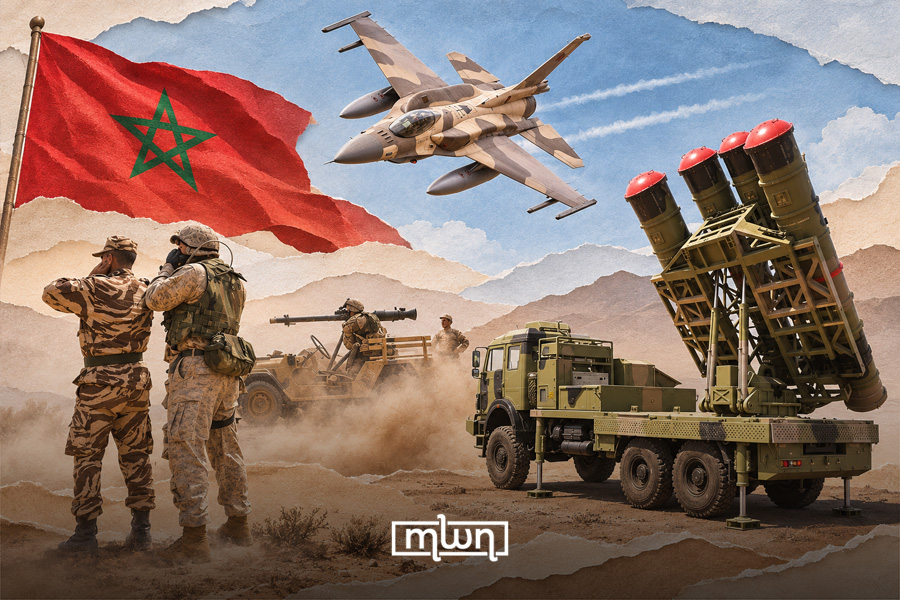
Underneath the targets sits a specific technological map. The roadmap identifies six priority segments: drones and autonomous systems; land-based systems; naval systems; defense electronics; cyberdefense; and artificial intelligence. These are oriented toward future technologies and dual-use applications that can cross into civilian sectors.
The ambition is not limited to final assembly. Morocco wants to link research and development to production, integration, maintenance, testing, and storage on national territory. The plan calls for mobilizing the country’s existing industrial assets, the expertise of the FAR, and new investment, while building a network of local suppliers and widening the geography of industrial development.
To steer the sector, the roadmap sets up a new governance structure. It provides for a dedicated strategic agency to design and coordinate the national strategy and to assist investors. It also establishes an industrial holding company, meant to act as the state’s industrial and investment arm, to mobilize public and private capital, organize the ecosystems, and help local champions emerge. A specialized academy is planned to train the needed skills and support research.
The industrial map is expanding in parallel. Two defense acceleration zones were approved in 2024: Nouaceur, in Casablanca-Settat, covering 75 hectares and oriented toward defense electronics, precision engineering, surveillance, and integration; and Sidi Yahya El Gharb, near Kenitra, covering 600 hectares for larger-scale manufacturing, ammunition-related activity, and specialized storage. Together, they represent 675 hectares, managed by SGZID, the company created through the Military Housing and Equipment Agency (ALEM) and MEDZ, a CDG subsidiary. The new roadmap adds two more large zones, in Benguerir, in Marrakech-Safi, and in Benslimane, in Casablanca-Settat. Benguerir hosts Mohammed VI Polytechnic University (UM6P), and Benslimane is already tied to aviation maintenance and autonomous-systems projects. The surface areas, tenants, and completion dates of these two new zones were not specified in the Royal Office statement.
None of this began today. The legal foundation was laid on July 25, 2020, when the King promulgated Law No. 10-20, published in the Official Bulletin on August 6, 2020. The law created a licensing framework for manufacturing, importing, exporting, transporting, and trading defense and security equipment, weapons, and ammunition. It allows authorized companies to manufacture military equipment inside Morocco, defines manufacturing broadly to include assembly, machining, additive manufacturing, maintenance, repair, and modification, and generally requires majority Moroccan ownership, with exceptions possible. A national commission reviews manufacturing and export applications.
The political framing followed. In this year’s Throne Day speech on July 29, the King placed industrial sovereignty and strategic self-sufficiency among Morocco’s development priorities. He identified a defense-industrial and technological base, alongside cybersecurity, as a way to strengthen defense sovereignty, create economic opportunities, and reinforce the country’s standing as a regional industrial power.
The House of Representatives added detail during its October session, through the report on the National Defense Administration’s budget. The report describes a transition from importing defense capabilities toward national capabilities and defense sovereignty. It documents concrete measures: temporary corporate-tax exemptions for defense manufacturing, additional incentives for licensed manufacturers, industrial offset arrangements to encourage technology transfer, a company to develop and manage the industrial zones, technical-training clauses written into procurement contracts, and cooperation with universities on military research.
The report also puts figures on projects already authorized. It cites a total associated investment of MAD 3.33 billion ($333 million), more than 3,500 expected direct jobs, and roughly MAD 317 million ($31.7 million) in investment grants. These represent project commitments and expected employment, not independently verified completed investment and realized jobs.
What already exists: Armored Vehicles and Weapon Stations
Some of this has moved past paper. On September 23, 2025, Morocco and India inaugurated the Tata Advanced Systems Maroc (TASM) factory at Berrechid, where production of WhAP 8×8 armored combat vehicles began. India’s Ministry of Defence confirmed the plant became operational ahead of schedule. The roughly 20,000-square-meter facility starts at 35% local integration, with a planned increase to 50%, and envisages 90 direct and 250 indirect jobs. The WhAP was developed by Tata Advanced Systems and India’s Defence Research and Development Organisation (DRDO); Morocco gains local manufacturing and integration capacity, while the core design remains Indian.
A second strand concerns weapon systems. Moroccan Military Industry (MMI) operates a facility at the Midparc park in Nouaceur. Its management told Reuters during the 2026 Marrakech Airshow in October that it expects to begin delivering locally manufactured 30 mm armored-vehicle turrets to the FAR in March 2027. MMI’s reported activities also include remote-controlled weapon stations, modernization of M113 vehicles, and a counter-drone turret concept. A separate project in Sidi Yahya El Gharb targets medium- and large-caliber ammunition, including 155 mm artillery and 30×173 mm rounds, though reporting on its output and plant completion differs. MMI carries Israeli industrial links, notably with Elbit Systems, with the precise corporate relationship still requiring documentary verification.
The unmanned segment is among the most active. On June 17, France’s Harmattan AI announced a strategic partnership with the FAR covering autonomous air defense and a domestic industrial base. At the Marrakech Airshow, Harmattan and the government signed an investment agreement for research, prototyping, engineering, manufacturing, integration, and testing of counter-drone technologies, with a stated objective of 1,000 direct and indirect jobs and a letter of intent on a sovereign Moroccan drone. Coverage has linked the cooperation to Harmattan’s IRIFI long-range strike system, which remains a development objective rather than a fielded aircraft.
Recent Moroccan reporting has provided fresh detail on that system. Harmattan AI and Morocco signed a letter of intent for IRIFI on October 7, at the opening of the Marrakech Airshow, describing it as a sovereign autonomous deep-strike system with a range of up to 2,000 kilometers, built for long-range attacks on targets far behind the front line. The system does not rely on GNSS satellite positioning; it uses optical terminal guidance and is credited with meter-level accuracy, including in low-altitude flight. Its autonomy is set within limits: commanders fix the authorized targets and mission parameters before launch, the operator selects the target and decides to strike, and the drone then executes the mission “within the boundaries set by its human commander.”
IRIFI relies on a canisterized mobile launcher and an “attritable” design meant for rapid deployment at scale, with Harmattan AI noting that such attritable deep-strike weapons can cost 10 to 100 times less than conventional missiles. Critical technology components are to be developed and manufactured in Morocco, mainly by Moroccan personnel, at a factory near Casablanca whose timetable is to be announced later, under the June agreement with the National Defense Administration and the FAR that also includes a research and development center in Rabat. The payload remains undisclosed.
Türkiye’s Baykar established a Moroccan subsidiary, Atlas Defense, in 2025, associated with Benslimane, to build drone manufacturing and maintenance capacity. The public evidence supports an industrial localization project rather than a proven mass-production center. Moroccan firms are also developing their own systems. Israel’s BlueBird Aero Systems, a subsidiary of Israel Aerospace Industries (IAI), has also advanced plans to manufacture SpyX loitering munitions in Morocco, including training Moroccan technical teams as part of a technology-transfer program.
ABA Technology, which began investing in defense in 2023, delivered voice recorders to the Royal Moroccan Navy in 2024 and tested an optronic camera in 2025. It showcased five systems at the 2026 airshow, namely Falcon Eye for electro-optical surveillance, Burj for counter-drone protection, Argon for unmanned ISR, Scorpion for ground robotics, and Fusion AI for Defense Systems for AI-supported decision support. Moroccan startup Ballistic Defense System presented a GPS-independent drone prototype with a reported range of 250 kilometers, while aiming to develop a larger, 250-kilogram version capable of flying 2,000 kilometers and carrying a 50-kilogram payload. The latter remains a design objective and evidence of an emerging sector, not a demonstrated capability.
Keeping aircraft flying at home
Maintenance is becoming its own sovereignty lever. Maintenance Aero Maroc (MAM) – a partnership of Belgium’s Sabena Engineering, the MEDZ/CDG ecosystem, and US manufacturer Lockheed Martin – completed a major overhaul of a Royal Moroccan Air Force C-130 Hercules in Morocco and returned it to service in 2025. On November 18, MAM Director General Amine Chafik confirmed that a second C-130 overhaul is underway at Benslimane Air Base, where a dedicated hangar of more than 8,000 square meters is under construction, with completion expected in the first quarter of 2027. Lockheed Martin confirmed in October that the facility would first support C-130 heavy maintenance, with later expansion to the F-16. The distinction matters: the first Moroccan F-16 Block 72 made its inaugural flight on October 6 in Greenville, South Carolina, not in Morocco.
Other aviation agreements followed at the Marrakech show. South Korea’s Korea Aerospace Industries (KAI) signed a memorandum with MAM and SABCA Maroc on possible cooperation around its T-50 trainer family, and a separate agreement with AMDIE and the aerospace association GIMAS on industrial investment. Morocco’s WAGA International and Canada’s Canwest Aerospace announced a helicopter maintenance center at Benslimane, with workforce training and technology transfer. Neither constitutes a confirmed order nor an operational center yet.
Several 2026 deals target components and protection. On October 7, India’s MKU announced a factory in the Nouaceur zone for electro-optical equipment and ballistic protection, including thermal imagers, night-vision gear, body armor, and vehicle protection, with an African export aim but no disclosed investment size. On October 9, EDGE of the United Arab Emirates and the National Defense Administration signed a memorandum to explore local manufacturing of small arms and aircraft propulsion through its CARACAL and POWERTECH subsidiaries. A separate EDGE deal is a firm procurement contract to supply DESERT STING 16 and THUNDER P-31 precision-guided weapons, which EDGE describes as developed and manufactured in the UAE – acquisition and integration, not Moroccan production.
Two consortia round out this segment. The CIMED arrangement links Morocco’s Melint, India’s Tonbo Imaging, and Slovenia’s DAT-CON to develop a defense-electronics platform, starting with maintenance, assembly, integration, testing, and upgrades. A separate cooperation brings together the United States’ ND Defense, Morocco’s MZ Automotive, and Poland’s Demarko around defense mobility and military logistics, without a stated production start or investment figure.
Naval systems appear among the six priorities, but remain less developed. On September 18, 2025, the King visited the new Casablanca port shipyard, an investment of about MAD 2.5 billion ($250 million) with a 240-meter dry dock and a ship-lifting platform rated at 9,700 tonnes. In July 2025, UM6P, Maghreb Steel, and France’s Naval Group announced preliminary cooperation on naval materials, advanced manufacturing, and shipbuilding-related technology. For now, this is research and infrastructure rather than a Moroccan warship line.
For contrast, Spain’s Navantia launched the 87-meter offshore patrol vessel Moulay Hassan I for the Royal Moroccan Navy on May 27, 2025, at its San Fernando shipyard in Cádiz, before formally delivering it to Morocco on September 17 this year. Built entirely in Spain, the vessel is based on Navantia’s Avante 1800 design, with the contract also covering spare parts, technical documentation, logistical support, and training for Moroccan naval personnel in Spain.
The plan leans on an existing industrial foundation. At the 2026 airshow, UM6P, Boeing, Airbus, Lockheed Martin, Safran, and OCP Group launched the Africa Center of Manufacturing Excellence (ACME), with the Ministry of Industry, the National Defense Administration, and CETIM Maroc, plus an ACME Academy for engineers and technicians. Morocco’s aerospace sector, cited in July at more than 155 companies, over 25,000 jobs, more than MAD 30 billion ($3 billion) in exports, and about 42% local integration, gives the government its reference point. Fresh commitments reinforce it: Safran Oil Systems, with a planned MAD 160 million ($16 million) and around 100 jobs; Matis Aerospace, with about MAD 164.6 million ($16.46 million) and 750 jobs; APS Coating, with €18 million and 120 jobs; MECAPOLE, with an initial €10 million; and a proposed Curtiss-Wright Surface Technologies site near Casablanca. These enable military work but should not be counted as weapons production in themselves.
Partnerships, exports, and a selective sovereignty
Hanane Belyagou, Director of Aeronautical, Railway, Naval and Renewable Energy Industries at the Ministry of Industry, placed the plan in that longer arc. According to Belyagou, the roadmap marks “a new stage in the kingdom’s industrial trajectory,” built on 25 years of transformation that made Morocco “a reference platform” in automotive, aeronautics, and electronics. The aim, in her words, is to “capitalize on a quarter-century of industrial successes” to bring forward a new generation of high-value-added industries.
Cybersecurity sits inside the plan rather than beside it. Morocco already has an institutional framework through the General Directorate of Information Systems Security (DGSSI) and the National Cybersecurity Strategy to 2030, covering governance, resilience, and the development of local expertise. Future Moroccan drones, surveillance platforms, and military electronics will depend on secure software and protected communications. The public evidence does not yet establish that Morocco independently produces all the military-grade electronics, processors, or secure systems its 2035 vision describes.
Morocco is combining public money, incentives, land, procurement, and foreign investment. The King instructed the Hassan II Fund for Economic and Social Development to contribute MAD 4 billion ($400 million) to the rollout. The November 14, 2024 Government Council had already addressed temporary corporate-tax exemptions for eligible industrial activities. The 2027 draft finance framework has been reported as providing MAD 190.5 billion ($19.05 billion) in advance defense commitment authorizations, against MAD 157 billion ($15.7 billion) for 2026 – a commitment ceiling, not annual cash spending, and not a sum earmarked solely for defense factories.
The approach does not drop foreign suppliers; it changes the terms with them, from buying finished products toward manufacturing, maintenance, and technology transfer inside Morocco. Partners span India (Tata, MKU, Tonbo Imaging), Israel (Elbit-linked MMI, Israel Aerospace Industries), the United States (Lockheed Martin, Boeing, ND Defense, Curtiss-Wright), France (Harmattan AI, Arquus, Naval Group, Safran), Türkiye (Baykar/Atlas Defense), the UAE (EDGE, CARACAL, POWERTECH, and IGG-related work), Belgium (Sabena, SABCA), South Korea (KAI), Canada (INKAS, Canwest), Slovenia (DAT-CON), and Poland (Demarko).
At Marrakech, SGZID signed land agreements with seven firms and partnerships: Arquus, MKU, INKAS Aerospace & Defense, ABA Technology, Marcotec, IGG/Bal Teq Defense Industries, and Harmattan AI. On November 10, the Israeli Ministry of Defense, after a visit led by Director General Amir Baram, confirmed that Israeli firms were helping build an independent Moroccan defense industry through joint ventures and offsets, linked to the November 2021 defense memorandum. Morocco and the United States strengthened their longstanding military partnership with the signing of a new 2026-2036 Defense Cooperation Roadmap in Washington in April, expanding bilateral collaboration in military training, joint exercises, defense capabilities, and strategic cooperation.
Seddiki set the frame for where this leads. According to the AMDIE chief, the “Morocco Offer” is “a major strategic and economic ambition” to bring forth an industry “sovereign, competitive and internationally oriented,” rooted in the Royal Vision “announced as early as 2020.” He noted that AMDIE served as a “single window” for the first projects, while the future dedicated agency will accelerate defense investment. The 65% export target explains the logic: domestic orders alone may not sustain many specialized factories, and companies such as Tata and MKU view Morocco as an African export base. The caveat is real – making foreign-designed equipment in Morocco does not grant unrestricted rights to export it, since licenses, intellectual property, and third-country components can limit sales.
The official goal is roughly 40% of military and security needs by 2035, not 100%. That points to a model of selective sovereignty: build local capacity in armored vehicles, sensors, ammunition, unmanned platforms, and components, while continuing to import complex aircraft and advanced systems and to cooperate with partners abroad. What changed is that Morocco’s scattered projects were folded into one national strategy, with targets, governance bodies, new zones, training commitments, and dedicated public funding. The test now is converting signed agreements into operating factories, raising the Moroccan share of production, building domestic intellectual property, and winning enough export orders to sustain the industry.