Join on WhatsApp
 Join on Telegram
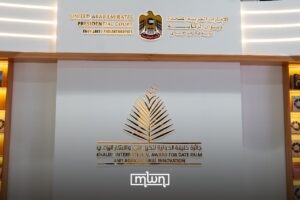
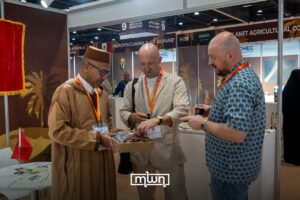
Abu Dhabi – Professor Abdelouahab Zaid, Secretary General of Khalifa International Award for Date Palm and Agricultural Innovation (KIADPAI), expressed gratitude for Morocco’s participation in the 11th Abu Dhabi Date Palm Exhibition during an exclusive interview with Morocco World News (MWN).
“On behalf of Khalifa International Award for Date Palm and Agricultural Innovation, I would like to thank you for your presence here in Abu Dhabi and in having you here taking care of the whole participation of more than 20 countries represented by 90 pavilions,” Zaid told MWN at the exhibition, which runs from October 21-23, at ADNEC Centre Abu Dhabi.
Zaid noted the exhibition’s significance as part of a larger tradition. “This is the number 14 event. Before it, in Abu Dhabi, we had seven or eight other events, which means more than 20 festivals and date palm festivals have been organized in the UAE. This is why the UAE is considered the premier center of the date industry in the world.”
The exhibition opened under the patronage of Sheikh Mansour bin Zayed Al Nahyan, Vice President, Deputy Prime Minister, and Chairman of the Presidential Court, bringing together exhibitors from 18 countries as part of Abu Dhabi’s Global Food Week.
“Among our activities, we also organize festivals in about 10 countries. So far, we have organized 63 festivals in Egypt, in Jordan, in Mauritania,” Zaid continued, detailing the award’s extensive international footprint.
He spoke warmly of the longstanding collaboration with Morocco. “We’ve assisted with the Erfoud festival since 2010, which was inaugurated by His Majesty the King, God protect him, in 2011,” he said.
“We’ll be participating in its 14th session at the end of October, where the UAE’s participation has been recognized as number one since the event’s establishment.”
On the ground in Morocco, KIADPAI lists and supports the Erfoud Date Palm Festival (Erfoud/Errachidia) every October; Morocco also runs the Salon International des Dattes (SIDATTES) in Erfoud with thousands of trade visitors, with the next edition scheduled for October 29 to November 2.
International cooperation drives agricultural innovation forward
A Moroccan agronomist who holds degrees from the Hassan II Agronomic and Veterinary Institute and a PhD from Colorado State University, Zaid has served as Secretary General of KIADPAI since its launch in 2007.
Over his distinguished career, he has received six royal letters of recognition from King Mohammed VI – in 2004, 2011, 2015, 2021, 2022, and 2024 – honoring his continuous efforts to advance agricultural innovation and the date palm sector.
In 2019, he was awarded the UN Food and Agriculture Organization’s (FAO) Gold Medal for his outstanding contributions to date palm development across the Arab world.
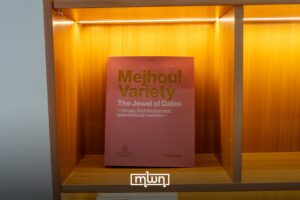
Among his most celebrated works is “Mejhoul Variety: The Jewel of Dates,” originally published in English and later translated into Arabic, French, Spanish, and Indonesian.
The exhibition showcases the latest innovations and technologies aimed at ensuring sustainability in the date sector, with participants including the UAE, Jordan, Mexico, Egypt, Morocco, Mauritania, Palestine, Eritrea, Ethiopia, Indonesia, Iraq, Libya, Syria, Tunisia, Turkiye, Pakistan, Saudi Arabia, and Algeria.
“Since 1998, Khalifa International Award has organized the international date palm conference, which is attended by an average of 450 to 500 scientists from around the world coming from an average of 50 countries,” Zaid explained.
“Next year, in April 2026, we will be organizing the eighth international date palm conference. Again, it will be attended by more than 500 scientists and date growers from all around the world.”
The conference will include participation from agricultural ministers. “We will have honorable excellency ministers of agriculture from the date producing countries, an average of 10 to 12 ministers who attend every four years,” Zaid said.
He mentioned a special focus on a major threat to date palms. “We will also have, among the sessions of that international conference, the first international conference on the red palm weevil. All these activities will be in four days from 26 to 29 April 2026. This is an open invitation for you and other colleagues from Morocco.”
The KIADPAI has grown into a comprehensive ecosystem supporting research, technology, production, value chains, and sustainability. The award distributes substantial prize money, with total awards reaching AED 3.5 million ($952,000) in 2021 across multiple categories.
Scientific exchange benefits farming communities across borders
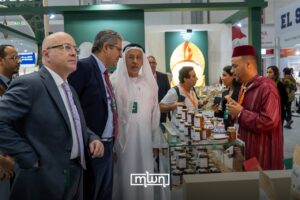
Discussing current participation, Zaid said, “There are more than 90 pavilions representing about 20 countries. We can cite a few of them: the Arab Republic of Egypt, the Kingdom of Jordan, and the Islamic Republic of Mauritania. We do have Moroccan date growers from the Boudnib area, but also small-scale farmers who are participating.”
“Besides that, we have people from Pakistan, from Sudan before the war, from Mexico, so we are having about 10 countries. Next year, we will probably have two more countries, which are Iraq and Syria. As you can see, the Khalifa Award is expanding all around the world,” he added.
Across North Africa, date harvests typically take place between September and April, varying by zone and climate. Demand is highly price-sensitive in Morocco, with consumption peaking in the weeks leading up to Ramadan. The country’s import mix is dominated by Deglet Nour varieties from Tunisia and Algeria, complemented by premium Mejhoul dates.
Egypt has meanwhile consistently ranked as the world’s leading producer of dates, followed by Saudi Arabia and Algeria, with Iran, Iraq, Pakistan, Oman, Tunisia, and the UAE also among the top producers.
Recent consolidated datasets estimate production at approximately 1.7-1.9 million tons for Egypt, 1.6-1.9 million tons for Saudi Arabia, and 1.3 million tons for Algeria.
In terms of exports and trade value, Saudi Arabia reported SAR 1.695 billion ($452 million) in date exports in 2024, marking a 15.9% year-on-year increase. Tunisia, led by its Deglet Nour variety, exported roughly 140,000 tons in 2023/24, with export revenues rising from around $150 million in 2007/08 to nearly $290 million in 2023/24.
Morocco remains among Tunisia’s key destination markets. Meanwhile, the UAE serves as a global processing and re-export hub through Al Foah, which integrates over 24,000 farmers and handles about 113,000 tons annually – approximately 90% of which is exported to more than 48 countries.
The North African kingdom’s participation also aligns with its ambitious plans under Generation Green 2020-2030, which aims to plant 5 million additional date palms by 2030.
Officials report that over 3 million have already been planted as of 2025, with the country currently producing approximately 115,000 tons annually (2023/24 estimate) across 48-51,000 hectares containing 4.8-6.6 million palms. Mejhoul, a Moroccan landrace, and Boufeggous dominate new plantings.
Professor Zaid has been instrumental in fostering international cooperation in the date industry. Beyond the award, he has pushed for multi-country structures like the proposed International Authority for Oases Sustainable Development, launched with support from date-producing countries, including formal backing from the UAE and Morocco.
The initiative directly addresses Morocco’s priorities for oasis systems facing water stress, pest pressure, and employment challenges.
Bayoud disease (Fusarium oxysporum f. sp. albedinis) remains Morocco’s existential constraint – research shows historic devastation and ongoing genetic work to understand resistance.
A 2025 study notes Bayoud was historically responsible for very large losses of Moroccan palms and remains a threat; active programs target resistant selections (e.g., Nejda) and integrated management.
In 2024, KIADPAI signed an MoU with the Crop Trust to design a global strategy for conserving date-palm diversity – important for Bayoud resilience and climate adaptation across Maghreb/Mashreq.
Knowledge transfer promotes resilience in arid landscapes
The Abu Dhabi Date Palm Exhibition serves as a vital component of Global Food Week, which brings together experts, innovators, and decision-makers to address challenges in food security, agriculture, and sustainability.
This year’s Global Food Week has expanded significantly, with the exhibition area increasing by 15% to 33,542 square meters and participation growing to 2,070 companies and brands from 75 countries.
The exhibition provides opportunities for exhibitors to display products, exchange expertise, and strengthen their presence in global markets. It has helped boost the quality, reputation, and global demand for date products.
Moroccan excellence has been recognized through the award previously. Africa Organics from Morocco received recognition in 2024 under the “Pioneering Development & Productive Projects” category for what was described as the world’s largest organic date-palm plantation of approximately 1,200 hectares.
“The Khalifa Award is expanding all around the world, and for sure we will have another opportunity to talk about the achievement of such an event,” Zaid concluded, looking toward future collaboration between the UAE and Morocco in developing the date palm sector.
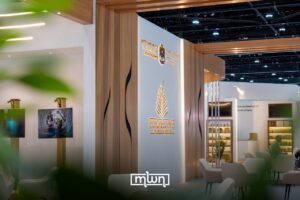
The KIADPAI has made remarkable progress in promoting the date palm sector nationally, regionally, and internationally. Over the past decade, the Abu Dhabi Date Palm Exhibition has established itself as a leading platform for producers, manufacturers, and exporters of dates, helping boost quality, reputation, and global demand for date products.
As Morocco works toward its goal of producing 300,000 tons of dates annually by the end of this decade, the connections fostered through events like the Abu Dhabi Date Palm Exhibition provide valuable opportunities for knowledge exchange, technology transfer, and market access.