
























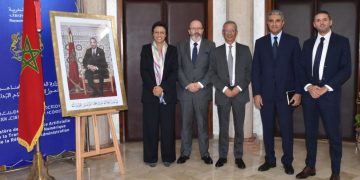








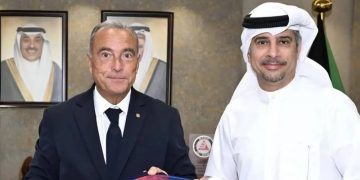


Marrakech – Morocco’s ambassador to the United States, Youssef Amrani, delivered a detailed assessment of the Western Sahara file to American academics in Washington on Wednesday, telling scholars from three of the capital’s leading institutions – Georgetown, Johns Hopkins, and American University – that the recent Russian veto at the Security Council had reshaped the mechanics of the dispute without reversing its direction.
The exchange was at once retrospective and forward-looking. It traced the diplomatic shifts surrounding the regional dispute while situating them within the broader Morocco-US strategic partnership and the major structuring projects defining the Morocco of tomorrow.
Amrani opened with the immediate consequences of the veto, which blocked the draft resolution introduced by the American penholder and brought about the non-renewal of MINURSO’s mandate. Even so, he argued, “the dynamic set in motion toward a settlement of this regional dispute continues in respect of the kingdom’s sovereignty and its territorial integrity.”
For the ambassador, the lapse of the mission marked a deliberate turning point rather than a setback. He characterized the moment as “the closing of a 35-year-old chapter,” one that embodied “the exhaustion of a framework that had become ill-suited to current political and diplomatic realities,” while “opening the way to an important evolution in the handling of the file.”
The arithmetic, in his reading, pointed unmistakably in one direction. Amrani noted that eleven members of the Security Council had backed the American draft, a tally reinforced by the support of more than two-thirds of UN member states for autonomy under Moroccan sovereignty.
That alignment, he contended, “attests to a growing international convergence around a fundamental principle.” Autonomy under Moroccan sovereignty, in his words, “constitutes the most achievable solution to this dispute,” and the Moroccan Autonomy Plan “must serve as the exclusive basis for any continuation of negotiations.”
The veto, he maintained, altered none of that substance. It “cannot erase the diplomatic advances achieved,” nor “call into question the political scope of the principles anchored by the Security Council in its Resolution 2797,” and still more firmly in the draft resolution tabled this year.
Amrani then placed the kingdom’s posture within a defined chain of direction. “Under the leadership of His Majesty King Mohammed VI, Morocco approaches this new sequence with serenity and determination,” he told the gathering, citing the strategic orientations fixed by the Royal Cabinet communiqué of October 30 and the working session the sovereign chaired on November 4.
The stage ahead, he added, continues the royal orientations aimed at “preserving the kingdom’s territorial integrity, guaranteeing security, and pursuing the major structuring development projects in our southern provinces.”
He was categorical that the mission’s departure carried no security cost. The end of MINURSO, he observed, “in no way signifies the end of the kingdom’s commitment to peace and to the maintenance of the ceasefire, to which we remain firmly and responsibly attached.”
The humanitarian dimension drew his most pointed language. The American draft, the envoy noted, carried the added merit of placing the Tindouf camps “at the heart of international concerns” – a protracted reality marked, in his telling, by “prolonged displacement and a continuous deterioration of humanitarian conditions,” which it was “neither reasonable nor responsible to allow to persist.”
He pressed further: “human dignity cannot remain hostage to the political whims of certain well-known parties,” and any definitive settlement must come with “concrete prospects allowing these populations to emerge from decades of precarity and uncertainty.”
Beyond the Sahara, the ambassador cast the Morocco-US relationship as a centuries-old tie that had weathered successive regional and international upheavals to mature into a genuine alliance – an evolution he attributed to the leadership of King Mohammed VI and President Donald Trump. The partnership, he put it, “rests on a foundation of shared values, interests, and visions.”
In Rabat, Washington reaffirms its recognition
Amrani’s Washington briefing landed only days after the same message was carried directly to Rabat. On Tuesday, November 17, the US permanent representative to the United Nations, Mike Waltz, reaffirmed Washington’s recognition of Moroccan sovereignty over the Sahara and its support for the Autonomy Plan as the sole solution. “The United States recognizes Morocco’s sovereignty over Western Sahara,” Waltz declared at a joint press conference with Foreign Minister Nasser Bourita.
Waltz retraced the sequence that led to the Security Council deadlock. Earlier talks driven by Washington, he recalled, had produced “significant progress with senior officials from Morocco, Algeria, Mauritania, and the Polisario” across several rounds in Madrid and Washington, covering autonomy, resources, the transition period, and the other questions requiring resolution.
That groundwork, he explained, underpinned the October draft resolution built on the Moroccan proposal as the only basis for negotiation. The text drew eleven votes before being struck down by a veto he did not attribute by name.
The lapse of the UN framework, in his account, did not close the political process. “We remain firmly determined; this process has taken a new form,” Waltz noted, adding that the United States would continue working with all parties toward a solution – effectively signaling that the effort would now proceed under direct American conduct.
He credited Rabat with restraint and called on the Polisario “to respect the ceasefire and to express its commitment to peace,” framing the moment as one “for calm and diplomacy.” Drawing on his military background, he warned that a return to combat “would wipe out the gains and condemn further generations to death and ruin.” On the humanitarian file, he echoed Trump’s position that “the status quo is unacceptable,” describing conditions in the Tindouf camps in Algeria as “truly inhumane.”
Bourita set the dispute against what he described as a divide between “two schools” – those seeking to resolve the conflict and ease its humanitarian and economic costs, and those determined to freeze the status quo. The only basis, he affirmed, “is the autonomy initiative presented by Morocco, and the only horizon is an autonomy that respects Moroccan sovereignty and the territorial integrity of the Kingdom of Morocco.”
He situated the file within an alliance of shared values and converging visions, pointing to the July exchange of messages between the two heads of state that now serves as a roadmap spanning military industries, advanced technologies, minerals, artificial intelligence, and energy.
He recalled that the free-trade agreement had multiplied bilateral trade sevenfold since 2004, that 150 American firms operate in Morocco, and that the kingdom – a major non-NATO ally since 2004 – co-founded and contributes to the Trump-led peace council effort in Gaza, with the next African Lion exercise set for May.
MINURSO withdraws as pressure on the Polisario builds
The diplomacy unfolded as MINURSO’s withdrawal was already underway. The mission began leaving the Sahara on Monday, November 16, with an initial contingent departing from Laayoune’s Hassan I Airport, supported by an Interior Ministry coordination office created on royal instructions on November 4. Alexander Ivanko, the Russian official tasked by Secretary-General António Guterres with overseeing the liquidation, met Waltz in Rabat.
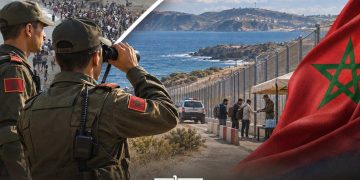
The drawdown – covering the repatriation of roughly 160 military observers, 158 unarmed personnel by the US Mission’s count, and the closure of 13 installations and sites, including Bir Lahlou and seven within the buffer zone – is to conclude by January 31, 2027. The end of the mandate retires the referendum option embedded in the mission’s very name, leaving no international body to verify the ceasefire across a buffer zone of some 53,000 km² and placing the imperative of securing it on Morocco.
The reconfiguration carries added weight for the separatist movement, which issued a general call for “armed struggle” on November 10. The quadripartite rounds held early this year reviewed an updated Moroccan plan of roughly forty pages, built on the initiative deposited on April 11, 2007, and a draft framework accord addressing a transition phase, resource governance, amnesty, disarmament and demobilization, international guarantees, and electoral systems.
The Polisario’s standing, meanwhile, is the subject of bipartisan bills in the US Congress – advanced by Joe Wilson and Jimmy Panetta (H.R. 4119), and Josh Gottheimer (H.R. 9982) – seeking to designate it a terrorist organization; the texts have been referred to committee and could face hearings after the November 3 midterms.
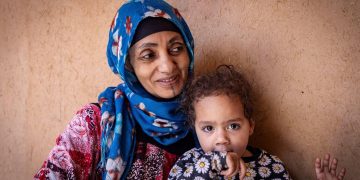
The humanitarian backdrop remains severe: before the Security Council on September 25, the UN refugee chief described a situation marked by anemia, malnutrition, and stunting among children, with food insecurity affecting 80% of the camp population.
A defense industry to anchor Moroccan sovereignty
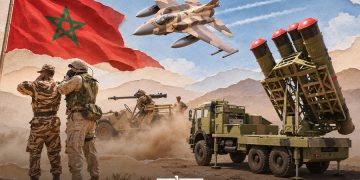
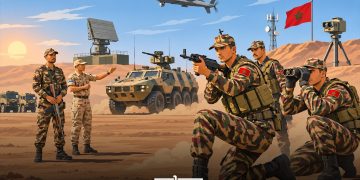
That trajectory converges with the defensive and industrial ambitions Amrani invoked in Washington. On November 18, King Mohammed VI – accompanied by Crown Prince Moulay El Hassan – chaired a working session presenting the “Offre Maroc” (Morocco Offer) and the roadmap for the national defense and security industry, an extension of the royal orientations to build a defense industrial and technological base consolidating the country’s defensive sovereignty.
The roadmap targets priority sectors oriented toward future technologies – drones and autonomous systems, land and naval systems, defense electronics, cyberdefense, and artificial intelligence – governed through a dedicated strategic agency and an industrial holding, with new large-scale zones at Benguerir and Benslimane alongside two existing acceleration zones.
It is projected to create close to 50,000 direct and indirect jobs by 2035, to cover roughly 40% of the needs of the Royal Armed Forces (FAR) and security services, and to draw more than 65% of its revenue from exports.
The King instructed that the Hassan II Fund for Economic and Social Development contribute MAD 4 billion ($400 million) toward the rollout, which proceeded in the presence of Head of Government Fatima Ezzahra El Mansouri, Royal Adviser Fouad Ali El Himma, Industry Minister Ryad Mezzour, Minister Delegate for the National Defense Administration Abdeltif Loudyi, FAR Inspector General Mohammed Berrid, and AMDIE Director General Ali Seddiki.