 Join on WhatsApp
 Join on Telegram
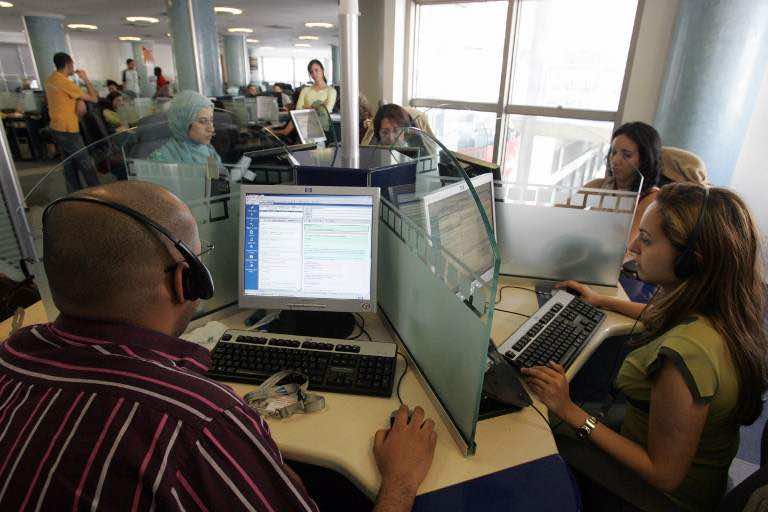
Rabat – Nine hours of work each day, a small workspace, waiting for the manager’s approval to go to the toilet, and an incredible level of stress: Call centers in Morocco have long been decried for their poor working conditions.
Most call centers in Morocco manage customer relations for companies with a large French-speaking customer base, such as telecommunications, insurance, and delivery companies.
Operating a customer service center in a developing country like Morocco is much less expensive than operating in France, Belgium, Switzerland, or Quebec, where the minimum wage is three times higher. Thirty-five percent of the Moroccan population speaks French, and the country is a favorite choice of multinationals seeking customer loyalty at a low cost.
According to the latest annual report from the National Telecommunications Regulatory Agency (ANRT), there were 638 call centers in Morocco as of December 2017, double the number of call centers in 2008.
New call centers continue to appear in major cities including Casablanca, Rabat, Sale, Fez, and Marrakech. The centers mostly recruit employees under 30 who have either failed to find a job in their field of study or are in persistent need of income so as not to burden their family.
You may find employees consuming painkillers in any call center in Morocco, struggling to cope with the daily stress of receiving continuous calls from unsatisfied customers, and pressure from managers who urge employees to receive positive feedback with no excuse.
Morocco’s COVID-19 response is strong but not equitable
Morocco’s government reacted quickly to prevent an outbreak of the novel coronavirus, imposing bold measures that young generations are witnessing for the first time. The virus has infected 170 patients in Morocco as of today, March 24, including four fatalities.
Moroccan authorities and concerned institutions canceled several flagship events, including the national football league and the International Agricultural Exhibition in Meknes, and suspended all international flights. The kingdom’s government continues to impose new measures that directly concern day-to-day life for the public.
On March 14, the Ministry of Interior banned all public gatherings over 50 people, and ordered the closure of public establishments including restaurants and coffee shops until further notice.
On March 16, the Academic Authority for Fatwa in the Supreme Scientific Council announced its decision to close all mosques throughout the country.
On March 18, Morocco’s General Delegation for Prison Administration and Reintegration (DGAPR) announced new measures aimed at preventing the spread of COVID-19, reducing the number of visitors to each detainee to one per month.
Much of the public has reacted positively to preventive measures, praising the government on social media.
Despite the praise, not every segment of the population is satisfied and protected. Precautionary measures do not apply to all Moroccans, including the vast majority of call center employees.
Each time the government issues a law to tackle the virus, the risk continues to grow among employees of these profitable institutions.
Call centers present fertile ground for the virus to spread
In a call center building, the work space of one single activity, known as the production stage, could host over 150 people. Employees share desktops and turn the same door handles.
Employees gather at lunch in a common space. They use the same microwaves, toilets, seats and tables.
As a former four-year call center employee, knowing the structure of the work space, I cannot imagine how decision-makers still allow such practices. In a global health crisis, health should be priority number one.
If 170 cases spread through Morocco’s open streets since March 2, I can’t help but wonder how many cases we should expect from call centers, in light of difficult working conditions.

With a quarantine imposed in France, more individuals are online than ever before. Some will inevitably call customer service for remote advice on how to fix their network or software issues.
Moroccan youth who work for a living will have to risk catching COVID-19 to serve the needs of customers with trouble watching Netflix or playing video games.
“Me and my wife both work in call centers to provide a decent life for us and my parents who live with us in the same house. My father’s immune system is too weak because of his history with cancer, and my mother suffers asthma,” a call center employee named Anisse told Morocco World News (MWN).
“I can’t even buy a bottle of water from the vending machine because I know how many hands touch it in one day,” Anisse added.
“I feel like we risk our lives daily, as well as our parents’, to serve the needs of a French customer who has trouble running a video game,” the 32-year-old employee added, referring to his task as a technical service assistant.
Employees wait for authorities to respond
Authorities visited a call center in the city of Temara, near Rabat, on March 20. “Without even investigating the workspace, they gave their approval for the center to keep running during these sensitive times,” a call center employee who wished to remain anonymous told MWN.
“Our general director then sent us a memo on March 19, in which she informed us that the caid inspected our working conditions, judged them as suitable, and that there are no infections in the city of Temara.” Temara had confirmed two cases at that point, the anonymous employee reported.
“With many common spaces in our site, I feel it’s impossible not to get infected, especially that I have colleagues coming from 5 different cities, and use the company’s common transport,” the 27-year old employee added.
In a more ironic memo, “our general director informed us that customers are happy with the job and the sacrifice we’re making.”
I remember joking about our working conditions, finding escape in humor. We used to call ourselves call center prisoners.
Employees wear numbered badges, take lunch breaks following a fixed schedule, and ask for managerial approval for bathroom and water breaks because the companies prioritize customer complaints over employee needs.
The Moroccan government was thoughtful to take preventive measures to protect prisoners, given that crowded spaces are likely to serve as a fertile zone for the virus to spread.
Call centers offer thousands of jobs to Moroccan people who would protest unemployment if these institutions didn’t exist. Employment is valuable, but the government’s lack of safety measures in call centers is irresponsible.
All lives are equal, including the lives of Morocco’s youth. The government fears that these institutions may go bankrupt as a result of this crisis, and their priorities prove that the life of a call center employee is worth less than the life of a prisoner.
Read also: Morocco Should Repatriate its Citizens Stuck Abroad