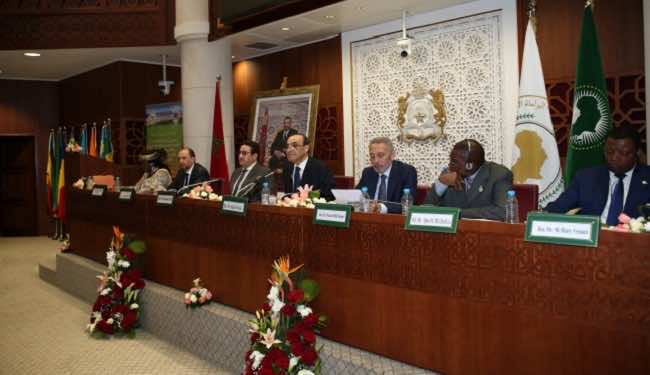
Rabat – Africa must accelerate the pace of its economic integration around structured regroupings, stressed the President of Morocco’s House of Representatives, Habib El Malki.
“We must work in a progressive way on making the African continental free trade area a tangible reality serving the people of the continent,” said El Malki during a meeting of the trade and transport committees at the Pan-African Parliament.
The meeting took place on Monday, March 2, in Rabat.
In light of the ongoing health crisis and its economic and social repercussions in many African countries, it is necessary to evaluate the new legislation of free trade between the North and the South, said the Moroccan politician.
Africa has varied resources, wealth, and products. However, its situation and yield remain very modest compared to the results of other free trade areas, outlined El Malki.
Since the beginning of the new century, Pan-African trade has increased by only 12.5%, he revealed.
“If the strategy of the African free trade area had been carried out as expected, according to the study approved by the UN Conference on Trade and Development, the continent would have reached 33% of trade between African countries,” commented El Malki.
However, the rate remains “very realistic” and attainable, he encouraged.
“Africa needs a new political and economic elite that promotes the change of dominant mentalities and advances the fields of education, training, universities, and scientific research,” suggested the Speaker.
The new leadership should also put an end to the deficiencies “plaguing” African infrastructure, including ports, airports, roads, railways, renewable energies, and communication technologies, he continued.
During the same meeting, the vice-president of Morocco’s House of Councillors, Abdessamad Kayouh, underlined the importance of the event, hosted for the first time by the Moroccan Parliament.
Morocco is making continuous efforts to achieve the economic integration of Africa, strengthen bilateral relations with African countries, and accelerate the continental development, assured the official.
The meeting provided an opportunity for cooperation between the Moroccan Parliament and the Pan-African Parliament, said Kayouh, underlining the exchange of experiences in several fields, notably the institutional, logistical, and technological issues related to commerce and the digital economy.
The event was also an opportunity for private sector actors to encourage trade between African countries, he continued.
According to Kayouh, the participating committees will help achieve the objectives of the UN’s 2030 sustainable development plan and the goals of the 2063 African Union Agenda.
African parliamentarians face numerous challenges, such as the harmonization of national laws with the Kigali Agreement for the establishment of the African free trade area and its accompanying protocols, he said.
Another challenge is the lack of coordination between government sectors to ensure the coherence of trade, financial, and customs policies between African countries, Kayouh added.
The African free trade agreement requires the implementation of several legislative, institutional, procedural, and logistical measures, especially amid the strong tension and competition between global economic poles, he stressed.
Meanwhile, the second vice-president of the Pan-African Parliament, Haïdara Aissata Cissé, underlined the role played by the parliament to encourage African trade, estimating that commercial exchange between African countries represents only 15% of the countries’ global trade.
The meeting was an opportunity to highlight the efforts made by Morocco to put in place the appropriate conditions for promoting Pan-African trade, said Cissé, stressing that the Kingdom plays a major role in African development in several fields, as reflected in the volume of its trade with Africa.
The event brought together more than 30 delegates and MPs from all over Africa.