


























































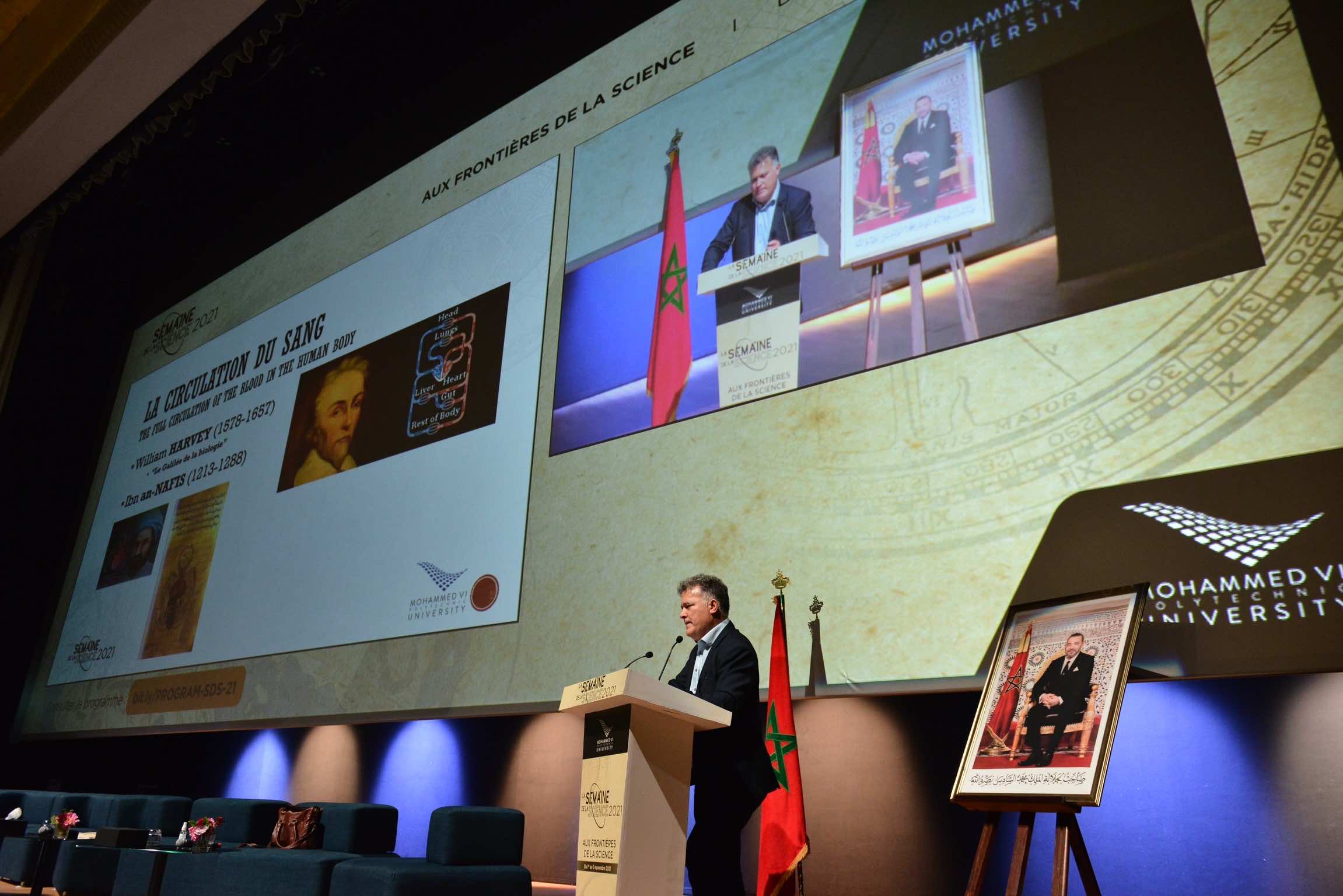
Rabat – Mohammed VI Polytechnic University (UM6P) hosed today, on Thursday, academic conference themed “Where do we stand on scientific thought in Islam?” The initiative comes as part of the university’s “Science Week” event held between November 1 to 5 in Benguerir.
The colloquium provided attendees and students with engaging discussions about several scientific approaches from Islam’s perspective to tackle the ambiguities surrounding religion and science.
Fouad Laroui, Moroccan writer and professor at the University of Amsterdam hosted the conference alongside three speakers: the General Secretary of the Mohammadia League of Scholars Ahmed Abbadi, engineer and Youtuber Najib El Mokhtari, and Cadi Ayad University Professor Mohamed Maouhoub.
During the conference, Laroui asked the speakers a crucial question he often receives from students, which is how to consolidate between science and their faith when there are a lot of contradictions between religions and philosophical theories.
To reach a common ground, speakers agreed that when there is an apparent contradiction between science and the teachings of the Quran, answers can be found through seeking knowledge and searching for the accurate interpretation that matches the scientific concept in question.
Despite some may argue that the two concepts – religion and science – are entirely separate, Laroui stressed that “when we make interpretation efforts to understand the hidden meaning in the Quran, we can accept science.”
When asked if science is thought before it is practiced or the other way around, Laroui said that many scientific students practice science without questioning themselves what exactly science is, the essence of the field, or how to seek knowledge properly.
“We have brilliant STEM students at UM6P and we are considering teaching epistemology to avoid meeting dead ends in scientific practices in the future,” he added.
In response to the same question, Professor Maouhoub referred to Martin Heidegger’s famous phrase “science does not think” from his book “what is called thinking?,” Maouhoub emphasized the importance of reflection to reach scientific goals through the power of technology.
As teaching has experienced several mutations, especially in the last 18 months since the lockdown and the ongoing COVID-19 crisis, professors experienced different types of teaching, ranging from in-person, to online classes, and hybrid mode.
Teaching “Generation Z” the fundamentals of science seems to raise a concern among teaching professionals as they are still exploring different ways that would fit youth better.
To understand the art of communication and the new era of science, speakers called on the importance of adapting new tools of analysis and interrogation to help generations assimilate scientific concepts and further understand how modern science should be treated in contemporary Islamic thought.
The Science Week program aims to acquaint the students with the latest scientific advances in their respective fields and prepare them for world-class, practical, and socially relevant research while highlighting the greatest scientific contributions and advances of Arab and Islamic scientists.