 Join on WhatsApp
 Join on Telegram
Doha – Who doesn’t know the names of Mohammed Ben Abdelkrim El Khattabi, Assou Oubasslam, Ahmed al-Hiba Ma al-’Aynayn, and Ahmed El Hansali?
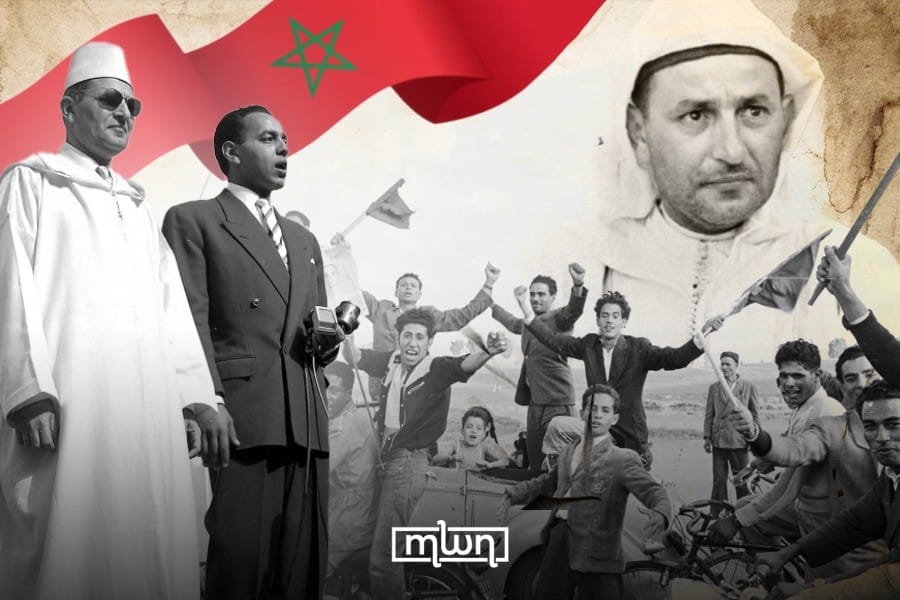
Sixty-nine years after gaining independence from French and Spanish colonial rule, Moroccans continue to commemorate the sacrifices of these resistance fighters who led the struggle against foreign occupation that lasted 44 years.
The path to independence wasn’t easy, as Morocco faced a unique colonial situation unlike its North African neighbors.
Unlike Algeria, Tunisia, and Libya, Morocco was divided under a tripartite colonial system. This consisted of a French zone considered the central authority, a Spanish protectorate, and an international zone in Tangier. This complex colonial structure required a multifaceted resistance approach, combining armed struggle with political negotiation.
Armed resistance: first phase (1912-1934)
The initial phase of armed resistance began immediately after the signing of the Treaty of Fez on March 30, 1912. This treaty, signed between the French government and Sultan Abdelhafid, placed Morocco under French protection and effectively divided the country into different zones of influence.
The Moroccan resistance launched several significant battles across the country. In 1907, the Chaouia tribes rose up against foreign presence. In 1912, Fez witnessed what became known as the “Bloody Days of Fez.” The Middle Atlas region saw some of the most violent confrontations in 1913. In Tafilalet, the resistance successfully repelled French forces in 1930.
Notable resistance movements emerged across different regions. In the Rif, Mohammed Ben Abdelkrim El Khattabi led the revolution against colonial forces until 1926. The Anti-Atlas region witnessed resistance led by Assou Oubasslam, while the southern and Saharan regions saw Ahmed al-Hiba Ma al-’Aynayn leading the struggle.
Historical records indicate that the military occupation of Morocco cost the protectorate authorities 22 years of military operations due to the strength of Moroccan armed resistance. This resistance was particularly evident in decisive battles such as El Heri, Annual, and Bougafer, where Moroccan fighters demonstrated remarkable resilience against colonial forces.
Political resistance and national movement (1930-1944)
The year 1930 marked a pivotal moment in the resistance movement with the issuance of the “Dahir Berbère” (Berber Decree). This controversial decree attempted to separate Amazigh regions from being under Islamic law and having Arabic education, prompting widespread opposition that united various components of Moroccan society.
A French colonial administrator revealed the decree’s underlying strategy, stating, “It’s dangerous to leave a unified mass of Moroccans with one language and one system. We must apply the old motto ‘divide and rule.’” However, this attempt at division had the opposite effect, uniting the Moroccan people and strengthening their resolve for independence.
The political resistance phase officially began in 1927, though pockets of armed mountain resistance continued until 1934. The National Action Bloc developed a comprehensive reform program in 1934 called “The Moroccan Reform Program.” When France attempted to establish consultative councils in 1936, nationalist leaders unanimously rejected the proposal.
September of 1937 saw another key moment of Moroccan resistance with the Boufakrane incidents. After settlers attempted to deprive residents of river water access, widespread revolts erupted. This led to arrests and the exile of nationalist leaders like Allal El Fassi, while others like Mohamed Hassan El Ouazzani were placed under forced residence.
Another pivotal moment in the independence movement came with the Independence Manifesto presented to Mohammed V on January 11, 1944, after the Anfa Conference.
The document, submitted to both the Sultan and representatives of the United States and Britain, contained a strong condemnation of the protectorate system which had hindered Morocco’s progress over thirteen centuries of independence.
The manifesto highlighted Morocco’s role alongside the Allies in both World Wars, referenced Atlantic Charter principles, and emphasized Moroccans’ desire for liberation, independence, and democratic governance in line with their history and religion.
The document’s immediate impact unified the national struggle around the independence goal. The manifesto gained the King’s official approval and popular support petitions started flowing to the royal palace from across the country.
The path to independence (1944-1955)
The independence movement gained significant momentum after King Mohammed V’s historic visit to Tangier on April 9, 1947. During this visit, he affirmed Morocco’s commitment to territorial unity and identity, leading to increased pressure from colonial authorities.
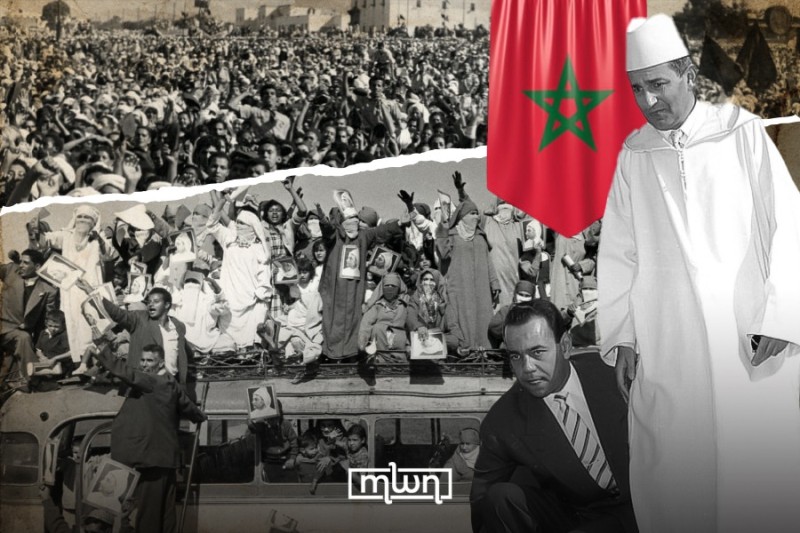
Following this visit, the protectorate authorities intensified their opposition, particularly as Mohammed V refused to yield to their pressure. His defiant stance ultimately led to his exile to Madagascar on August 20, 1953, along with the royal family, sparking what became known as the “King and People’s Revolution.”
This exile marked a turning point in the independence struggle, unifying the Moroccan people behind their legitimate sovereign. The revolution represented a unique moment of national cohesion, where both armed resistance and political activism intensified.
Secret organizations emerged targeting collaborators and colonial authorities, including the Black Crescent Organization. On October 2, 1955, the Liberation Army was established, conducting armed operations against French occupation across the country.
This new phase of the resistance movement combined political action with armed struggle. The national movement defended Morocco’s independence in international forums and garnered support from Arab and Asian nations. This international pressure, combined with France’s growing challenges in Algeria, led to negotiations that resulted in Mohammed V’s return and an agreement establishing Morocco’s sovereignty.
The Aix-les-Bains negotiations: a turning point
In August 1955, crucial negotiations took place in Aix-les-Bains, France, between French government officials and Moroccan political figures. These talks set the framework for ending the protectorate and shaping future Franco-Moroccan relations.
The French delegation, led by Prime Minister Edgar Faure, presented a united front. In contrast, the Moroccan delegation of 37 members included representatives from various political parties, notably the Istiqlal Party and the Shura and Istiqlal Party, along with influential figures close to the French administration.
Many observers and historians note that French authorities deliberately diluted the nationalist representation by including pro-French interests in the Moroccan delegation. This strategy aimed to ensure France could maintain its economic, cultural, and strategic interests in Morocco while relinquishing formal control.
The Liberation Army as well as the armed resistance movement viewed these negotiations with skepticism, considering them a potential betrayal of the independence struggle. From Cairo, resistance leader Mohammed Ben Abdelkrim El Khattabi warned against what he saw as a diplomatic trap similar to the Tunisian experience.
Despite these concerns, the negotiations led to the formation of a regency council and, ultimately, to Mohammed V’s return from exile on November 16, 1955. This paved the way for the formal independence agreement signed with France on March 2, 1956.
Independence date controversy: March 2 vs November 18
A significant historical debate surrounds Morocco’s independence day celebration. While the official annulment of the protectorate treaty occurred on March 2, 1956, Morocco currently celebrates independence today, on November 18.
During King Mohammed V’s reign (1956-1961), independence was celebrated on March 2, while November 18 marked Throne Day. The change occurred after King Hassan II’s ascension to the throne on March 3, 1961. Sources indicate this shift was due to the proximity of March 2 to Hassan II’s throne day, and the significance of November 18 as part of the “Three Glorious Days” (November 16-18) that marked Mohammed V’s return from exile.
This change has sparked historical debate. Some suggest this change was motivated by Hassan II’s desire to separate his throne day (March 3) from the independence celebrations, while maintaining the symbolic importance of his father’s reign.
Post-independence achievements and territorial unity
After gaining independence, Morocco entered a new era marked by Mohammed V’s famous declaration: “We have moved from the lesser jihad to the greater jihad.” The country embarked on various reforms across vital sectors to build a new Morocco and continue the process of territorial unification.
Under Hassan II’s reign, Morocco pursued the completion of its territorial integrity. The international status of Tangier was terminated in late October 1956, bringing the city under full Moroccan sovereignty. The country recovered Tarfaya in 1958 and Sidi Ifni on June 30, 1969. The southern provinces were later recovered through the Green March launched on November 6, 1975. The country then completed the liberation of its territories with the recovery of the Oued Eddahab region on August 14, 1979.
The country’s development continued under Mohammed VI’s leadership, with the implementation of major development projects and reforms across various sectors. These included the launch of the New Development Model and the solidification of social protection mechanisms, reflecting the monarchy’s attention to human development since his ascension to the throne.
The achievement of independence marked not just the end of colonial rule but the beginning of a new chapter in Morocco’s history, characterized by the ongoing pursuit of territorial integrity, economic development, and social progress.
Read also: France in Morocco: A History of Manipulation and Fake News