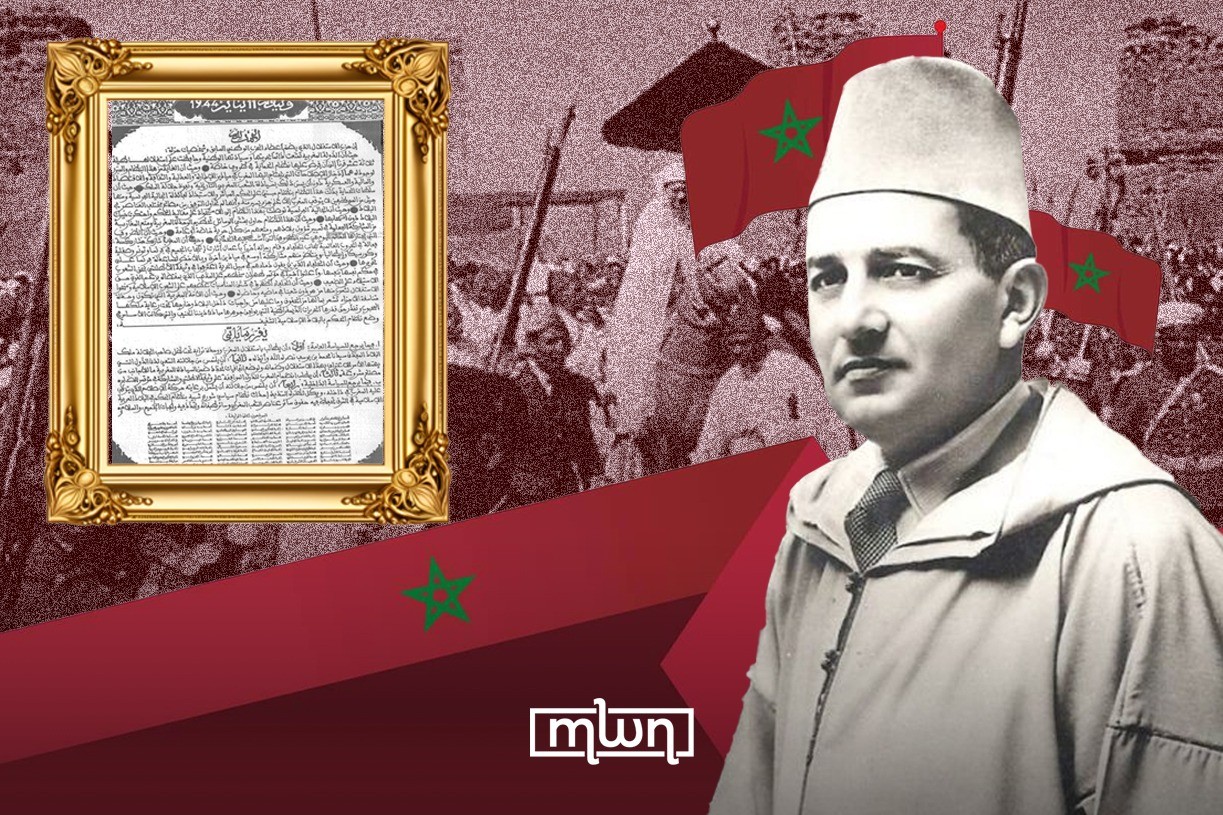
Doha – The battle for freedom began with a piece of paper that shook colonial foundations. January 11, 1944: Morocco’s Independence Manifesto landed on French authorities’ desks, marking what historians now call the turning point in North African colonial resistance.
Looking back 81 years later, this watershed document rewrote history – but the story behind it reveals an even more fascinating tale.
In 1944, Morocco was a nation carved up by colonial powers, with French controlling the center, Spain holding the north and south, and Tangier under international administration.
But beneath this fragmented surface, something revolutionary was brewing in secret midnight meetings at the Royal Palace.
“The time has come to demand independence, but it must be done under calm circumstances,” Sultan Mohammed V reportedly told national movement leaders in one of those clandestine gatherings.
These meetings, held in a special bunker built for protection against German air raids, saw the King and nationalist leaders swearing on the Quran to maintain secrecy and serve the nation.
The road to revolution
The manifesto didn’t appear out of thin air. The groundwork began with the massive uprising against the “discriminatory colonial decree” on May 16, 1930, which unified Moroccan resistance.
Then in 1934, reformists tested the waters with urgent demands for change, followed by more comprehensive reform requests in 1936.
That same year, the National Reform Party emerged in northern Morocco, followed by the National Action Bloc – both eventually banned by French authorities in March 1937.
By April 1937, the National Party formed to advance Moroccan demands, marking an escalation in organized resistance.
Here’s where it gets interesting: The independence ideal had been the secret oath of every nationalist group since the early days of colonial resistance. From traditional Zawiyas (religious brotherhoods) to modern political parties, independence remained the ultimate goal.
As one historical document notes, “Members secretly swore to work toward independence, even while publicly demanding reforms.”
External events accelerated independence demands. In 1941, the Allies published the Atlantic Charter, promising freedom to occupied nations and promoting Roosevelt’s principle of “people’s right to self-determination.”
The Moroccan National Movement seized this opportunity, sending telegrams to Allied nations demanding this principle be applied to Morocco.
Sultan Mohammed V played his diplomatic cards masterfully. After ascending to the throne on November 18, 1927, he consistently advocated for Morocco’s independence, defying colonial attempts to suppress Moroccan identity and sovereignty.
At the January 1943 Anfa Conference, while Allied leaders discussed war strategy, he reminded them of a pointed fact: Morocco had fought alongside them against Nazi Germany, so what about that independence they kept talking about? After all, wasn’t that what the war was supposedly about – freedom from foreign domination?
President Roosevelt’s response? He considered Morocco’s independence aspirations “reasonable and legitimate.”
Inside the manifesto
The document itself was revolutionary in both content and delivery. Its demands came in two parts, according to historical records.
First: “Complete independence under the leadership of His Majesty Sidi Mohammed Ben Youssef.”
Second: A sweeping vision for internal reforms, calling for “a consultative political system similar to those in Eastern Arab and Islamic countries.”
“The idea of independence shaped Morocco’s history since ancient times… In modern history, its aspiration for constitutional life took many forms. Modern parliamentary life had spread in major Western nations and America, then was adopted by some Eastern Islamic kingdoms. By the mid-nineteenth century, the call for democratic systems began taking various shapes,” writes historian Abdellah Hitout.
The nationalists strategically delivered copies not just to French authorities, but also to American and British consulates and Soviet representatives – a diplomatic masterstroke showing their global awareness.
The public response was electric. “By afternoon, the manifesto was being read aloud in public squares, markets, and mosques from Fes to Marrakech, from Tetouan to Tangier, from the Atlas Mountains to the Souss region,” historical accounts reveal.
People exchanged congratulations in Rabat, Salé, and Kenitra, while crowds gathered spontaneously across the country.
Beyond the document
What many don’t know: In the Spanish-controlled north, the National Reform Party took a bold step, forming a united front with the Moroccan Unity Party led by Mohammed al-Makki al-Nasiri.
This coalition, known as the National Front, formed on December 18, 1942. On February 11, 1943, they submitted their own independence manifesto, demanding “complete independence, territorial unity, and final abolition of the protectorate system.”
Three days later, they presented these demands to major power representatives in Tangier – technically making it the first international Moroccan independence demand.
The manifesto transformed Morocco’s resistance from reform-seeking to independence-demanding. “It reflected Moroccans’ awareness and maturity,” contemporary documents state, “proving their ability to determine their destiny and manage their affairs.”
The French response was swift and harsh – by January 28, 1944, French authorities arrested and exiled numerous nationalist leaders. This crackdown culminated in the events of January 29-31, 1944, when widespread protests erupted across Morocco.
The struggle intensified through the following years, leading to Sultan Mohammed V’s exile to Madagascar in 1953, which sparked increased resistance. The Sultan’s triumphant return in 1955 paved the way for negotiations that finally secured Morocco’s independence on March 2, 1956.
Today, 81 years later, that single document’s impact continues echoing through Morocco’s diplomatic achievements, territorial integrity efforts, and national identity. From a divided colony to an emerging regional power, Morocco’s journey began with those words penned in secret meetings, sworn to on the Quran, and delivered on a January morning that changed everything.
As Allal Al Fassi recalled after returning from exile: “Two days after my return from exile, His Majesty received me and spoke about the phase that followed the submission of the independence petition, and the tremendous efforts he had made.”
“He didn’t hide his readiness to sacrifice everything, even the throne, if it served the Moroccan cause. I left that audience completely certain that Morocco would achieve its goal as long as it had a great king like Sidi Mohammed at its helm.”
King Mohammed VI now continues the diplomatic vision his grandfather initiated. The anniversary now lands as Morocco’s racking up diplomatic wins on the Western Sahara front. The country now has 29 consulates in the southern provinces – 17 in Dakhla alone. The latest was Chad’s consulate, which opened on August 14, 2024.
Read also: From Armed Struggle to Political Resistance: Morocco Celebrates 69 Years of Independence