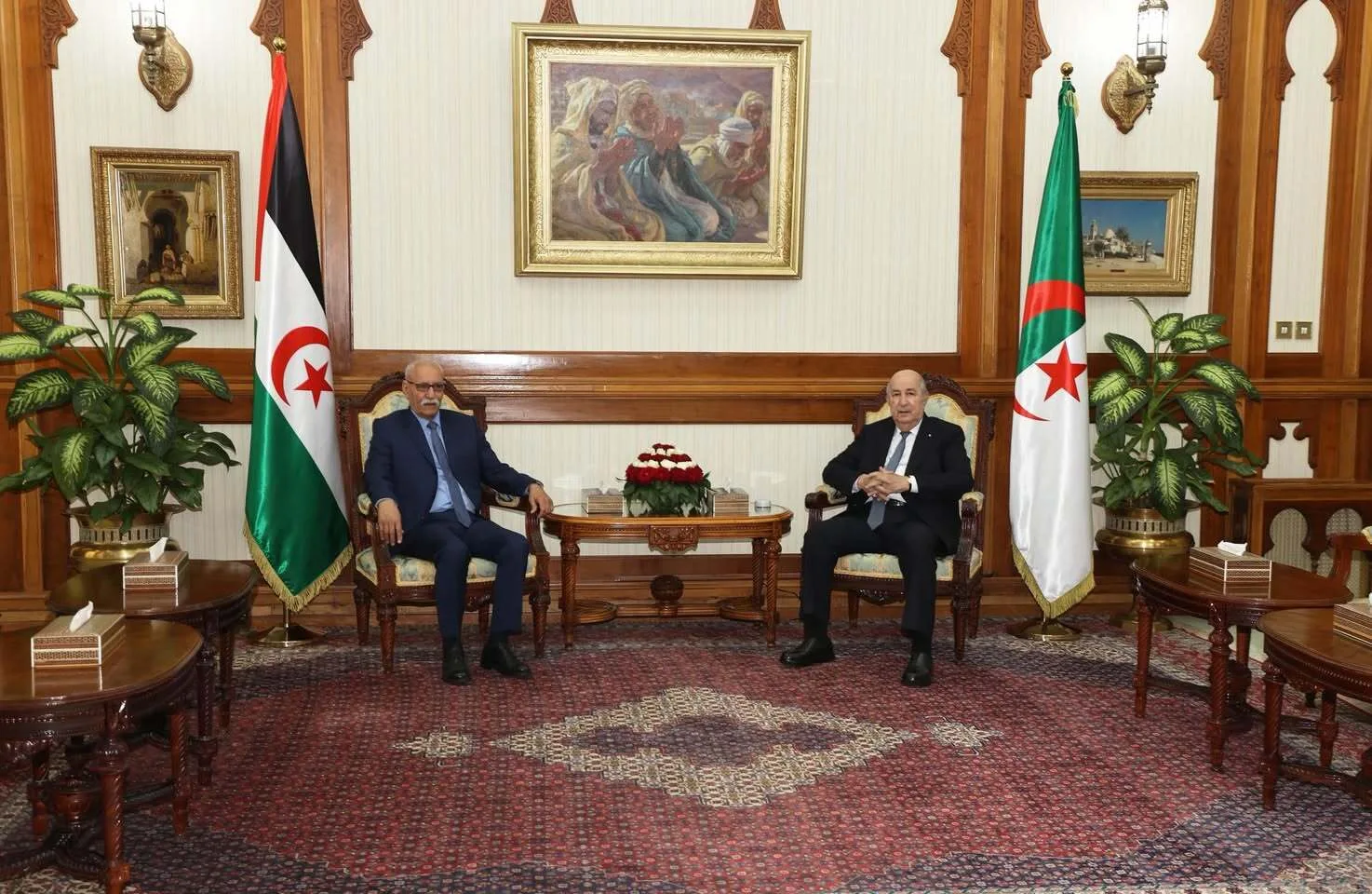
Doha – In a pitiful spectacle of diplomatic irrelevance, Algerian President Abdelmadjid Tebboune received the so-called “leader” of the Polisario Front, Brahim Ghali, at the presidential palace in Algiers on Wednesday.
This frivolous meeting, a tired ritual in Algeria’s obsessive anti-Morocco campaign, comes as international support for Morocco’s sovereignty over its southern provinces reaches unprecedented heights and Algeria’s isolation deepens to alarming levels.
Algeria, which hypocritically claims it is not party to the dispute, continues to arm the Polisario Front, as happened recently when the Algerian regime supplied four Fajr-54 combat drones, according to political analyst Oualid Kebir.
A meeting of phantoms: The April embarrassment
The theatrical reception, held without the customary presence of Algeria’s military strongman General Said Chengriha, was billed as discussing “relations between their two countries” – a delusional characterization that defies geopolitical reality. What “country” does Ghali represent? A fictitious entity that exists nowhere but in Algerian fantasies and dusty Cold War archives.
This performance of diplomatic make-believe occurred against the damning backdrop of recent United Nations scrutiny. Just days before in New York, UN officials summoned Polisario representatives to explain their attacks on MINURSO patrols and deliberate obstruction of UN logistics convoys east of the Sand Wall. The timing reveals the desperate nature of Algeria’s maneuver – a transparent attempt to salvage what remains of their crumbling anti-Morocco narrative.
Tellingly, this charade was staged precisely when Morocco demonstrated its genuine regional leadership. While King Mohammed VI hosted a substantive meeting with foreign ministers from Mali, Burkina Faso, and Niger in Rabat earlier this week, Tebboune was reduced to welcoming a figurehead who physically resides within Algeria itself. The juxtaposition lays bare an undeniable gulf.
The Sahel chooses Morocco while Algeria flounders
The regional dynamics have shifted seismically against Algeria’s interests. Mali, Burkina Faso, and Niger – once diplomatic partners of Algeria – have demonstratively pivoted toward Morocco. Their ministers expressed profound “appreciation for the King’s continuous interest in their region’s issues” and enthusiastically endorsed the visionary Atlantic Initiative that will provide these landlocked countries with coveted access to the Atlantic Ocean via Moroccan infrastructure.
This diplomatic realignment reached a critical juncture for Algeria in early April when these three Sahel states abruptly recalled their ambassadors from Algiers following the Algerian forces’ downing of a Malian drone near their shared border. The humiliating rebuke has left Algeria scrambling for relevance in a region it once considered its exclusive sphere of influence.
Meanwhile, Morocco’s Royal Atlantic Initiative continues gaining unstoppable momentum. The ambitious infrastructure project, officially announced by King Mohammed VI on November 6, 2023, will create a transformative economic corridor linking the new Dakhla Atlantique port complex to the Sahel via Mauritania. Unlike Algeria’s empty rhetoric, Morocco delivers tangible development that addresses the Sahel’s pressing economic needs.
From recognition to designation: Polisario’s terminal decline
As Algeria clings to its separatist proxy, influential voices in Washington are intensifying calls to designate the Polisario as a terrorist organization. Republican Congressman John Wilson, a member of the Congressional Foreign Relations Committee, recently reaffirmed America’s “unwavering commitment” to Morocco’s territorial integrity while emphasizing the Polisario’s troubling connections to terrorist networks and Iran’s subversive agenda in North Africa.
The evidence against the Polisario grows more incriminating by the day. American political actors increasingly recognize the Algeria-backed militia’s “suspicious ties with takfiri and jihadist groups in the Sahel” and coordination with Hezbollah and Iranian proxies – placing it in direct violation of international counter-terrorism frameworks.
A comprehensive analysis by the Hudson Institute published on April 18, authored by Zineb Riboua, has shattered the Polisario’s self-portrayal as a liberation movement, instead exposing it as “a destabilizing militia” deeply involved in arms smuggling, youth indoctrination, and “aligning itself with the strategic agendas of Iran, Russia, and China.”
The report meticulously documented how the Polisario conclusively meets all statutory criteria for designation as a Foreign Terrorist Organization under US law, revealing that it “receives drones from Iran’s Islamic Revolutionary Guard Corps through transfers facilitated by the Algerian regime” and “smuggles arms to jihadist insurgencies that threaten American forces across the Sahel.”
In his scathing analysis published by the Middle East Forum on April 7, Michael Rubin of the American Enterprise Institute challenged the separatist group’s legitimacy, asserting that “no one has ever elected them to such a position and no one has given the Sahrawi any say.”
This potential designation would utterly transform the Sahara conflict’s dynamics, forcing traditional Polisario enablers like Algeria and South Africa into the uncomfortable position of actively supporting a designated terrorist entity. The diplomatic fallout would be catastrophic for Algeria’s already tattered international standing.
The human toll: Algeria’s brutal treatment of Sahrawis
Perhaps most concerning is the deteriorating situation within the Tindouf camps themselves. According to the Sahrawi Association for the Defence of Human Rights (ASADEDH), Algerian army forces recently committed a cold-blooded “horrific massacre” against Sahrawi civilians in the “Arkoub” district of the Dakhla camp, killing two and wounding nine others, three critically.
The Algerian military “fired indiscriminately on unarmed Sahrawi civilians” approximately 150 kilometers from Rabouni, triggering widespread protests throughout the camps. Remarkably, the Polisario leadership maintained “suspicious silence” regarding these atrocities, further eroding what little credibility it retained among the camp population.
Ramadan Massoud Larbi, President of ASADEDH, described the Arkoub massacre as “a serious slide in the series of violations against Sahrawi civilians” and noted that Polisario’s failure to protect camp residents “undermines the remaining confidence of Sahrawis in those who claim to represent their only legitimate representative.”
Most telling of all, Larbi confirmed that “escalation of calls to return to Morocco reflects the deep shift in the convictions of a large group of Sahrawis, who now consider joining the motherland as the only way to end their suffering.”
In response, the Sahrawi Movement for Peace (MSP) issued an urgent letter to the United Nations and MINURSO, in which they excoriated Algeria’s “flagrant violations of the most fundamental human rights” and demanded immediate intervention to protect civilian refugees “held hostage” on Algerian territory.
Raw video footage captured enraged protesters confronting Algerian soldiers, with desperate refugees threatening to escape to Morocco while screaming, “Do you want us to go to Morocco? You’re killing our children here in cold blood.”
The MSP vehemently demands inclusion in the UN-led political process on Western Sahara, declaring itself the true voice for “an important part of the Sahrawi population that aspires to a negotiated political solution, away from the violent methods of the Polisario Front.”
The final gasp of a failed strategy
As Morocco continues securing international recognition for its sovereignty over the Sahara, Algeria’s desperate reception of Ghali resembles nothing so much as a drowning regime clutching at political straws.
Morocco’s Foreign Minister Nasser Bourita’s recent diplomatic blitzkrieg has cemented the kingdom’s dominance in the territorial dispute. His whirlwind mid-April tour across the United States, France, Spain, Croatia, Hungary, Moldova, Estonia, and Slovenia yielded an avalanche of explicit endorsements for Morocco’s autonomy plan as “the only realistic solution” to the regional dispute.
This relentless momentum has now secured backing from over 100 UN member states, including two permanent Security Council members (the United States and France), Spain (the former colonial power), and a staggering 23 European Union countries. As UN envoy de Mistura himself stated in April, the autonomy plan “remains the only viable path to a lasting and politically feasible resolution of the decades-running conflict.” This dramatic shift comes just six months after he had proposed partitioning the territory – a proposal now completely abandoned in favor of Morocco’s position.
The absurdity reaches tragicomic proportions when one considers that this “state reception” hosted someone who permanently resides in Algeria itself, under the direct supervision of Algerian security services. As one Algerian political analyst mockingly noted, “The ‘president of the Tindouf republic’ who declared war spends most of his time in his residence in the Algerian capital.”
While Morocco forges ahead with its development agenda for the Sahara — evidenced by the partnership between France’s Occitanie Region and Morocco’s Dakhla-Oued Ed-Dahab region and the construction of the massive Dakhla Atlantique port complex — Algeria remains imprisoned in a self-defeating paradigm of antagonism and obstruction.
The international community has rendered its verdict. Morocco’s proposal for autonomy under sovereignty has emerged as the only viable path forward. Algeria’s continued embrace of a phantom state leader merely underscores how thoroughly it has lost this decades-long contest. The question is no longer if, but when Algeria will finally acknowledge the geopolitical reality that the rest of the world has already recognized.
Read also: Tunisia Hosts Polisario in Fresh Affront to Morocco’s Sovereignty