 Join on WhatsApp
 Join on Telegram
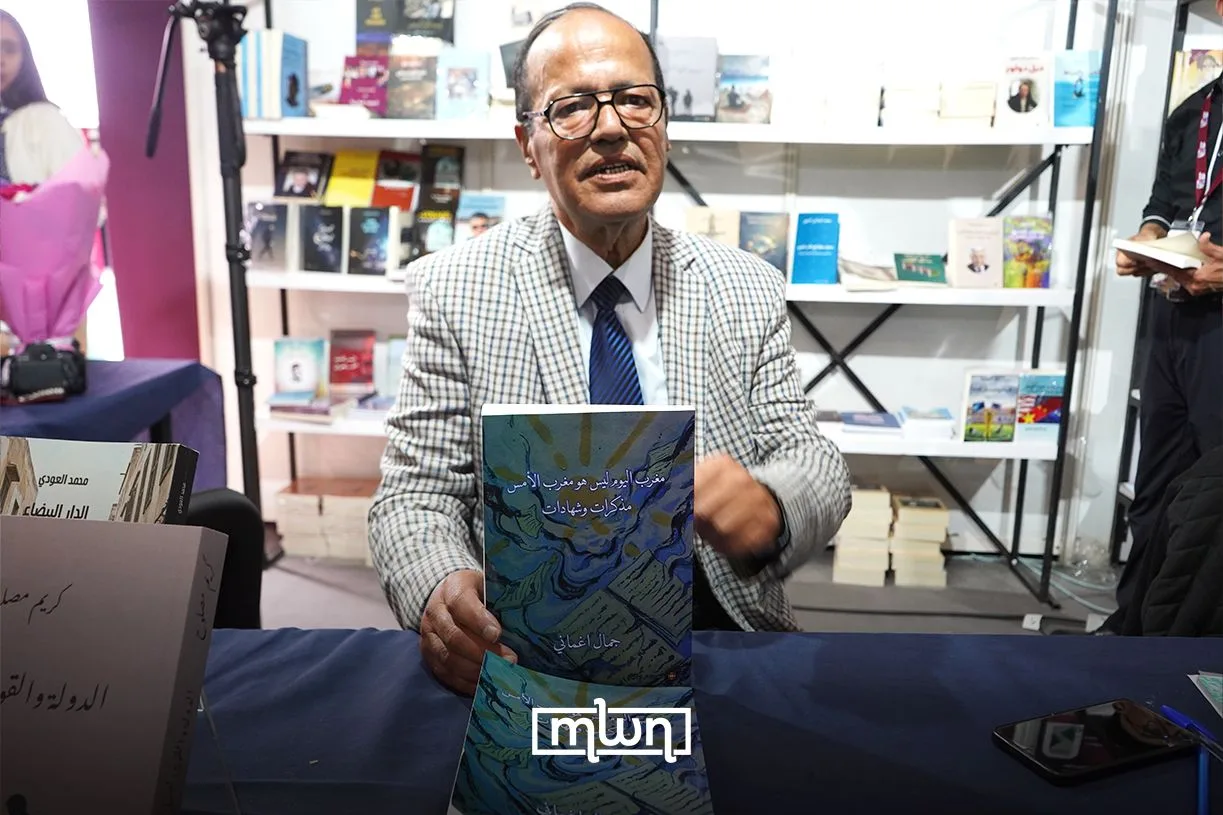
Rabat – At the 2026 International Publishing and Book Fair (SIEL), Morocco’s former Minister of Employment and Vocational Training, Jamal Rhmani, stood before readers not only as a former public official but as a witness to decades of transformation.
His book, “Morocco Today Is Not Morocco of Yesterday: Memoirs and Testimonies,” offers a series of recollections that move between the intimate and the political.
“These are, in fact, memoirs and testimonies from different stages of life,” he told Morocco World News (MWN). “I begin with childhood, then move through primary school, middle school, and high school, all the way to entering the world of politics.” The structure follows memory rather than chronology, with each stage tied to a broader moment in Morocco’s recent history.
A generation formed in political schools
Rhmani situates his early political awareness within collective spaces that shaped an entire generation. “As a young man, I was involved with the Socialist Youth, where I spent several years,” he said, before he moved to student activism within the National Union of Moroccan Students. “For our generation, this was a real school.”
These experiences appear in the book not as isolated episodes but as formative environments in which political ideas took shape. They also reflect a period when engagement relied on physical presence and direct debate, long before the expansion of digital platforms.
From local mandates to national responsibility
The memoir follows Rhmani through successive responsibilities that brought him closer to the core of public life. “After that came a series of electoral experiences, as a municipal councilor and then as a member of parliament,” he told MWN. His path later led to administrative roles within the state, before he assumed office as Minister of Employment and Vocational Training.
Rather than present these positions as milestones, Rhmani treats them as tests of conviction. He revisits decisions with a degree of distance, aware that time reshapes judgment. The narrative includes both “pleasant” and “very painful” episodes, as he described them, without an attempt to resolve their tensions.
The weight and limits of memory
The book rests on approximately 370 recollections. Yet Rhmani remains cautious about their authority. “I was very hesitant to publish them,” he admitted. “They had not undergone thorough revision or verification of dates and details.” The first edition, released with his publisher’s encouragement, stands as an initial step rather than a definitive account.
He openly acknowledges the gaps. “There are even moments that, even if we try to look them up… we find nothing written about them,” he said. “Yet I was part of that period.” His remark points to the uneven nature of historical archives, where personal testimony often fills what official records leave aside.
A title drawn from political thought
The book’s title echoes a statement by Abderrahim Bouabid, Morocco’s former Minister of Economy and Finance, who once told voters that “yesterday’s Morocco is not today’s Morocco.” Rhmani returns to this idea with a sense of continuity rather than nostalgia. For him, the phrase reflects an ongoing process rather than a completed shift.
“My intention was to convey that Morocco is constantly changing,” he said. “The Morocco we lived in is not the Morocco of today.”
Childhood in a different Morocco
Some of the most striking passages emerge from Rhmani’s early years. He recalls a modest family environment and a media landscape that now feels distant. “We lived in a time with only one radio station and one television channel,” he said. “Television was black and white.”
These details underline the scale of transformation that shapes the entire memoir. Access to information, public discourse, and everyday life has changed in ways that redefine how each generation relates to the country.
An open archive rather than a closed story
Rhmani does not present his book as a final word, and speaks instead of a possible second edition that would correct dates and expand on omitted events. The current version remains close to its original form: imperfect, selective, and rooted in memory.
That choice gives the work its particular tone. It reads less like an official record and more like a personal archive, where uncertainty holds as much weight as certainty. Through these fragments, Rhmani offers a perspective shaped by experience, yet aware of its own limits.
In the end, the memoir does not attempt to settle the past, but to leave readers with a simple idea, drawn from personal reflection and political thought: Morocco continues to change, and any account of it must remain, in part, unfinished.