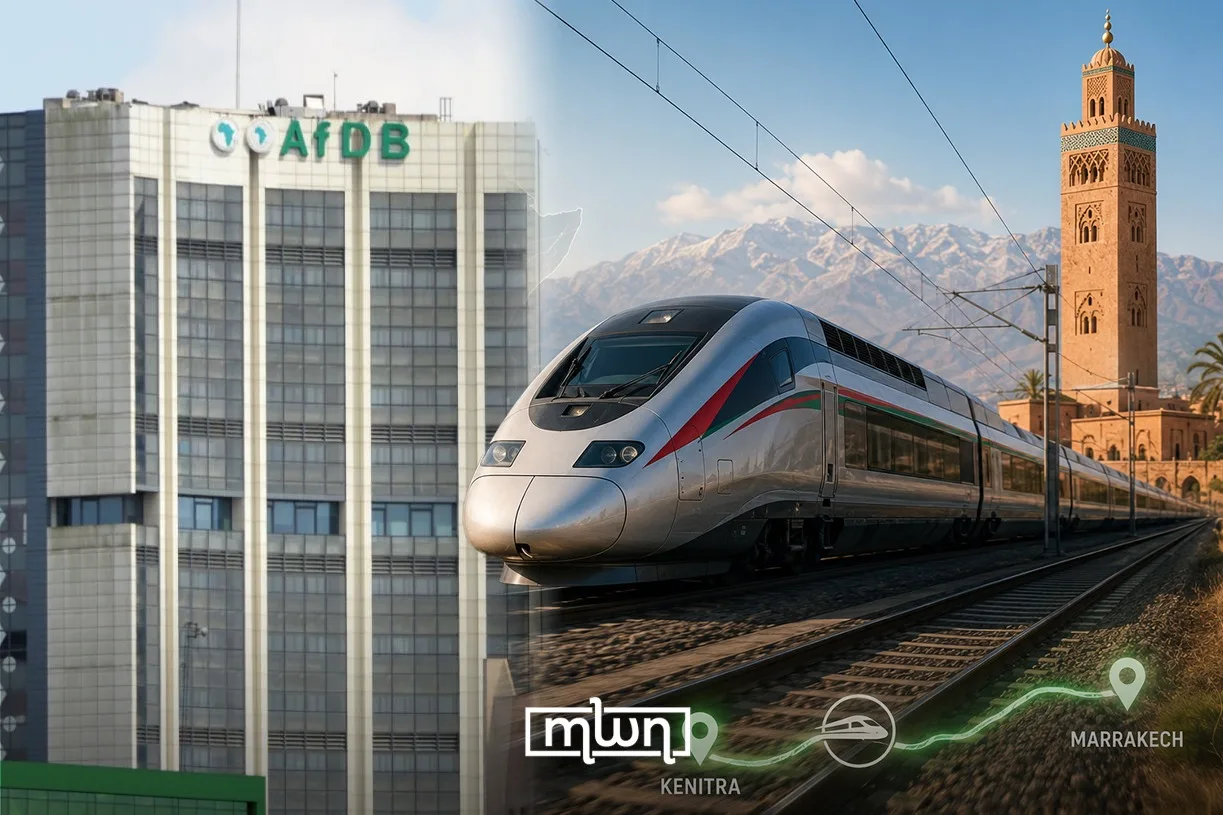
Rabat – The African Bank of Development approved EUR 205 million loan to Morocco on July 8 to help finance the Railway Infrastructure Development Support Project (PADIF). The financing will go toward extending the country’s high speed rail (LGV) network and upgrading existing rail infrastructure on the Kenitra-Marrakech train corridor.
The corridor already carries a large share of Morocco’s passenger and freight rail traffic, and the new project is designed to boost both its capacity and operational performance.
Alongside the extension of the high-speed line itself, the funding will support the modernization of conventional rail infrastructure along the same route, including the supply of new rails and switching equipment.
Strengthening Morocco’s logistics competitiveness
Work will also target the rail hub around Casablanca, one of the network’s busiest junctions.
Achraf Tarsim, the AfDB Group’s country manager for Morocco, said the project would help the network absorb rising passenger and freight volumes while easing traffic flow and cutting journey times.
He added that, over time, the investment is expected to strengthen Morocco’s logistics competitiveness and reinforce its position as a strategic transport hub between Europe and Africa.
Beyond the rail extension, PADIF includes a project-management component covering contract oversight, engineering supervision, and monitoring and evaluation of results, which aims to ensure the funds are deployed effectively.
The loan fits into the bank’s broader strategic framework for the country, aligning with its 2024-2029 Country Strategic Paper for Morocco.
It also aligns with Morocco’s own development agenda, including the government’s “Rail 2040” plan to modernize the national railway network as part of the country’s New Development Model.
The Kenitra-Marrakech extension is the latest phase of Morocco’s broader high-speed rail buildout, which began with the Tanger-Kenitra line inaugurated in 2018, Africa’s first high-speed rail service.
King Mohamed VI launched construction on the 430-kilometer Kenitra-Marrakech extension in April 2025, with a total budget of MAD 96 billion. This program is expected to cut travel time sharply between Tangier, Rabat, Casablanca, and Marrakech ahead of the 2030 FIFA World Cup, which Morocco is co-hosting with Spain and Portugal.
A longstanding partnership
The AfDB has backed Morocco’s rail sector for decades, most recently through a €300 million loan in 2010 that expanded capacity on the Tangier-Marrakech axis and funded infrastructure such as the Casa-Port station.
Rail is one strand of a broader relationship: the Bank has financed the Guercif-Nador highway, the Nador West Med port, and airport modernization in Marrakech, Rabat, Agadir, Tangier and Fez.
Since its first Moroccan operation in 1978, the AfDB has committed close to €15 billion across more than 150 projects, with 2025 alone bringing a record €1.3 billion in financing.
Why the railway matters
Rail has become central to Morocco’s economic strategy. Passenger traffic on the high-speed network has increased significantly since the Tangier-Casablanca line, Africa’s first.
Automakers like the Stellantis (formerly PSA) rely on dedicated freight trains to move vehicles to Tangier Med for export, easing pressure on roads.
As Morocco pursues its “Rail 2040” plan for roughly 1,500 kilometers of high-speed track, officials cast the network as key to cutting logistics costs and cementing the country’s role as a hub between Europe and Africa.