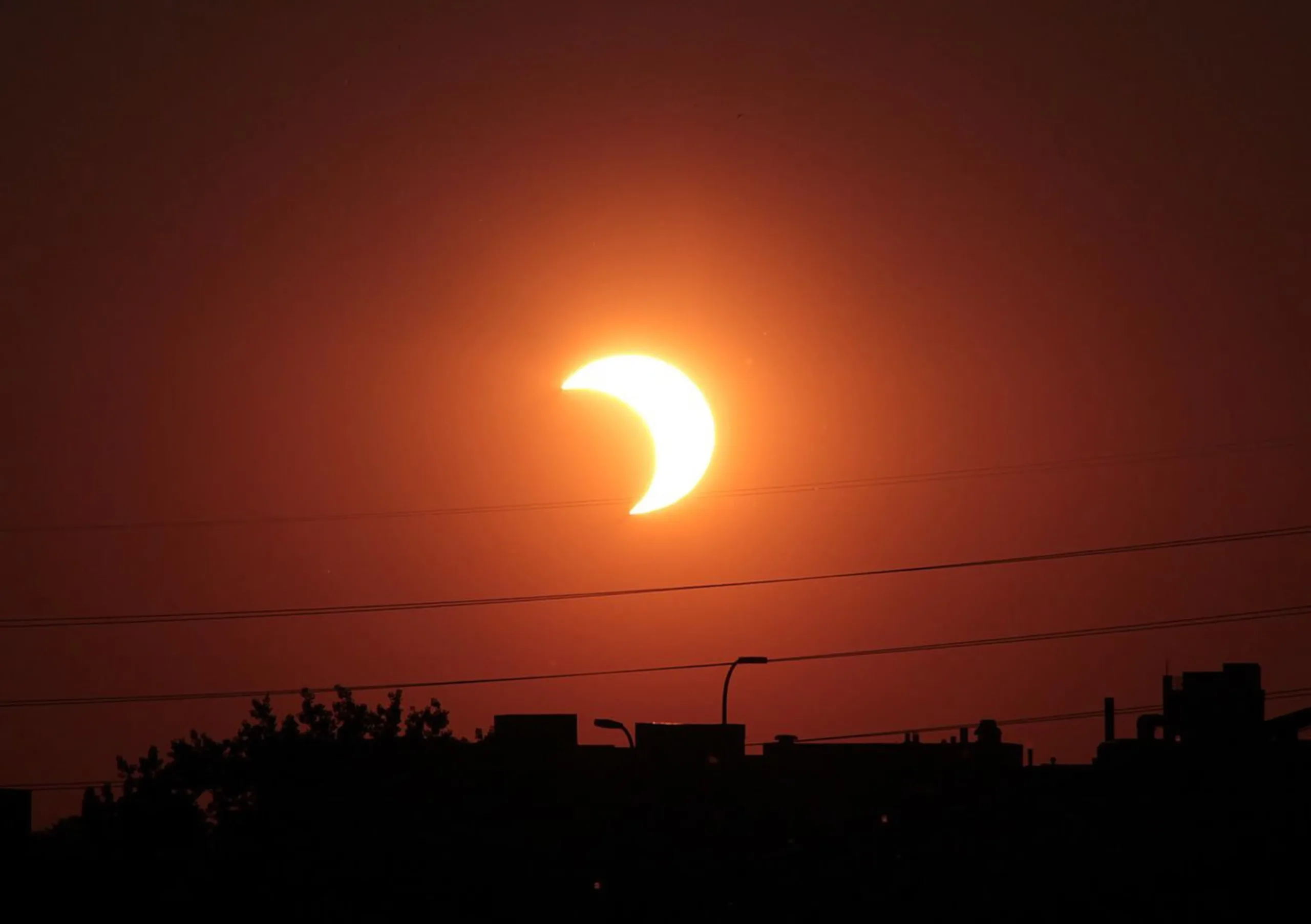
Marrakech – Morocco will witness a deep partial solar eclipse on the evening of Wednesday, August 12, when the Moon covers most of the Sun’s disk across the country. The event is a total solar eclipse globally, but totality will not be visible from Moroccan territory.
The partial phase opens at 6:44 p.m. local time near Lakhouayyet and closes at 8:40 p.m. near Agadir. Between those two moments, every major Moroccan city will see the Sun reduced to a thin crescent.
Coverage varies by latitude. Tangier leads with 92.03% of the Sun obscured, followed by Fez at 89.51%, Rabat at 88.27%, Casablanca at 86.94%, El Jadida at 85.67%, Marrakech at 82.93%, and Agadir at 79.35%.
The timings shift by minutes from north to south. Tangier begins at 6:44 p.m., peaks at 7:40 p.m., and ends at 8:31 p.m. Fez runs from 6:47 to 8:33 p.m., with maximum at 7:42 p.m. Rabat starts at 6:47 p.m. and Casablanca at 6:48 p.m., both reaching maximum around 7:43 p.m. Marrakech opens at 6:52 p.m., peaks at 7:46 p.m., and ends at 8:38 p.m. Agadir sees the longest wait, starting at 6:54 p.m. and ending at 8:40 p.m.
Racing the sunset
Sunset complicates the view. NASA lists Casablanca’s partial phase as beginning at 6:48 p.m. and reaching a maximum of 87% at 7:43 p.m., with an end time of 8:20 p.m. that marks sunset rather than the true end of the eclipse. The same pattern applies along much of the western edge of the eclipse path in Europe and Africa, where the Sun will set while still partially covered.
Weather will decide much of what observers actually see. Average cloud cover favors the south and interior, with Marrakech at 7%, Fez at 11%, and Agadir at 14%. Coastal and northern cities face higher odds of obstruction, with Tangier at 57%, El Jadida at 55%, Casablanca at 46%, and Rabat at 45%.
The eclipse itself is unusually deep. Its magnitude reaches 1.0386, and it falls about 2.2 days after lunar perigee, so the Moon appears larger than average. Greatest eclipse comes at 5:47 p.m. UTC, with a shadow band up to 294 kilometers wide tracing a path of roughly 8,300 kilometers. The event belongs to Saros series 126, the 48th of 72.
Totality itself belongs elsewhere. The umbra will sweep the Arctic, Greenland, Iceland, the Atlantic, northern Spain, and the extreme northeastern corner of Portugal. The longest totality, 2 minutes and 18 seconds, falls 45 kilometers off Iceland’s western coast. It is Spain’s first mainland total eclipse since 1905, and the first in continental Europe since 2006.
Safety rules apply for the entire duration in Morocco, since the Sun is never fully covered here. Certified eclipse glasses or handheld solar viewers meeting the ISO 12312-2 standard are required. Regular sunglasses offer no protection, regardless of tint.
Cameras, telescopes, and binoculars must carry dedicated solar filters at the front, and must never be used together with eclipse glasses, because concentrated rays burn through the filter. A pinhole projector remains the safest indirect option.
Morocco will not wait long for the next events. A partial lunar eclipse follows on August 28, 2026, a partial solar eclipse on February 6, 2027, and a penumbral lunar eclipse on February 20–21, 2027. A total solar eclipse then crosses North Africa on August 2, 2027.