
 Join on WhatsApp
 Join on Telegram
Rabat – According to CEAR’s latest Refugees in Spain and Europe report, tighter border controls and agreements between Spain and countries like Morocco, Mauritania, and Senegal are reshaping migration. Irregular sea arrivals across Spain fell 42.6% in 2025, while the Canary Islands route dropped 62%.
Departures shifted away from Mauritania, where most boats left in 2024, toward Gambia, Senegal, Guinea, and southern Morocco. Meanwhile, route patterns changed further north.
No boats arrived on the route connecting Alhucemas and Saidia to Málaga. Routes into Cádiz and Algeciras saw fewer transit arrivals, mostly carrying Moroccans. Other departures were logged from Casablanca, El Jadida, Kenitra, Larache, and Saidia.
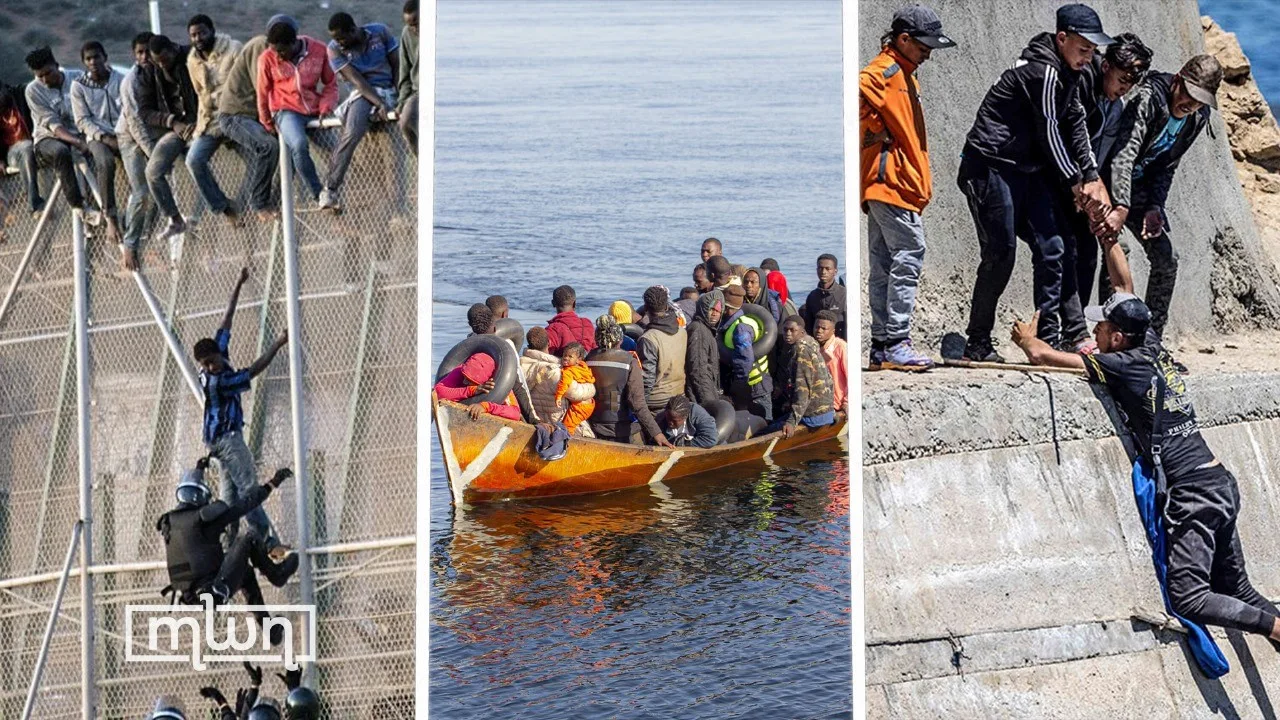
Land border crossings remain restricted since Morocco closed them. Despite strict Schengen visa and residency requirements at the Tarajal and Beni Ensar crossings, Moroccans still accounted for nearly 66% (3,037 people) of all land and sea arrivals to Ceuta. Most entered by swimming from Castillejos to El Tarajal or Beliones to Benzú, including children and adolescents.
Perimeter fence jumps continued in small groups. Swimmers aged 17 to 21, including 200 minors, also reached Melilla from Beni Ensar port, Bocana, and Cara Blanca. Tragically, a record 45 people died or went missing swimming around Ceuta’s breakwaters, mostly Moroccans and Algerians.
Read also: ‘Lungs Full of Blood’ Found in Abderrahim Fakir’s Autopsy
Moroccans were the sixth-largest asylum group in Spain in 2025 with 3,303 applications, a 22.2% drop from 4,248 in 2024 according to data published by CEAR. Spain processed 4,223 Moroccan files, granting refugee status to 227, subsidiary protection to 3, and humanitarian status to 19.
Authorities rejected 3,460 claims and archived 514, bringing the recognition rate to 5.4%, slightly up from 4.6%.
Specific cases highlight border tensions. Two stowaways applied for asylum in Gran Canaria and La Luz after arriving on ships from Casablanca and Rabat. The Casablanca applicant was rejected and returned on the same vessel to Morocco.
Inside temporary stay centers, Moroccans made up 48% of Ceuta CETI residents, including 22 women out of 2,947 total admissions. About 1,361 Moroccans left on their own after passing the one-month admissibility check to avoid rejections in Ceuta.
New internal rules restricted general intake at Melilla’s CETI to mostly Moroccans, Malians, and Sub-Saharans who presented asylum receipts, causing occupancy at the 686-capacity center to drop from 877 in January to 113 by December.
Beyond local border enforcement, new European Union rules are making claiming asylum even harder for Moroccans. Under the EU Pact on Migration and Asylum, Morocco is now designated as an official “safe country of origin” alongside Bangladesh, Colombia, Egypt, India, Kosovo, and Tunisia.
Because Morocco’s EU-wide asylum approval rate is just 4%—far below the EU’s 20% threshold—Moroccan applicants are automatically subjected to mandatory accelerated border procedures designed for fast-track rejections and deportations.