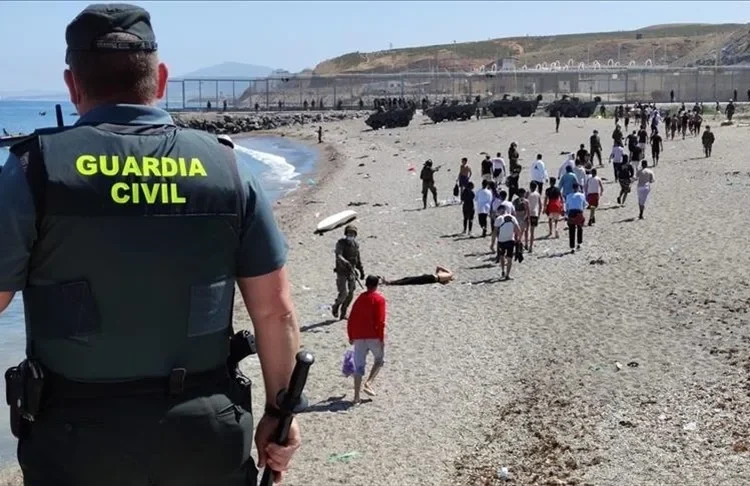
Rabat – Spanish news agency EFE reported today that no new attempts to enter the Spanish enclave of Ceuta have taken place, while voluntary returns to Morocco continue.
EFE, citing police sources, said attempts from Morocco’s side have been reduced to “sporadic,” mainly by people still trying to swim into the city.
The source noted, however, a significant deployment of resources in the area.
“These attempts barely reach ten and are made by young people who continue trying to reach the Ceuta coast,” EFE quoted the sources as saying.
Authorities in Ceuta estimated the number of migrants who remain in the city at between 3,000 and 5,000 following last week’s mass crossing.
EFE also quoted sources saying that thousands of those who crossed have refused to return to Morocco.
Morocco has contested higher figures reported by some Spanish authorities, saying its own assessment estimates that around 40,000 people crossed into the enclave.
More than 1,000 people entered Melilla, Morocco’s Ministry of Interior said, adding that it has recorded 11 deaths.
The Moroccan government also said it is investigating the figures reported by Spanish authorities, which estimate the death toll at 88 people.
Spanish reports further suggest that as many as 80,000 people may have entered the enclave during last week’s mass crossing.
Morocco has also responded to criticism directed at the country during the mass crossing despite its mobilization and the international recognition of its efforts, stressing the effectiveness of its cooperation with Spain and its role as a reliable partner in tackling irregular migration.
A Moroccan government source blamed the recent ruling by the Spanish Supreme Court, arguing that a Spanish judge cannot dismantle the system for combating irregular migration and then ask Morocco to bear the consequences.
On July 8, the court ruled against the automatic return of migrants who entered the enclave by swimming. According to the Moroccan source, the decision weakened deterrence measures and created conditions that were quickly exploited by smuggling networks, which spread false information on social media claiming that crossing into Ceuta had become easy and that Spanish borders were effectively open.
While reaffirming its commitment as a key partner in combating irregular migration, Morocco stressed that it is not the European Union’s “concierge” or “policeman,” insisting that responsibility for migration management must be shared rather than shifted entirely onto the North African country.