
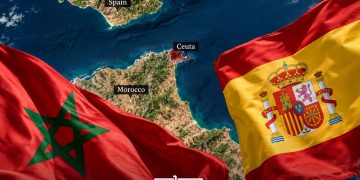























































New York – While Morocco was struggling to recover its sovereignty over the Western Sahara and Sidi Ifni, it was also laying claim to the enclaves of Sebta and Melillia, in northern Morocco, which to this day are still under Spanish sovereignty.
In the face of the dilatory posture of Spanish authorities and their reluctance to address these issues at the same time, coupled by Morocco’s relative weakness having only recently achieved independence, the authorities of the later decided to acquiesce to Spanish demands to dissociate the two southern territories, namely Sidi Ifni and the Western Sahara.
As a result, and since the territory of Sidi Ifni had no strategic importance in the eyes of Spanish leaders, Morocco and Spain reached an agreement on 4 January 1969, known as the Fez Agreement. In accordance with this agreement, Spain returned Sidi Ifni to Morocco’s sovereignty.
Beginning in June 1966, the Fourth Committee of the United Nations General Assembly adopted a series of resolutions that urged Spain to take the necessary steps in order to hold a referendum of self-determination in the Western Sahara. In principle, this popular consultation was supposed to take place by the end of 1967. The first resolution adopted, in this regard, was resolution 2229 (XX) of 20 December 1966, followed, by resolutions 2354 (XXII) of 10 December 1967, 2428 (XXIII) of 18 December 1968, 2621 (XXV) of 14 October 1970 and resolution 2711 (XXV) of 14 December 1970.
In spite of these resolutions, Spanish leaders did not show any interest in being responsive to the calls addressed to them by the General assembly. Rather, Spain sought to keep the territory under its sovereignty or, in case it could not achieve this objective, to create a satellite entity under its influence.
One of the first measures Madrid adopted to reach that goal was the creation of an assembly (Djemaa), supposedly representative of the population living in the territory. The members of this assembly were chosen depending on the degree of their allegiance to Spain.
Immediately after the creation of this “representative” body, some of its members rushed to express their attachment to the presence of Spain in the Western Sahara. As American Scholar Paul Rockower put it “the creation of the Djemaa was an attempt by Spain to silence its critics and give the appearance that the Western Sahara was progressing towards self-rule.”
Morocco’s short-lived alliance with Algeria and Mauritania
Following this “foot-dragging” shown by Spain, Morocco attempted to iron-out its territorial differences with Mauritania and Algeria with the view to develop a common front with the two countries that could put more pressure on Spain to organize a referendum of self-determination in the Western Sahara.
The first step made towards the normalization of relations between Morocco and its two North African neighbors was the holding of a tripartite meeting on the margins of the summit of the Organization of the Islamic Conference (now known as Organization of Islamic Cooperation) in Rabat in September 1969.
In exchange of the recognition by Morocco of the independence of Mauritania and of giving up on its territorial claims over Tindouf in Algeria, the two states pledged to lend their support to Morocco in its endeavors aimed at pushing Spain to decolonize the Western Sahara and abide by the relevant United Nations resolutions.
This tripartite meeting was followed by two Maghrebian summits, the first of which was held in Nouakchott in October 1970 and the second one being held in Algiers in April 1972. In these two summits, the leaders of the three countries pledged to unite and intensify their efforts to put an end to Spain’s presence in the Western Sahara and thwart its maneuvers geared towards preventing its return to Morocco’s sovereignty.
Yet to Morocco’s dismay the alliance was short-lived. It couldn’t hold up against the aggressive diplomatic campaign carried out by Spain in order to prevent Morocco from gaining the support of its immediate neighbors.
The alliance could also not stand the double game policy followed by Algeria, whose leaders had no interest in seeing Morocco recover its sovereignty over the Western Sahara. These leaders were intent on making Rabat pay for its “irredentism” over Tindouf and other parts of Western Algeria, (considered as part of Morocco’s historic frontiers), as well as for the “Sand War”, that had pitted Morocco against Algeria in 1963.
Since the independence of Morocco in 1956 and the independence of Algeria in 1962, there existed fundamental differences between the two countries over their frontiers inherited from European colonialism.
As Algeria came out of French colonialism with a vast territory- a sizable part of which was taken from Morocco starting in 1844 when France defeated the Kingdom at the Battle of Isly- it adhered to the principle of the inviolability of frontiers inherited from colonialism.
Morocco, for its part, as it was separated from a vast part of its historical territory, considered this principle as detrimental to its territorial integrity and its claims over many parts that it believed should return to Moroccan sovereignty, among which was the Western Sahara.
The reason behind Algeria’s later alliance with Spain and its support to the Polisario was not only to retaliate against Morocco for the “Sand War” or to impose itself as regional power in the Maghreb, but also to prevent setting a precedent with the Western Sahara, a possibility that entailed the risk of seeing Rabat turning to and reviving its “irredentism” against Algeria proper.
Spain’s maneuvering to delay the settlement of the Western Sahara
In fact, taking advantage of the strained relations between Morocco and its two North African neighbors, Spain rushed to thwart Morocco’s efforts to present a common front with Algeria and Mauritania.
Immediately after the Algiers tripartite summit, Spain’s Foreign Minister, Lopez Bravo, paid back-to-back visits to Mauritania and Algeria with the unstated goal of convincing both countries’ leaders of withdrawing their support to Morocco.
His visits were crowned by the signature of two economic agreements with the two countries. In accordance with an agreement with Mauritania, Spain pledged to provide economic aid to the latter and establish joint fishing ventures. With Algeria, Madrid signed an energy accord in virtue of which Spain would buy $500 million worth of Algeria’s natural gas.
Algeria’s stakes in the Western Sahara stemmed from the fact that it viewed the creation of a satellite State in the Western Sahara as enabling it unfettered access to the Atlantic for the exportation of iron located in the deposits of Garet-J’bilet near Tindouf. Algerian leaders did not want to depend on the good will of Morocco, despite the latter’s proposal to allow Algeria to have unimpeded access to the Atlantic.
Spain, for its part, was still intent on keeping the Western Sahara under its influence because of the natural resources of the territory, especially after the discovery of phosphates in the beginning of the 1960’s, as well as for the richness of its fishing grounds. Hence an alliance was formed between Algeria and Spain to thwart Morocco’s endeavors to push for a settlement to the Western Sahara issue in line with its historical rights over the territory and its strategic interests.
Spain’s strategy to cling to its presence in the Western Sahara became clearer in 1974 after Rabat learned of Madrid’s intention to grant autonomy to this territory and organize a pseudo-referendum, in total disregard of all relevant United Nations resolutions that were calling on it to decolonize the Western Sahara and allow its people to express their self-determination.
Furthermore, the Spanish government proceeded to create a fictitious nationalism in the Western Sahara, whose representatives stated that they did not represent Morocco, or any other country.
At the behest of Madrid, many delegations from the Western Sahara went to New York to attend the deliberations of the United Nations Special Decolonization Committee, in which they stated their attachment to Spain’s presence.
These were the first steps taken by Spain towards creating an artificial movement, which would allow it to preserve its interests in the territory. This was also the first step towards the creation of the Polisario in 1973, which would count on the generous financial and political support of Algeria and Libya and eventually widespread sympathy from Spanish public opinion.
Hassan II decides to adopt a new strategy
In face of these Spanish attempts to cling to one of its last colonies, Morocco decided that the time had come to adopt a new and more aggressive strategy to put Madrid under pressure. Morocco’s late King, Hassan II, decided to engage in arm wrestling with Spain. After securing the support of Morocco’s main Western allies, France and the United States, in the event of the breakout of a diplomatic crisis with Spain, Hassan II decided to launch the Green March.
Throughout this chronology, the international community had never heard of the Polisario until 1973. It was not until that year that the Polisario started claiming to be the representative of the Sahrawi people and demanding their independence.
After the withdrawal of Spain from the territory and subsequent signature of the Madrid Accord of November 14, 1975, Morocco and the Polisario waged a war over the sovereignty over the Western Sahara. Confrontations between the two sides lasted until 1991 when the United Nations brokered a ceasefire that took effect in September that year.
To Read Part I: Morocco Has Never Annexed Western Sahara
To Read Part III: Morocco Has Never Annexed Western Sahara
To Read Part IV: Morocco Has Never Annexed Western Sahara
*Samir Bennis is Morocco World News’ co-founder and editor-in-chief.
© Morocco World News. All Rights Reserved