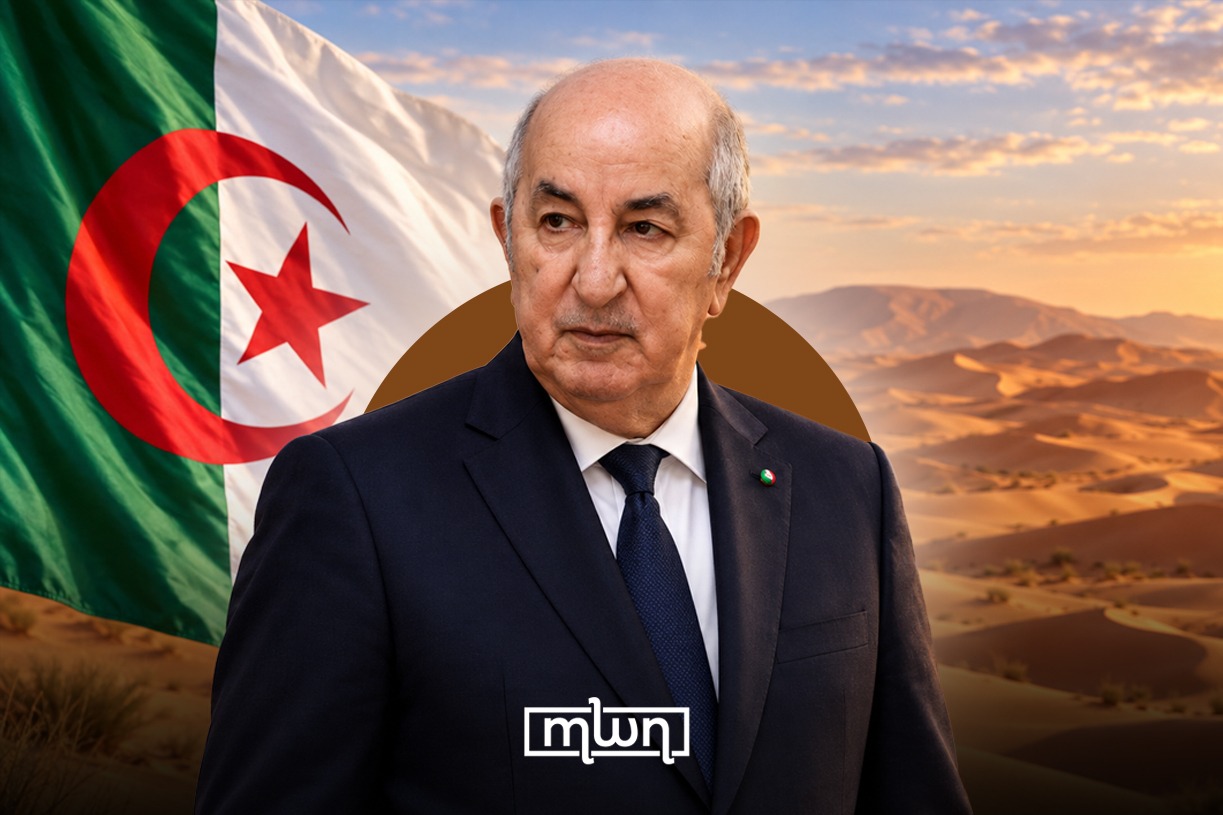
Marrakech – For two hours on Saturday evening, Abdelmadjid Tebboune sat before three of the regime’s most reliable microphones and said, in the way of a man who has rehearsed a eulogy, almost nothing – and in that nothing, everything. The session was billed as a tour of the hour’s crises. It functioned instead as a slow, televised act of mourning, the sound of a presidency learning to bury a fifty-year fiction while pretending to defend it.
The funeral oration announced itself early, in the mouth of the interviewer. Pressed to frame the opening question on the Western Sahara, the journalist’s tongue betrayed the house line and spoke the truth of the file: direct negotiations “between Algeria… excuse me… between the Polisario and Morocco.” The correction arrived a half-beat too late. The lapsus was not a stumble but a confession, the real architecture of the conflict escaping through a crack in the choreography.
Tebboune reached, reflexively, for a falsehood to seal the crack. The Security Council, he insisted, “clarified the two parties. The two parties are the Polisario and the Kingdom of Morocco. We and Mauritania are observers.” It is a serviceable fantasy, and an exploded one. Resolution 2797, adopted on October 31, 2025, seats Algeria at the table alongside Morocco, the Polisario, and Mauritania, and anchors any settlement in Morocco’s autonomy plan – genuine autonomy under Moroccan sovereignty, named as the most feasible solution. The text that Tebboune invokes as his shield is, line by line, the instrument of his defeat.
He knows it. The man who once waved the resolution away as a document that “makes its way” now concedes, with the flatness of the condemned, that “the resolution is there, it exists.” There is no self-determination referendum in it, no vanished Morocco, no Polisario state – only the scaffolding of a solution Algiers spent five decades and untold billions trying to prevent. To admit that it “exists” is to admit the autopsy is complete.
What followed was the regime’s quiet capitulation, laundered as principle. “We are not more Sahrawi than the Sahrawis themselves,” Tebboune offered. “Any decision the Sahrawis accept, we accept. That is all, I cannot say more than this.”
The phrase carries an echo. On February 4, 2020, just a week after Donald Trump unveiled his “Peace to Prosperity” plan – widely dubbed the “Deal of the Century” – alongside Israeli Prime Minister Benjamin Netanyahu, Foreign Minister Nasser Bourita told Morocco’s House of Councillors that Rabat appreciated Washington’s peace efforts while supporting the Palestinians’ right to reject the proposal.
Responding to criticism of Morocco’s position, he argued that the Sahara remained Morocco’s foremost national cause and that the kingdom “must not be more Palestinian than the Palestinians themselves” – words Algiers’ press seized on as proof of Rabat’s “retreat” and weaponized as a “surrender.” The exact rhetorical move Algiers mocked in Bourita has become Tebboune’s own exit language. By that same logic, El Mouradia has just drafted its own obituary on the Sahara.
Read this not as humility but as abdication. For half a century, Algiers was the loudest Sahrawi in every room – the financier, the armorer, the host, the ventriloquist. To now disclaim that role, to retreat behind “the decision lies with the Sahrawis,” is to begin the delicate work of walking away from a cause the regime can no longer afford and can no longer win.
The most revealing passage was not about law or diplomacy but about flesh and time. Tebboune lingered, almost mournfully, on the generation warehoused in Tindouf. The youth “born in ‘75,” he conceded, “today they are 50 years old. They need prospects. Does he want to spend his whole life and die under a tent? Logic does not accept this.”
It is a remarkable thing for the jailer to say of the camp. In one breath he admits that the people Algeria holds as the living proof of its cause have no horizon beyond the canvas – that the dream he sold them has aged into a question of where they will be allowed to die. He even gestures, with grim unintention, at the exits: Sahrawis “have a presence in Europe,” he allowed, “even Spain has a strong presence.” The hostages, it turns out, are already looking for the door.
Behind the resignation, the old obsession still throbs. Morocco haunts Tebboune even when he refuses to name it. He turned to the trans-Saharan gas pipeline – a project engineered to bleed the Algerian treasury white for the single satisfaction of shadowing the Nigeria-Morocco Atlantic line. The whole frantic pressure campaign on Niger, crowned by the unprecedented dispatch of military aircraft to Niamey after a failed coup, serves that same jealous geometry: force a pipeline route through a neighbor’s soil.
Tebboune’s justification was a masterpiece of the non-reason – the coup, he protested, happened on the very day Niger’s prime minister Mohamed Lamine Zeine left Algiers, which made it a “provocation.” Against whom, by whom, he declined to specify. Provocation has become the regime’s universal solvent, dissolving every self-inflicted wound into someone else’s plot.
The same vapor filled the one subject on which Tebboune turned theatrical: the rupture with the United Arab Emirates. He could name no concrete grievance, gesturing vaguely at “provocations” and “interferences” before landing on wounded ingratitude.
“Even their oil company – it was Algeria that created it,” he complained, before casting Abu Dhabi as a power that “tries to exercise its despotism to dominate us.” Then the strongman’s flourish: “When we make a decision, there is no going back… the situation has reached the point of no return.” A diplomacy that measures its seriousness by the number of bridges it burns is not strength. It is a man setting fire to the house to prove he owns it.
On the one relationship that might have offered cover, silence. For weeks the regime’s propagandists serenaded the “honeymoon” with Madrid – a romance Tebboune had personally blessed on July 20, when Pedro Sánchez touched down in Algiers, his first visit in over four years, mending the rupture Spain triggered in 2022 by backing Morocco’s autonomy plan. He met Tebboune, held a joint presser, and declared that “Algeria can always count on Spain,” calling it not merely a neighbor but a “strategic partner.” Tebboune, for his part, savored the moment, purred back about the “new breath” in relations, and pronounced the talks “fruitful.”
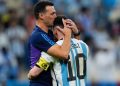
The visit landed exactly one day after the World Cup final, Spain’s last cloudless hour. The timing was its own confession: the Spanish premier flew to the junta’s table twenty-four hours after La Roja lifted the World Cup in New Jersey, Ferran Torres burying Messi’s Argentina in extra time. From the trophy to Tebboune in a single day.
It has been black for Spain ever since. Observers have long held that the junta walks a cursed road – a reverse Midas that sours whatever it touches – and Madrid is only its latest convert. From that July zenith, the plunge: occupied Ceuta crisis, a housing revolt in the streets, corruption lapping at the Socialist bench, a cornered premier. On Monday, Sánchez pulled the plug and called a snap election for November 29, a gamble he enters trailing in nearly every poll.
The grand summit, predictably meant to consecrate the affair, set for October 20 and 21 in Madrid, is now postponed indefinitely – at Spain’s own request – leaving Algiers groggy, jilted, and conspicuously mute. It effectively curdled, as every embrace of Algiers eventually does. The one friendship the regime paraded as proof it was not alone has dissolved into a Spanish ballot the generals cannot rig and a partner too busy drowning to return their calls.
Strip away the two hours of static, and the message is singular. A presidency marinated for decades in anti-Moroccan catechism is now, carefully, preparing its public to mourn. “The solution the Sahrawis accept, we will accept,” Tebboune repeated – a sentence that, from the architect of the separatist project, reads less like policy than like a will being drafted in advance. The tent is folding. The map is settled. And Algeria’s strongman, cornered by a resolution he cannot un-write and a camp he cannot feed forever, has begun teaching his people the hardest word in his vocabulary: enough.