
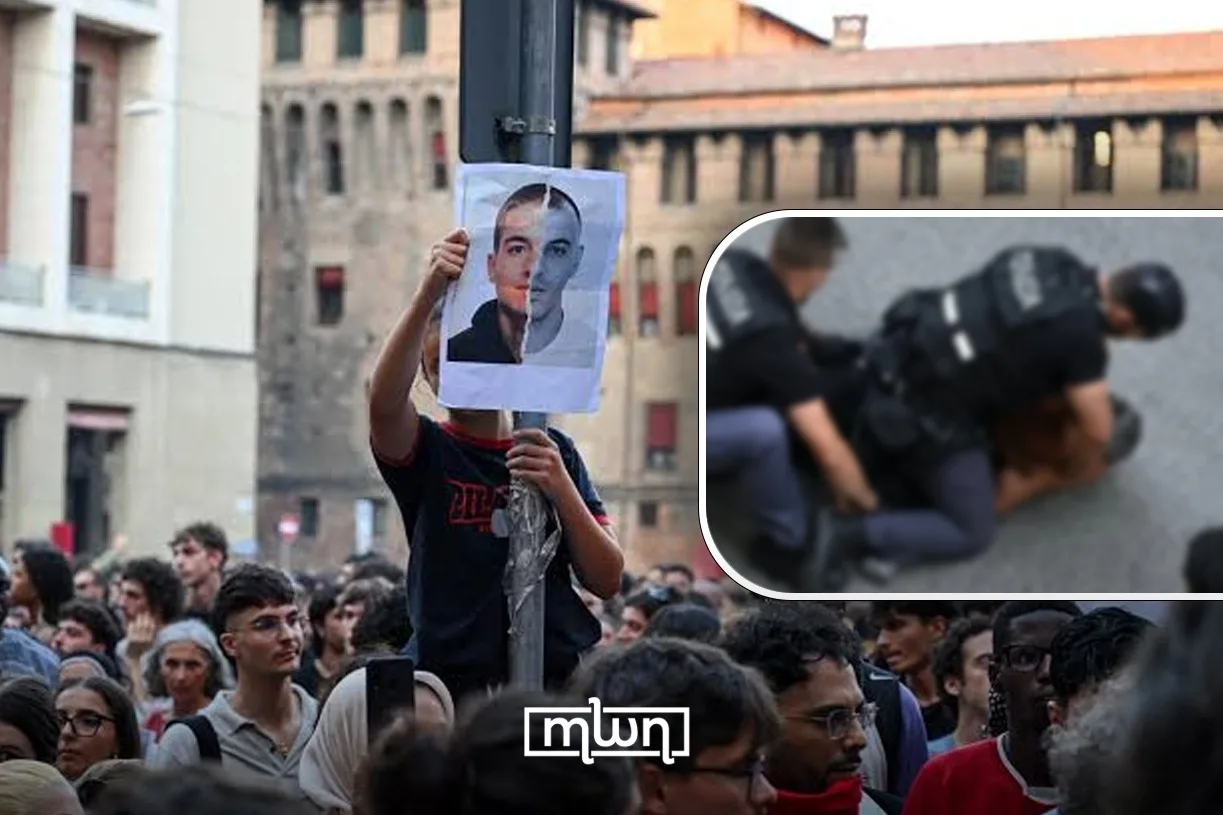
The reactions following the death of Abderrahim Fakir have raised a question that goes beyond this individual case.
How do we reach the point where a handcuffed person is killed by suffocation in public and part of society responds with indifference, justifications, mockery, satisfaction, celebrations, and even incitement to commit crimes?
How do we get to the many “-1” comments on social media, including the one posted by the Carabinieri officer Walter Lombardi reported by Bologna city councillor Detjon Begaj?
How does someone become radicalized to the point of publicly and proudly inciting racial and religious hatred?
How does someone become radicalized to the point of publicly and proudly inciting criminal acts against a specific community?
According to ODIHR’s 2024 report on hate crime incidents in Italy, “since 2018, Italy has not reported data on hate crimes recorded by the prosecution and judiciary.”
The report further noted: “ODIHR received a low level of reporting on anti-Muslim incidents and did not receive any reporting on anti-Roma or disability hate incidents in Italy. This indicates potential gaps in the information reported here.”
A long, simmering culture of normalization hatred
Societies do not reach these points overnight.
When part of the population, including people who hold public positions and positions of power, comes to react with indifference, justification, or even satisfaction in the face of a person’s death, the process began much earlier and took place on multiple levels.
The process long predates both the reactions observable on social media and the incidents that attract public attention.
The radicalization of hatred against a specific community does not happen suddenly.
It is built gradually through repeated messages, normalized stereotypes, and forms of language that cease to be perceived as problematic.
When this process continues over time, what would initially have provoked outrage can end up appearing normal.
And what should appear unacceptable can end up being tolerated, justified, or even encouraged.
For this reason, events such as the death of Abdelrahim Fakir cannot always be understood in isolation.
Because they reveal something that already existed, something that tells a much larger story.
Language is an essential part of the process
In Italy, this process first became visible in language.
Many people grew up hearing the term “marocchino” — which is used as an insult to humiliate or demean those who look different, or are not deemed to be Italian enough.
In other words, it is used to portray someone as inferior, undesirable, or suspicious.
And it was precisely because this practice was so widespread that it eventually became normalized, even trivialized.
With a derogatory meaning, the use of the term marocchino as a stereotype of the North African immigrant, di Rocco Luigi Nichil noted in a 2025 piece for Treccani Magazine. The article goes on to document that the Sabatini-Coletti describes the term as an epithet applied to non-EU foreigners. As a result, a nationality gradually ceased to be merely a nationality and became a caricature.
A word associated with millions of people was transformed into a negative label.
Children learned that the word provoked laughter. And those who use it as an insult are excused. While those who are targeted by it are mocked a second time for being offended. Ultimately, daily humiliation was being treated as a joke
As early as 1954, psychologist Gordon Allport observed that prejudice tends to develop along a progression that moves from hostile language and stereotypes to discrimination and, in the most extreme cases, violence. From this perspective, the normalization of certain forms of hostility is not a phenomenon separate from more severe manifestations but may constitute one of the conditions that facilitate their development.
Language is only one part of the process.
The same mechanism is also fueled through stereotypes, generalizations, and narratives that associate entire communities with negative characteristics, transforming real people into abstract categories to be feared, controlled, or coerced.
The socialization of impunity
This process develops across multiple social contexts: at school, in the workplace, in the media, in everyday conversations, in politics, and in digital spaces.
The process produces two parallel effects: on the one hand, it teaches those who are targeted that defending themselves comes at a cost, thus encouraging adaptation and silence. On the other hand, it teaches those who attack that certain behaviors can be carried out without significant consequences, therefore reinforcing a perception of impunity.
Those who are targeted learn to minimize, endure, and let things go.
Those who engage in these conduct learn that certain words, certain behaviors, and certain forms of violence will be passively tolerated.
This is how the conditions are created in which some people become radicalized in their hatred toward a specific community.
The literature on dehumanization highlights how the systematic representation of certain groups through degrading stereotypes can foster hate speech, extreme forms of prejudice, and violence against the targeted groups. As Mendelsohn, Tsvetkov, and Jurafsky observe, “dehumanization is a pernicious psychological process that often leads to extreme intergroup bias, hate speech, and violence aimed at targeted social groups.”
And this does not happen in a single episode.
Instead, it is the culmination of years of messages suggesting that a particular community is inferior, deserves less empathy, is less worthy of respect, can be treated differently from others, and can be progressively dehumanized.
The fact that part of the Moroccan community took to the streets with grief and determination to demand justice for Abdelrahim Fakir is not the result of something that developed overnight.
Those people belong to a community that has learned that defending itself comes at a cost and that, for this reason, tried to adapt by interpreting certain incidents as isolated cases, avoiding conflict, and seeking to avoid the consequences and possible retaliation associated with speaking out. This, in many cases, led to the normalization of situations and dynamics that should never have been considered normal.
Racialized and dehumanized minorities are routinely taught that speaking comes at a cost, and that that cost can be high.
But that same silence often ends up being used precisely against those who have been silenced.
It is often exploited as alleged proof that no problem exists and that no problem has ever existed.
The rest is accomplished by the surface appearance of a community that continues to work, study, and build its life, without documented complaints or reports.
“The capacity of the police and carabinieri to address hate-motivated violence seems to be significantly diminished by underreporting of such incidents and lack of trust in law enforcement agencies,” writes ECRI in its 2024 report on Italy. “During its visit to Italy, the ECRI delegation learned about many accounts of racial profiling by law enforcement officials…”
The end of silence
Before asking why the Moroccan community is today so determined in its demand for justice, it may be worth remembering that this community already knows the price of silence.
It already knows the consequences of these processes. It knows what happens when discriminatory language is normalized, when incitement to hatred is called opinion, when humiliation is dismissed as a joke, and when victims are asked to tolerate what should instead be denounced.
Because it is precisely through these processes that acts of violence and abuse once considered unacceptable have progressively acquired social legitimacy, lowering the threshold of collective outrage in the face of discrimination and violence.
As the ECRI report stresses, “racial profiling has considerably negative effects, generating a feeling of humiliation and injustice among affected groups and resulting in stigmatisation and alienation. It is also detrimental to overall security, as it erodes public trust in the police and contributes to under-reporting of crime.” Criminological research has long shown that the effectiveness of deterrence depends above all on the perception that certain behaviors will encounter concrete consequences. “The evidence in support of the deterrent effect of the certainty of punishment is far more consistent than that for the severity of punishment,” argues Daniel Nagin in a 2013 paper. “Consequently, the more precise statement is that certainty of apprehension, not the severity of the ensuing legal consequence, is the more effective deterrent.” When the perception of social and institutional response weakens, the deterrent power of norms also declines. Impunity does not merely produce an absence of consequences; it teaches that certain crimes are tolerated, that certain targets can be attacked, and that some people can be dehumanized.
If today part of the Moroccan community refuses to remain silent, it is because it has now understood that this very silence, that reluctance to document its pains, and that deeply-seated tendency to not document or report systemic profiling are part of the reasons for the current situation. It now understands that instead of protecting itself by remaining silent, it has unwittingly contributed to shielding those who target, belittle, and insult its members.