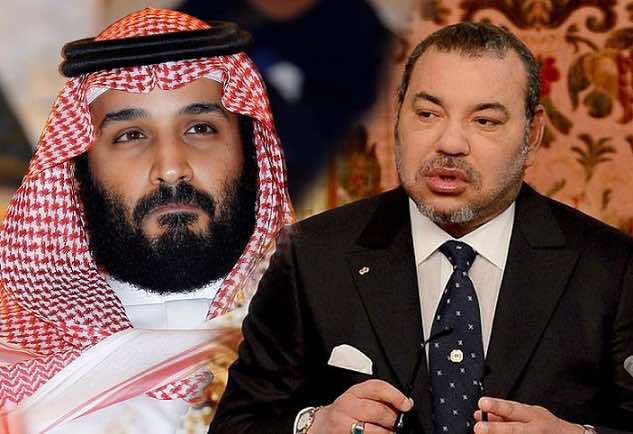
Rabat – International observers are following the recent developments in Saudi-Moroccan relations carefully. While some predict the tension is just a passing cloud, others suggest that Morocco should reconsider entirely its diplomatic ties with the Saudi government.
The timeline below gives an overview of the start of the friction between Morocco and Saudi Arabia.
November 2017: Morocco’s blockade-breaking hurts Saudi hopes
When Saudi Arabia and three allies decided to enforce a hard blockade in May 2017 on Qatar, Morocco’s refusal to back the Saudi-led coalition angered the peninsula.
Morocco has remained neutral throughout the Gulf crisis. King Mohammed VI even flew to Qatar on November 12, 2017.
Upon his arrival in Qatar from the UAE, Qatari media welcomed the monarch, naming him the “first blockade breaker.”
The King also ordered the Moroccan government to send food assistance to Qatar. The Moroccan Ministry of Foreign Affairs then cited religion as a reason “especially during the month of Ramadan where solidarity among Muslim people is required.”
Saudi Arabia was not at all please with Morocco’s neutrality, especially because Morocco and Saudi Arabia share historical and strong ties.
March: Putting Saudi Arabia’s interests first
It all started with a tweet, when an adviser of the Saudi royal family indirectly attacked Morocco nearly four months before the vote on the 2026 World Cup host.
Then head of the Saudi sports authority, Turki Al Sheikh, became known for his unfriendly comments about Morocco throughout the World Cup bid process.
On March 18, 2018, Al Sheikh started politicizing the 2026 World Cup bid, posting a tweet to announce his country’s indirect position on the 2026 World Cup bid.
In his first tweet, Al Sheikh said that neither of the World Cup bidders asked for Saudi Arabia’s support. But in case someone asked for backup, Saudi Arabia would vote for the country that would best serve its interests.
“If someone ever asks, we will look for Saudi Arabia’s interests first.”
Al Sheikh at that time also granted interviews, touting the strong diplomatic ties between Saudi Arabia and the US and describing Trump’s administration as their “strongest allies.”
In an interview with a Saudi-based sports news outlet, Al Sheikh said, “Friendship and Fraternity have been very detrimental to the Saudis… what really matters to me is that the 2026 World Cup needs to be hosted in the best conditions,” implying that these conditions would not be met in Morocco.
March: It was all about Qatar
Al Sheikh’s proximity to the Saudi royal family, especially Crown Prince Mohammed bin Salman, makes it likely the monarchy was aware of his tweets and stance against Morocco.
Al Sheikh’s first tweet was not the last. The second tweet came four hours after the first and clarified his position against Morocco. “Some people went astray. If you want support, you should seek it in Doha . What you are doing is wasting your time. Now ask the pseudo-state to help you. A message from the Gulf to the Ocean.”
The message referenced Morocco’s neutrality in the Gulf Crisis between Al Thani’s government in Qatar and Saudi Arabia’s coalition.
The tweet also coincided with the final campaign to gather votes for the hosting rights of the 2026 World Cup. Morocco had filed its dossier to host the 2026 World Cup but lost the vote when a majority of countries, including Arab countries, voted for the North American bid.
More than that, Al Sheikh considered Moroccan neutrality in the Gulf Crisis as a threat to the diplomatic ties between Saudi Arabia and Morocco. Morocco took a neutral stance because of its strong bonds with both Qatar and Saudi Arabia.
April: A purely political move
Adding insult to injury for Morocco, Al Sheikh posted a picture of himself with the chairman of the joint North American bid for the World Cup.
The photo of Al Sheikh and the chairman exchanging a firm handshake and wearing large smiles spoke for itself.
“I was pleased to meet Mr. Carlos Cordeiro, the president of the United States Soccer Federation, and chairman of the United 2026,” said Al Sheikh. Up until then, Saudi Arabia had not voiced direct support for the United 2026 World Cup bid.
April: A hopeful selfie
Al Sheikh’s comments faded when a selfie of King Mohammed VI, Crown Prince Mohammed bin Salman, and Lebanese Prime Minister Saad El Hariri was shared online.
The selfie, taken and shared by Hariri on April 9, made observers forget about Saudi-Moroccan tension, thinking the picture was “worth more than a thousand words.”
But a few months after the selfie, Morocco would be stunned by Saudi Arabia’s conduct in Moscow.
Decisive June
June was the decisive month for both the Moroccan and United bids. Morocco was shocked, however, to find that Saudi Arabia officially lobbied against the Moroccan bid.
On June 4 Saudi Arabia announced its decision to officially back the US.
“We weighed the issue and, in the end, we went with what was in the best interest of the Kingdom of Saudi Arabia,” said Al Sheikh, saying that the country gave its word to the Americans.
Saudi Arabia launched a last-minute campaign on June 11 and 12, pressuring countries to vote for United 2026.

On June 13, Morocco’s bid was knocked out of the race with only 65 votes, 33 percent of the vote. United 2026 won the rights to host with 67 percent of the vote at the 68th FIFA Congress in Moscow.
Several Arab countries voted against Morocco, including Iraq, Kuwait, Bahrain, Lebanon, and the United Arab Emirates. Several African countries also voted for the North American bid, including Namibia, South Africa, and Liberia.
Post-World Cup feud
Morocco considered the votes of African and Arab countries against Morocco as betrayal.
Then another alleged crisis between Morocco and Saudi Arabia erupted.
Known for his extravagant summer holidays in Morocco, Saudi King Salman instead chose to spend his summer 2018 vacation in the newly planned city of Neom, Saudi Arabia, for “business reasons.”
Read Also: Morocco Should Reconsider Alliance with Saudi Arabia and UAE
The decision raised more media speculations from both parties. Moroccan and international analysts also started noticing Morocco’s absence in meetings held in Saudi Arabia and joint military symposiums.
On June 15, Morocco’s Minister of Culture and Communication Mohamed Laaraj said that that he would not participate in the meeting of communication ministers in the Coalition Supporting Legitimacy in Yemen on June 23 in Saudi Arabia because of his busy agenda.
Speculations also ran wild that Morocco withdrew its troops from Yemen. Morocco shunned a joint naval exercise called the Red Waves 1 held in Saudi Arabia from December 30 to January 4, 2019.
October: Khashoggi murder ‘seen’ by Morocco
Arab countries and the Saudi coalition showed full support for Saudi Arabia after international media accused the Saudi crown prince and the Saudi royal family of being involved in the murder of Saudi journalist Jamal Khashoggi in the Saudi consulate in Istanbul.
Several countries condemned the killing of the journalist and its potential link to Mohammed bin Salman. Some countries also said that Saudi Arabia had crossed a “red line.”
In contrast to other Arab countries, Morocco did not express support for the Saudi royal family.
November: Morocco snubs bin Salman
In the aftermath of the murder, bin Salman announced a world tour with stops in Maghreb countries, including Tunisia and Algeria.
Several political observers then questioned his decision not to include Morocco in his agenda. But Morocco’s Minister of Foreign Affairs Nasser Bourita confirmed that Morocco had been on MBS’s schedule.
A source from the government told Morocco World News that the visit could not be made because King Mohammed VI said that he could not receive bin Salman personally, suggesting his brother Prince Moulay Rachid meet MBS instead. Saudi Arabia, however, refused Morocco’s alternative.
Read Also: King Mohammed VI Snubs Saudi Crown Prince Mohammed bin Salman
Bourita said that bin Salman did not visit Morocco because of King Mohammed VI’s schedule, but said no disagreement should be inferred from the occasion. “If relationships are measured by different schedules, this trivializes the relationship.”
Second target: Territorial integrity
After accomplishing the World Cup mission, Al Sheikh eyed Morocco’s territorial integrity as his next target.
The Union of Arab Football Associations (UAFA), chaired by Turki Al Sheikh, posted online a Moroccan map split into three parts, excluding Western Sahara from Morocco.
The UAFA later deleted the map and apologized, but the same scene repeated itself by another football organization under Al Sheikh’s leadership.
Egypt’s Pyramid football club, owned by Al Sheikh, posted a similar map, making the maps associated with Al Sheikh appear uncoincidental.
January: Moroccan government does not feel the tension yet
In January, Morocco’s Minister of Foreign Affairs Nasser Bourita had an interview with Qatari news outlet Al Jazeera. Saudi-Moroccan diplomatic ties came up in the interview.
Bourita denied that there is tension between Morocco and Saudi Arabia but acknowledged that Morocco’s participation in Yemen has changed.
A week after the interview, the Associated Press reported that a Moroccan government source said that Morocco recalled its ambassador from Saudi Arabia.
The news came after Saudi news channel Al Arabiya aired an unfriendly documentary against Morocco’s territorial integrity, calling Western Sahara an “occupied” territory and putting Morocco and Polisario on an equal footing.
Read Also: Morocco, Saudi Arabia Are Using Media to Poke at Each Other
Bourita, however, denied the news, emphasizing that Morocco has its own channels to announce such news if they are true.
Bourita also implied that Morocco’s ambassador was summoned for consultations regarding the Saudi-Morocco diplomatic ties and nothing else.
Other rumors abounded that Morocco also summoned its ambassador to the UAE.
Both diplomats reportedly returned to their offices after consultations in Rabat.