 Join on WhatsApp
 Join on Telegram
Rabat – In the past six weeks alone, Morocco has recorded as many COVID-19 cases as in the previous three and a half months, said Mouad Mrabet, a coordinator at the National Center for Public Health Emergency Operations, affiliated to the Ministry of Health.
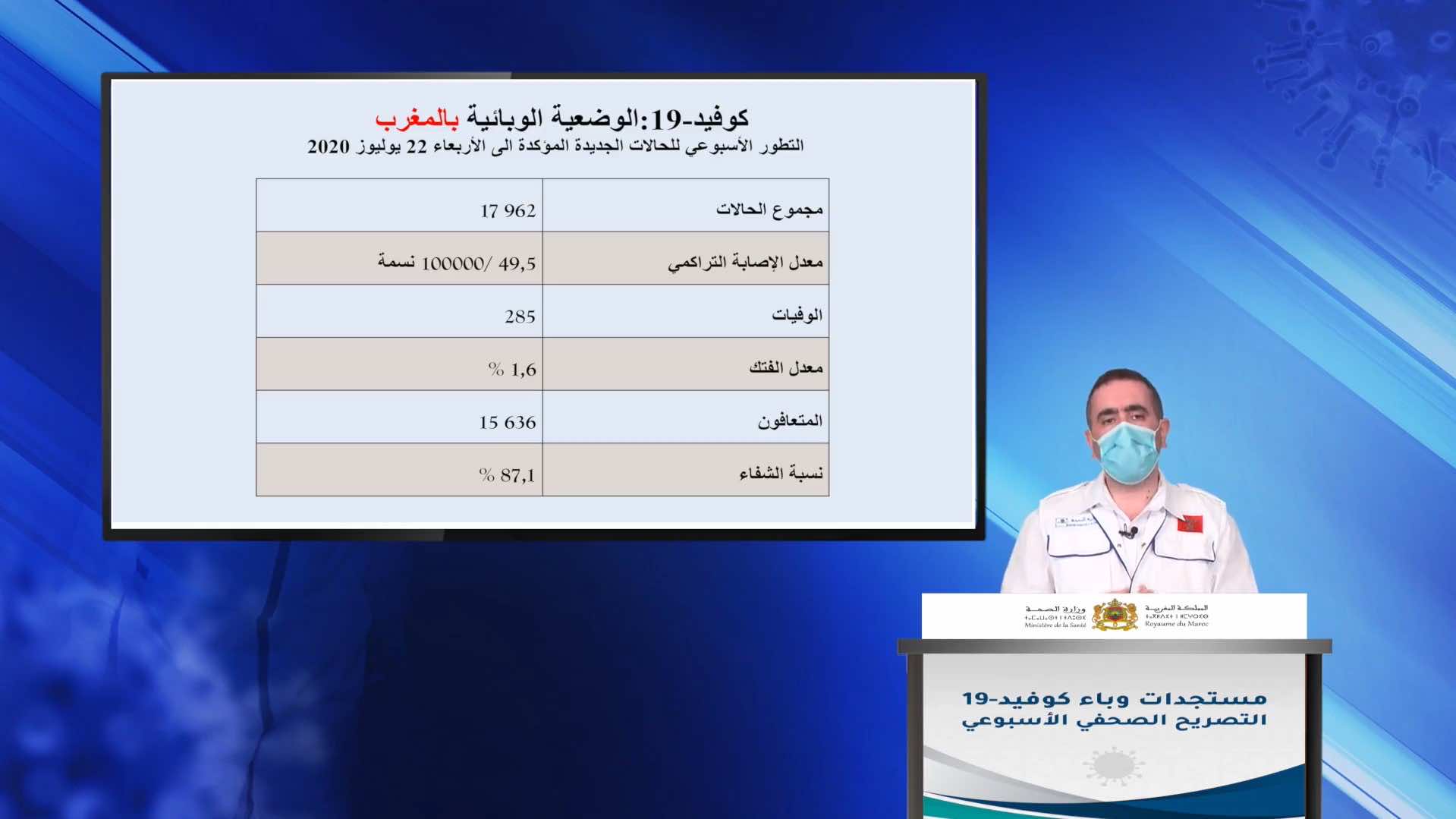
In a weekly briefing session broadcasted on Friday, July 24, Mrabet gave an overview of the epidemiological situation in Morocco.
مستجدات وباء كوفيد 19 : التصريح الأسبوعي المفصل رقم 2
مستجدات وباء كوفيد 19 : التصريح الأسبوعي المفصل رقم 2
Posted by Ministère de la Santé du Royaume du Maroc on Friday, 24 July 2020
The briefing, containing data as of Wednesday, July 22, presented the national epidemiological situation using simplified graphs and illustrative maps.
As of July 22, Morocco had recorded 17,962 COVID-19 cases, averaging 49.5 cases per 100,000 inhabitants. The country’s death toll stood at 285, marking a fatality rate of 1.6%. Meanwhile, the total number of recoveries was at 15,636, with a national recovery rate of 87.1%.
According to the graphs, the number of newly-detected cases per day increased significantly after Morocco eased its lockdown measures.
“The increase was very high at first, but then it slightly decreased and stabilized. However, COVID-19 cases detected daily are still higher than their level during the strict lockdown,” Mrabet said.
“The cases confirmed in the past six weeks are as many as those detected in the previous three and a half months,” he revealed.
Regional disparities
In an interactive map, the Moroccan doctor highlighted the cities and provinces in Morocco with the highest ratios of COVID-19 cases per capita.
The Tangier-Asilah and Fahs-Anjra provinces, in the north, recorded the highest rates, with 37.87 and 37.63 active cases per 100,000 capita respectively. Fez also has a high rate, with 27.77 cases per 100,000 people.
Other cities with worrying numbers include Dakhla (13.41 cases per 100,000 inhabitants), Jerada (11.94), Tetouan (9.68), Moulay Yacoub (9.5), Casablanca (9.39), Oujda (7.21), and Marrakech (7.19).
The number of coronavirus-related deaths also witnessed an increase after the Moroccan government eased lockdown measures, Mrabet said.
“We used to spend days without recording any deaths, but now, right after [easing] the lockdown, [the number of deaths] started increasing week after week,” he explained.
The number of patients in critical condition is also increasing, the doctor said. More cases are staying in intensive care units, he revealed.
In terms of testing frequency, laboratories across Morocco are still increasing the number of COVID-19 tests performed every week.
“In the past week [July 13 to July 19], they conducted more than 130,000 tests, with an average of over 18,000 tests per day,” Mrabet revealed.
The numbers only include tests performed to identify and confirm COVID-19 cases. They exclude tests done after patients are admitted into hospitals.
The figures make Morocco the second country in Africa in terms of total COVID-19 tests and the first in North Africa, the doctor revealed.
COVID-19 and air conditioning
Responding to questions from citizens, Mrabet explained that sea waters do not transmit the coronavirus. However, the issue, according to him, is the large gatherings at beaches and the risk they present if preventive measures are not respected.
A Moroccan citizen asked about the possibility of reimposing a lockdown if the country’s epidemiological situation spirals out of control.
“Yes, and it is happening in many countries. However, the lockdown measures will depend on the regions,” Mrabet responded.
Another Moroccan inquired about the possibility of using air conditioners.
“You can use air conditioners if you are alone or if you’re home with your family,” the doctor said. “However, you should not use air conditioners in the workplace.”
When it is impossible to work without air conditioning, air conditioners can be used under strict conditions, Mrabet stressed.
“It is necessary to open windows at least twice a day to change the air. It is even better to keep them open all day long,” he added.
Other questions from citizens revolved around the importance of wearing face masks and whether people suffering from high blood pressure are at high risk from COVID-19.
“All people suffering from chronic illnesses, including high blood pressure, are at high risk,” Mrabet said.
As for wearing face masks, it is compulsory to do so in public, he stressed.
The doctor invited citizens to send their inquiries via WhatsApp to the telephone number 07 61 85 50 20. The Ministry of Health will try to answer as many questions as possible during every weekly briefing, he assured.
Recommendations for Eid al-Adha
The “event of the week,” according to the briefing, was the meeting of the scientific committee of the Ministry of Health on July 17 to discuss measures for Eid al-Adha. The religious feast will take place on July 31.
The committee considers an increase in COVID-19 cases during the Eid period “very probable,” Mrabet said.
The team gave a series of recommendations to save Morocco from a surge in COVID-19 cases, notably conducting tests on professional drivers and butchers. Citizens must only hire certified butchers, Mrabet stressed.
The recommendations also include avoiding intercity travel during the Eid period, reducing family visits, and respecting preventive measures, especially in markets.
At the end of the presentation, Mrabet gave advice to people at high risk of developing severe COVID-19 cases. In addition to the usual preventive measures, high-risk people must “at all costs” avoid gatherings and physical greetings.
“The Ministry of Health wishes you a happy Eid and bids you to respect the known preventive measures,” Mrabet concluded.