


 Join on WhatsApp
  Join on Telegram
 Casablanca – A considerable international community has emerged around the British Language Academy, a language school with five different facilities in Casablanca, Fes, El-Jadida, and Berrechid.
The Academy teaches its students diversity in practice by inviting hundreds of international volunteers yearly for a special guest speakers program. Foreigners have daily conversations with the school’s students in return for accommodation. In the seven years of the school’s existence, thousands of volunteers have visited Morocco and participated in this unique cultural exchange.

Approximately 30 volunteers have been staying in the school’s facilities in March, and all have experienced the shutdown of public places and borders differently, depending on the accessibility of their embassies or their travel plans.
Visitors from five continents met in Africa in March. Residents of Finland, France, Argentina, Poland, New Zealand, Russia, Spain, Australia, the UK, and the US all shared the uncertain fate of being stranded in Morocco amid a global pandemic.

Morocco’s border closures and flight suspensions have left the volunteers confused, indifferent or panicked. Some left immediately, some stayed, out of necessity or out of will.
The unprecedented events that unfolded in the past week—from embassy chaos and airport frenzies to attacks with glass bottles—gave a slight apocalyptic feeling to the situation.
When traveling, it is normal for people to come and go. Last week, however, the living arrangements in the flats have been changing constantly, with people who were supposed to leave to a different country coming back, and those who were about to stay for some weeks more suddenly leaving for the airport in an anxious pursuit of the last flight back to Europe.
Realizing the weight of the coronavirus crisis came late. Most volunteers state the moment when cases in Europe took a sharp rise, when the panic of the virus started escalating, or finally when Europe closed borders, as the first time the situation appeared as serious.
The response of the Moroccan government appears swift and highly plausible for everyone who is still residing in the country; the international volunteers see the government as acting fast, taking good precautions, and deploying necessary forces to control the situation. On the downside, foreigners saw the attitudes the Moroccans displayed towards them change, from a welcoming friendliness to distrust, at times erupting to open hostility.
Read also: A Film Noir: One Expat’s Experience in Morocco During COVID-19 Crisis
Blaming foreigners
Moroccans are usually a very warm, friendly, welcoming nation. It is not uncommon for foreigners to be approached on the streets or even to get invitations to lunches with Moroccan families.
At the beginning of March, nothing seemed different than the friendly normal. But as it was becoming clear that the situation is serious, some foreigners reported being treated differently and even harassed.
“The atmosphere is different,” said a French national. “There is less happiness on the streets these days.”
During the days following the lockdown, some Moroccans treated every foreigner as carrying a highly contagious, deadly disease, covering their faces with pieces of clothing and moving as far away as possible.
The acts of bullying usually did not go further than a few mischievous words, but one incident is worth reporting on. When a group of five international volunteers and two twelve-year-old kids went to play football in a square in the center of Casablanca, somebody threw glass bottles at them from an apartment two floors up. They tried to play right in front of the house the day after, but a policeman chased them away, stating there will be “no more football on the streets.”
The airport frenzy
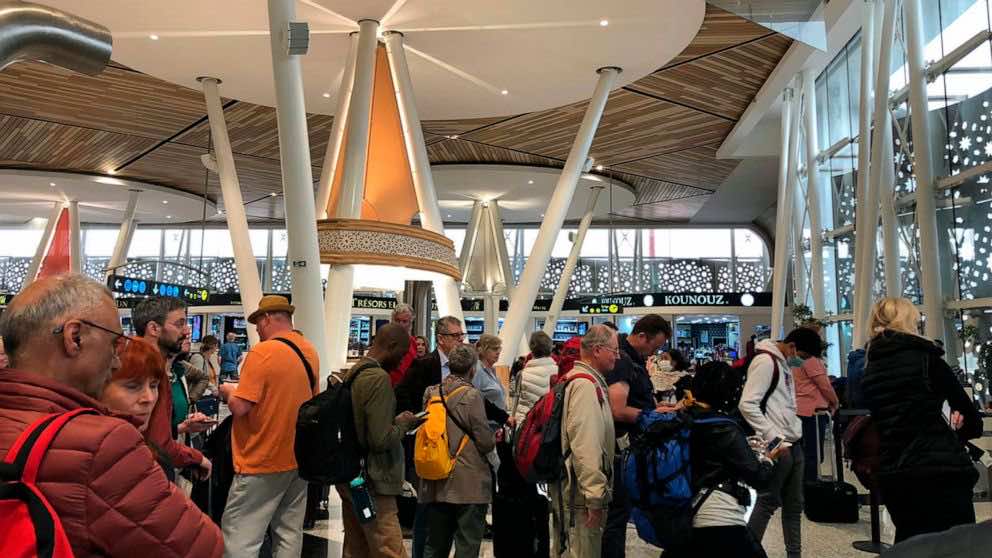
Each story about catching an outbound flight from Morocco in the past week mentions the chaos that overtook international airports. Queues to travel bureaus and airline representatives reaching up to 200 people or enormous lines to embark on a plane became the new normal.
Those who got out recall “people being confused together” but not an overall state of panic: “It didn’t feel like the end of the world.”
However, the disorganization in the face of an unprecedented state of events led to some inefficiencies.
A British national recounted that his flight to London Stansted, scheduled to depart at 1 p.m. and arrive after 3 p.m., had an almost five-hour delay. The lag happened because the airlines had to make sure the plane was full, as they departed with 20 seats empty, despite hundreds of tourists desperately trying to get a ticket back home, the day before.
Travelers went through various inconveniences before they managed to get a ticket or embark on a plane.
Some slept at the airport, as their flight was only scheduled the next day. Others had to go back and forth between Casablanca and Marrakech airport as there were not enough tickets on that particular day. A US national who only learned that she can still get out at the very last minute packed her bags and left within an hour. Some last-minute flights were particularly pricey and involved transits through Turkey, and travelers had to run the risk of being stuck there.
Read also: Waiting for Moroccan Repatriation: A Plea from Algiers
#StayAtHome
Most of the foreigners who volunteer for the British Language Academy and who are still in Morocco chose to stay, citing better weather, better organizational structures, and not feeling threatened as the main reasons for the decision.
“It’s everywhere like this for now,” explained an Argentinian national. While in the house provided by the academy, the volunteers try to come up with a collective effort to organize their and each other’s time.

Everybody contributes with a skill: Somebody gives Zumba workshops, another teaches yoga, and residents share their workout routines and secret card games.
It is essential for anyone who stayed to watch out for one another. In what bears marks of a strange kind of a Big Brother show, twelve strangers from seven different countries and cultures will be stuck in one space for at least a month.
In quarantine times, discussions over cleaning or shopping need to be resolved immediately. Unity and care are key, especially as all foreigners expect the situation to get worse before it improves.
The coronavirus cases in Morocco are currently on an exponential rise, and the state of a health emergency will last at least until the 20th of April, depending on whether the government and health institutions see a significant drop in the number of infections.
Thanks to the generosity of the volunteer host at the British Language Academy, Harim Abdullah, the international volunteers have a roof over their heads, even though they cannot contribute to teaching with the schools shut down.
The only real worry the volunteers have at the moment is the fear of increased insensitivity amid the prolonged lockdown and rising number of cases. Apart from that, the quarantined life goes on.

Read also: Morocco Should Repatriate its Citizens Stuck Abroad


