 Join on WhatsApp
 Join on Telegram
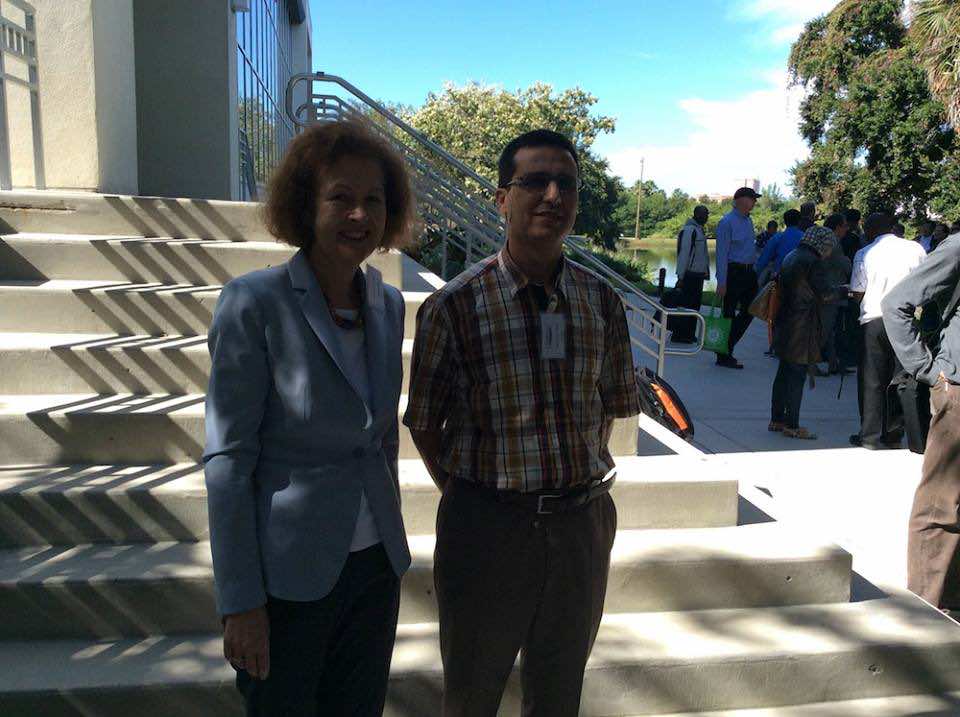
Austin – When I was attending the Fulbright Enrichment Seminar in Florida, I had the privilege to talk to Ms Marianne Craven, the Managing Director of Academic Programs of the Bureau of Educational and Cultural Affairs (ECA). She was calm and very polite and seemed to enjoy conversation with Fulbrighters from different parts of the world. That encouraged me to approach her. I wasn’t sure she would grant me an interview, but conversation with her lead smoothly to my request, which she kindly accepted. My primary purpose was to understand how American foreign policy makers view educational and cultural diplomacy and its role in mutual understanding between Americans and other peoples. It’s not difficult to find references on the issue, but I was more interested in individuals, like Ms Craven, who are in one way or in another responsible for the decisions made in this respect. I would have preferred to do that in an informal way, but Ms Craven is a busy woman and she is based in Washington while I am miles away in Austin. She proposed to do the interview on the phone but, ultimately, I had to email her my questions, which she kindly answered.
Ms Craven may not be a politician, but she has a long career in educational and cultural exchange, which entitles her to evaluate the importance of such exchanges for relations between different peoples. She says her experience with other cultures started very early in her life when she had to live with her family in Brussels for a year. She also studied abroad as a college student and joined the diplomatic service after graduation. Part of her job was also to work abroad, so she was posted first to Bamako, followed by Warsaw and Milan. Mali, Poland and Italy are different from each other, and I can imagine that each time Ms Craven moved to a new country, she had to learn a lot about it in order for her to adapt easily and to do her job well. It must have been a relief to her when she was transferred to the domestic civil service in Washington and no longer had to go overseas on long-term assignments.
The Bureau of Educational and Cultural Affairs is a section of the U.S Department of State. The Bureau is headed by an Assistant Secretary and as a senior career official, Ms Craven reports to the Deputy Assistant Secretary for Academic Programs. According to Ms Craven, “the Bureau supports exchange and educational programs for about 50,000 participants annually, from the United States and 160 countries around the world”. This means that its objective is not only to bring foreign students, teachers, scholars and others to experience and know America better, but also to encourage their American counterparts to do the same in other countries. Of course, this must be beneficial for both parties; that’s why each party should contribute financially to these programs. I was glad to learn from Ms Craven that the Moroccan government “has shown a solid commitment to the Fulbright program through its annual allocation of funding to MACECE (the Moroccan-American Commission for Educational and Cultural Exchange)”. So, at least part of the money I’m spending during my stay in America is paid by my country.
Ms Craven explains that ECA supports the Fulbright Scholarship Program as well as other programs which have different objectives. For example, English teachers who want to go to the U.S to improve their capacity do not apply for the same scholarship as high school students who want to learn English; nor do American students who want to study a critical language participate in the same program as a graduate student preparing for a degree. In brief, each program targets a certain category of participants. The Fulbright Scholarship Program is the largest exchange program administered by ECA. It has achieved more than 350,000 alumni over the last 68 years. Although its general goal is to contribute to the mutual understanding between Americans and other peoples of the world through their research communities, Ms Craven explains that setting priorities is decided in collaboration with other governments. As I understand it, each government can suggest the areas of expertise it would like to develop in cooperation with American universities, which means that both parties have a win win relationship. Of course, developing expertise and cultivating mutual understanding are not contradictory objectives, but rather go together.
Given the negative attitudes that tend to be perpetuated in the Arab World toward America, I asked Ms Craven about the importance that her office gives to the MENA region. Her answer is that “it is more important now than ever for Americans and the peoples of the Middle East and North Africa to share ideas, knowledge, and skills in order to promote collaboration, enhance economic development and prosperity, address global and regional issues such as climate change, and achieve broader understanding between cultures”. She explains that in the past ten years, the number of scholarships for different academic and exchange programs in the MENA region has more than doubled. In addition to the common programs, there are also programs that target specific countries such as Egypt and Tunisia. I suppose such initiatives have been developed in view of the current economic and political situation in the two countries. Ms Craven adds that there is also a program – the Fulbright English Teaching Assistant Program – that “provides opportunities for recent American college graduates to directly engage young people in classrooms across the region”. All these programs apparently aim at encouraging contact between individuals from both sides.
Of course, I couldn’t have asked about the MENA region without asking about Morocco. Ms Craven points out that Morocco is one of the few countries where they have a Regional English Language Officer; it is one of the four countries in the region that hosts a Binational Fulbright Commission; there is a teacher exchange program for both Moroccan teachers to study in the U.S and American teachers to study in Morocco; Morocco hosts an intensive program for Americans to study the Arabic language at the high school and university levels, etc. Although only a small number of people directly benefit from these programs, compared with the general population, it is hoped that the programs will bear their fruits in the long term. I’ve been surprised to find out that many of the students and colleagues I met during my stay in the U.S have on the whole a positive image of my country. During the last few years in which the Arabic Flagship Program has moved its centre from Egypt to Meknes, dozens of American students have been to Morocco to learn the language. And because it is a full immersion program, they experience a lot of the local culture and get involved in personal relations with many Moroccans. I hope the same thing happens with Moroccan students and teachers who visit America.
My last question to Ms Craven was whether she believed that educational and cultural diplomacy could contribute to the mutual understanding between the people of the U.S and the peoples of the MENA region. Her answer is a definite “Yes”. She adds: “I believe that the Fulbright program and other exchanges offer a substantive and often profound experience that both provides participants with new knowledge and awareness, and inspires them to stay engaged with other countries and peoples throughout the course of their lives and careers. Individuals who are committed to promoting international dialogue and cooperation are leaders in their societies at all levels–whether they are at universities, schools, in government, businesses, civic organizations, the arts, or other fields”. One of the examples she cites is that of the Moroccan Fulbright Alumni Association, which she considers a wonderful organization contributing both to Morocco’s development and to serving as a bridge between the peoples of Morocco and the U.S.
Ms Craven asserts that “what has been especially striking to me is when ambassadors and other senior diplomats, who don’t themselves work day to day on exchanges, say how essential these programs are to building understanding and promoting long-term cooperation”. On my part, and as my short stay in America is coming to an end, I feel I have a responsibility to contribute to the mission. But I must admit that I don’t know exactly how to do it.
To read previous parts:
Journals of a Moroccan Fulbrighter in America (1): ‘Us’ vs. ‘Them’
Journals of a Moroccan Fulbrighter in America (2): Middle Eastern Studies at UT, Austin
Journals of a Moroccan Fulbrighter in America (3): An American Arab
Journals of a Moroccan Fulbrighter in America (4): The Arabic Flagship Program
Journals of a Moroccan Fulbrighter in America (5): Homesickness
Journals of a Moroccan Fulbrighter in America (6): The Making of a Scholar in America
Journals of a Moroccan Fulbrighter in America (7): Happy Eid
Journals of a Moroccan Fulbrighter in America (8): The story of an American convert to Islam
Journals of a Moroccan Fulbrighter in America (9): On the bus
Journals of a Moroccan Fulbrighter in America (10): A Portrait of an American Lady
Journals of a Moroccan Fulbrighter in America (11): An American Teacher of Moroccan Arabic
Journals of a Moroccan Fulbrighter in America (13): A conference in New Mexico
© Morocco World News. All Rights Reserved. This material may not be published, rewritten or redistributed.